AI Chip Shortage Reshapes the Tech Playbook
The AI chip shortage is no longer just a hiccup in hardware supply chains; it is the pressure point exposing who can actually deliver scalable intelligence and who is bluffing. Startups hungry for GPU time are bidding against cloud giants, while governments rewrite export rules overnight. The stakes are existential: miss the next wave of silicon and your AI roadmap collapses. That urgency is forcing everyone from data center operators to automotive makers to rethink sourcing, architecture, and even their definition of ownership in a market where availability now outranks performance on the priority list.
- Severe AI chip shortage is reshaping product roadmaps and go-to-market timing.
- Geopolitics and export controls are turning supply into a strategic advantage.
- Design shifts: chiplet architectures,
ASICbets, and software efficiency are accelerating. - Enterprises are reconsidering cloud lock-in versus on-prem resilience.
AI Chip Shortage Becomes a Geopolitical Flashpoint
Scarcity has turned the GPU market into a proxy battlefield. Export controls on advanced semiconductors and EUV tools have made capacity at TSMC and Samsung a geopolitical asset. Nations with access to advanced nodes can train larger models faster, while those shut out pivot to indigenous designs or software frugality.
Access to cutting edge compute is now a sovereignty issue, not just an IT procurement problem.
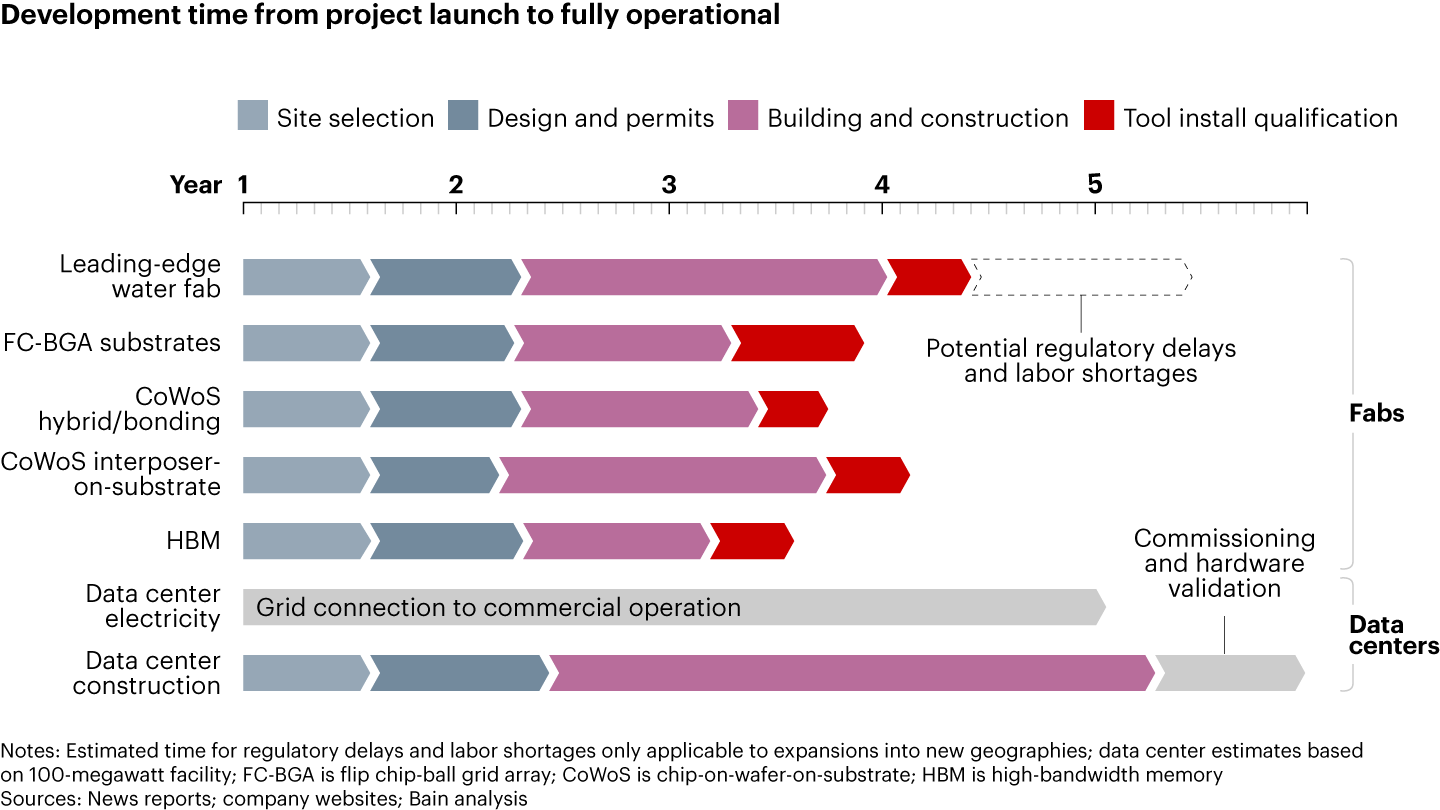
The bottleneck is not only wafer starts. Packaging lines for HBM stacks and advanced substrates are booked months out, a constraint that hits inference accelerators as hard as training rigs. Each delayed shipment cascades into slower model iteration, stretching hiring plans and launch calendars.
Policy Whiplash and Market Volatility
Rapid-fire policy changes on exports create procurement whiplash. Startups prepay for clusters that cannot ship; cloud credits pile up unused. Vendors quietly adjust SKU mixes to fit under control thresholds, leading to unpredictable performance deltas between advertised and delivered systems.
Why This Matters
For every industry leaning on AI – finance, healthcare, logistics – the shortage converts into delayed automation and higher unit costs. Teams that planned to fine-tune models weekly now ration training cycles monthly, and product managers rewrite roadmaps around what hardware is actually available.
AI Chip Shortage Forces Design Reinvention
Scarcity is accelerating design diversity. Chiplet-based approaches let designers mix memory, compute, and I/O on separate dies, bypassing monolithic yield constraints. Open standards like UCIe promise a mix-and-match ecosystem, though interoperability is still immature.
The smartest teams are designing for optionality: the ability to swap accelerators without rewriting the entire software stack.
Cloud providers are doubling down on in-house ASIC designs to reduce reliance on merchant GPUs. These chips target specific workloads – recommendation engines, speech, vector databases – and trade generality for predictable supply.
Software Efficiency as a First-Class Feature
With hardware uncertain, software efficiency has become a competitive weapon. Techniques like quantization, LoRA, and parameter-efficient fine-tuning cut memory footprints and power draw. Framework-level optimizations in PyTorch and JAX squeeze more throughput out of existing clusters, buying time until new silicon arrives.
Pro Tip: Architect for Swappability
Abstract hardware specifics behind containerized runtimes and use ONNX or MLIR to preserve portability. This keeps you nimble when vendors change driver stacks or pricing tiers shift mid-contract.
AI Chip Shortage Redefines Cloud Economics
Cloud providers now bundle scarce accelerators with premium networking and storage, making true cost-per-token hard to predict. Spot instances for A100 or H100 equivalents evaporate in seconds, and reserved capacity requires long commitments.
Capacity is the new currency; pricing is just the exchange rate.
Some enterprises are dusting off on-prem strategies, pairing smaller local clusters with cloud bursts. Vendors selling OCP-style reference designs promise faster deployments, but supply chain constraints for NICs, PCIe switches, and HBM modules still apply.
Risk: Hidden Lock-In
Accepting bundled capacity often locks teams into proprietary compiler stacks and SDKs, making future migrations costly. Teams should demand exit clauses and prioritize open tooling layers to keep leverage.
Future Implications
Expect new secondary markets for accelerator time, with brokers arbitraging idle enterprise capacity. Insurance-style hedging for compute could emerge, letting companies cap exposure to pricing spikes.
AI Chip Shortage Sparks New Alliances
Automakers, cloud providers, and telcos are forming unusual partnerships to secure supply. Joint ventures around local packaging plants and shared R&D on chiplet interfaces are becoming common. These alliances blur industry lines but give participants better negotiating power with foundries.
Silicon strategy is now a board-level agenda item, not a procurement detail.
Such alliances can spread risk, but they also expose companies to partners’ strategic pivots. Clear governance and shared roadmaps are essential to avoid misaligned tape-out schedules.
Why This Matters for Startups
Startup founders must now pitch not just their AI models but their hardware access strategy. Investors increasingly ask for evidence of secured capacity or credible cloud relationships. Without that, even brilliant models may never ship at scale.
Playbook: Navigating the AI Chip Shortage
The shortage punishes passivity. Teams need proactive playbooks that combine procurement savvy with architectural flexibility. Below is a practical, opinionated guide that prioritizes resilience over perfection.
Lock Supply Early, But Keep Flexibility
Negotiate multi-vendor agreements and avoid single-region dependencies. Use SLAs that specify not just uptime but delivery timelines for hardware refresh cycles.
Invest in Observability
Instrument clusters with fine-grained telemetry so you know exactly how close you are to saturation. Tools that surface kernel-level bottlenecks can unlock latent capacity without new purchases.
Model Right-Sizing
Shift from training giant monoliths to composing specialized smaller models. This lowers compute intensity and shortens iteration loops, aligning better with unreliable supply.
Talent Strategy
Build teams that understand both distributed systems and ML science. Optimization skills now matter as much as data pipeline design because every percent of utilization counts when hardware is scarce.
What Happens When the AI Chip Shortage Eases
Relief will not reset the clock. Companies that built efficiency muscles will retain a cost advantage. Expect a flood of alternative accelerators to hit the market, from RISC-V designs to specialized vector processors. That diversity could fragment tooling but will reduce single-vendor risk.
Scarcity is temporary; the architecture shifts it triggered will endure.
When supply loosens, pricing will normalize, but the strategic value of silicon literacy will stay. Teams that learned to orchestrate mixed fleets of accelerators will iterate faster and respond to new workloads with less friction.
The Editorial Take
The AI chip shortage is the clearest reminder that software dreams are chained to physical realities. It has turned chip roadmaps into national policy, forced startups to master supply logistics, and pushed engineers to squeeze every last teraFLOP from whatever silicon they can find. The winners will be those who treat compute as a strategic resource: diversifying suppliers, optimizing relentlessly, and demanding transparency from vendors. Waiting for the shortage to pass is not a strategy; building for uncertainty is.
The information provided in this article is for general informational purposes only. While we strive for accuracy, we make no guarantees about the completeness or reliability of the content. Always verify important information through official or multiple sources before making decisions.