AI Safety Demands Action
AI Safety Demands Action
The artificial intelligence boom has crossed a line that every executive, policymaker, and everyday user can feel: AI safety is no longer a theoretical argument reserved for labs and ethics panels. It is now a boardroom risk, a regulatory headache, and a daily trust problem. As more powerful systems move into search, customer service, education, healthcare, coding, and public administration, the uncomfortable question is not whether AI can do more. It is whether anyone can reliably prove what it will do next, who is accountable when it fails, and how much control humans are quietly handing over to machines that still behave unpredictably.
- AI safety has become a practical business and public policy issue, not just an academic concern.
- Governments and companies are struggling to balance innovation with guardrails that actually work.
- The next phase of AI will be defined by testing, transparency, liability, and user trust.
- Organizations adopting
generative AIneed clear governance before deployment, not after a crisis.
AI Safety Is Now the Main Event
The most important shift in the AI debate is not technical. It is cultural. For years, the industry sold artificial intelligence as a productivity upgrade: faster writing, smarter search, cheaper support, instant code, personalized services. That pitch worked. Businesses experimented, investors poured in money, and users began treating chatbots and automated tools as everyday utilities.
But the same systems that make AI useful also make it risky. Modern large language models do not behave like traditional software. A spreadsheet formula produces the same output when given the same inputs. A conventional database query is traceable. A chatbot that generates advice, analysis, or code can be fluent, persuasive, and wrong at the same time.
Key insight: The AI race is no longer only about who builds the most capable model. It is about who can prove that their model is reliable enough to be trusted.
That is why AI safety has moved to the center of the conversation. The industry is facing a credibility test. If AI companies want their tools embedded into hospitals, schools, legal workflows, banking systems, and government services, they need to show more than impressive demos. They need evidence, auditability, and accountability.
Why AI Safety Matters for Real Users
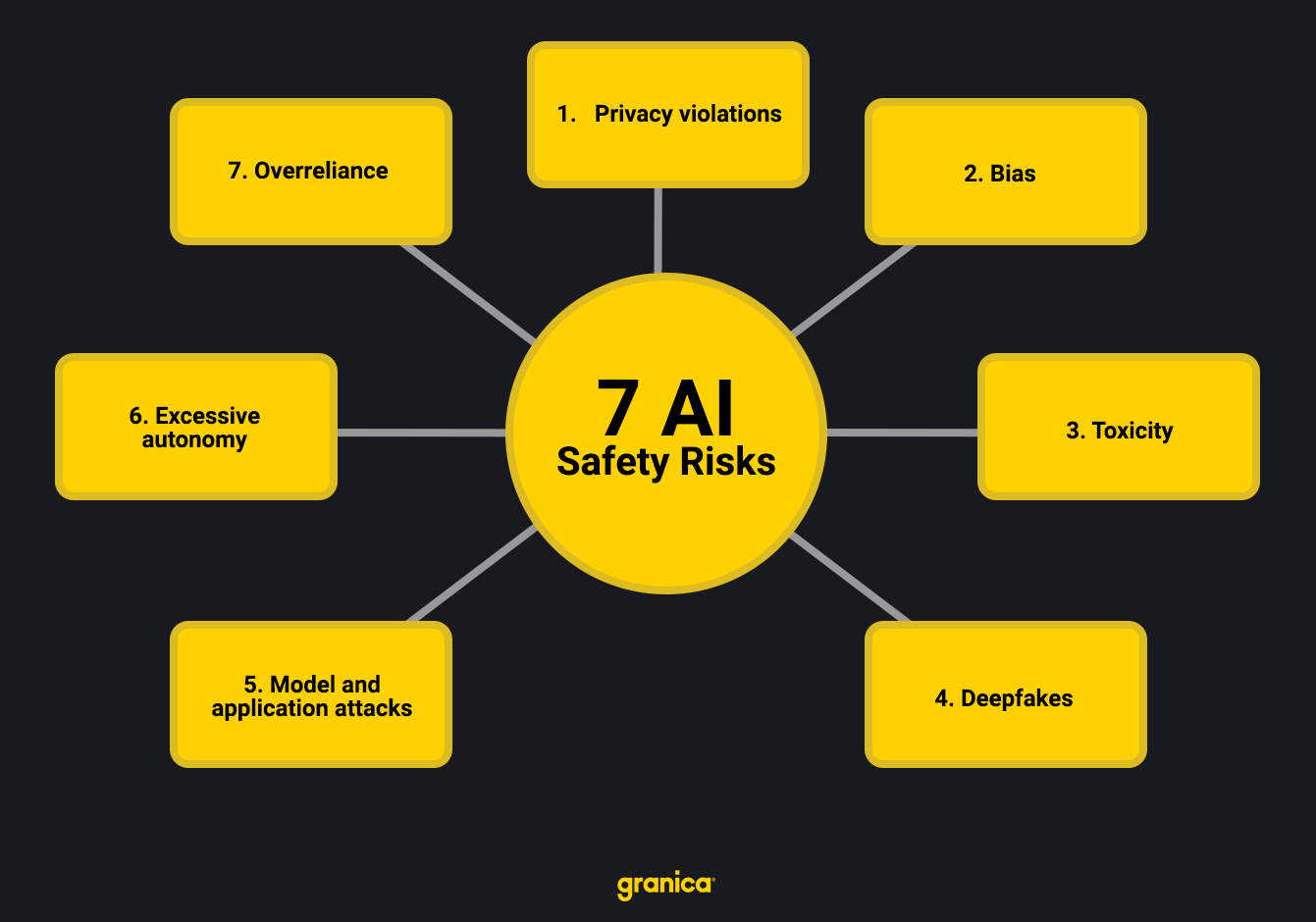
For consumers, the danger is often subtle. A chatbot may invent a fact, misread a policy, recommend a risky action, or fabricate a source with total confidence. For businesses, the risks multiply: leaked customer data, biased automated decisions, compliance failures, insecure generated code, and brand damage from a bot saying the wrong thing at scale.
That matters because AI systems are increasingly being positioned as interfaces between people and institutions. Instead of reading a benefits policy, a user asks a chatbot. Instead of calling support, a customer negotiates with an automated agent. Instead of searching documentation, a developer asks a coding assistant. Every one of those moments turns AI output into a decision point.
The Trust Gap Is Getting Wider
The public is being asked to trust systems that even their creators sometimes struggle to fully explain. That gap is dangerous. Trust without understanding becomes blind dependency. Skepticism without clarity becomes resistance. The middle ground is rigorous testing and honest communication about limitations.
Companies should stop pretending that disclaimers solve the problem. A footer that says an AI system may make mistakes is not a safety framework. It is a legal Band-Aid. Users need to know when they are interacting with AI, what data the system can access, what it is allowed to do, and when a human can intervene.
Hallucinations Are Not a Minor Bug
The industry often uses the soft word hallucination to describe false or fabricated AI output. That term can make the issue sound quirky, almost harmless. It is not. In a casual setting, a fake movie quote is annoying. In a medical, legal, financial, or security setting, fabricated information can create real harm.
The problem is structural. Generative AI systems are designed to predict plausible outputs, not to understand truth the way humans do. They can be connected to verified databases, constrained with rules, and improved with better training. But the baseline risk remains: fluent language can mask uncertainty.
AI Safety Needs More Than Voluntary Promises
The AI industry has leaned heavily on voluntary commitments, internal red teams, model cards, safety reports, and responsible deployment language. Some of that work is meaningful. But voluntary systems tend to hold until the competitive pressure gets too intense. When market share, investor expectations, and geopolitical positioning are on the line, self-regulation can become selective regulation.
That is where governments are stepping in. Regulators are increasingly focused on transparency, data protection, copyright, automated decision-making, child safety, national security, and competition. The challenge is that AI moves faster than legislative calendars. A model can become obsolete before a bill clears committee.
The hard truth: Regulation that is too vague becomes theater. Regulation that is too rigid becomes obsolete. AI safety policy has to be adaptive, technical, and enforceable.
The best regulatory approaches will likely focus less on freezing specific technologies and more on outcomes: risk assessments, independent testing, incident reporting, user disclosure, data governance, and liability when systems cause measurable harm.
What Strong AI Safety Should Look Like
Effective AI governance has to be practical. It cannot be a glossy ethics document that nobody reads. It should shape how models are selected, deployed, monitored, and retired. Whether an organization is using an off-the-shelf chatbot or building custom AI workflows, the same baseline questions apply.
- Purpose: What exact task is the AI system approved to perform?
- Data: What information can the system access, store, or transmit?
- Accuracy: How is output tested against verified benchmarks?
- Oversight: When does a human review or override the system?
- Liability: Who is responsible if the system causes harm?
These questions sound basic, but many deployments skip them. Teams adopt tools because they are convenient, not because they have been validated. That is how shadow AI spreads inside companies: employees paste sensitive data into public tools, departments automate workflows without review, and leaders discover the risk only after something breaks.
Pro Tip for Businesses
Before rolling out any AI tool, create a simple internal policy that classifies use cases by risk. Low-risk tasks might include summarizing public documents or drafting internal brainstorming notes. High-risk tasks include anything involving personal data, medical advice, legal interpretation, financial recommendations, hiring, security, or automated decisions about people.
A lightweight policy can start with three tiers: approved, restricted, and prohibited. That structure gives employees clarity without requiring a massive bureaucracy.
AI Safety and the Coming Liability Fight
The next major battleground is responsibility. If an AI-generated answer causes damage, who pays? The developer of the model? The company that deployed it? The employee who used it? The vendor that integrated it? The user who trusted it?
Right now, that question is often buried in terms of service. But as AI systems become more embedded in consequential settings, liability will become unavoidable. Insurers, courts, regulators, and enterprise buyers will demand clearer lines of responsibility.
This could reshape the AI market. Vendors that can provide stronger audit logs, explainability tools, compliance features, and contractual protections may win over flashy rivals. Enterprise customers do not just want smarter models. They want models they can defend in a risk meeting.
The Innovation Argument Is Real but Incomplete
There is a legitimate concern that heavy-handed rules could slow innovation. Startups may struggle with compliance costs. Open-source researchers may face uncertainty. Smaller companies could be squeezed while the biggest AI firms absorb regulatory burdens and become even more dominant.
That concern deserves attention. But the opposite risk is just as serious: if unsafe AI systems trigger public backlash, lawsuits, or major failures, the entire sector could face a trust collapse. Smart safety rules are not anti-innovation. They are infrastructure for adoption.
Why this matters: The companies that treat AI safety as a product feature, not a public relations problem, will be better positioned for the next phase of the market.
History is full of technologies that scaled only after safety standards matured. Aviation, pharmaceuticals, cars, and financial systems all became more mainstream because rules made them more reliable. AI is heading for the same reckoning.
AI Safety Will Define the Next Platform Shift
The most powerful AI systems are moving beyond chat. They are becoming agents that can browse, book, buy, write, code, analyze, and trigger actions across software environments. That transition raises the stakes dramatically.
A chatbot that gives a bad answer is one kind of risk. An AI agent that takes a bad action is another. Once systems can execute tasks across email, calendars, payments, enterprise databases, and cloud platforms, safety needs to include permissions, authentication, rollback, monitoring, and limits on autonomy.
This is where the industry may be underestimating the challenge. The future of AI is not just better conversation. It is delegation. And delegation requires trust.
What Comes Next
Expect more pressure for independent model evaluations, standardized safety benchmarks, watermarking debates, AI incident databases, and stricter procurement rules for public sector use. Businesses will increasingly ask vendors for documentation that resembles security compliance: test results, access controls, data retention policies, and failure procedures.
Users will also become more selective. The novelty phase is fading. People now want AI that is not only impressive but dependable. That shift favors products that are honest about uncertainty, transparent about sources of information, and designed to escalate sensitive situations to humans.
The Bottom Line on AI Safety
AI safety is not a brake pedal on progress. It is the steering system. Without it, the industry is asking society to climb into a vehicle that is accelerating faster than its designers can fully explain.
The excitement around AI is justified. These tools can unlock productivity, expand access to expertise, accelerate research, and change how people interact with computers. But excitement is not a substitute for governance. The winners in this next era will not be the companies that shout loudest about intelligence. They will be the ones that make AI trustworthy enough to use when the stakes are high.
The information provided in this article is for general informational purposes only. While we strive for accuracy, we make no guarantees about the completeness or reliability of the content. Always verify important information through official or multiple sources before making decisions.