Apple Intelligence Pushes AI From Hype to Habit
Apple Intelligence Pushes AI From Hype to Habit
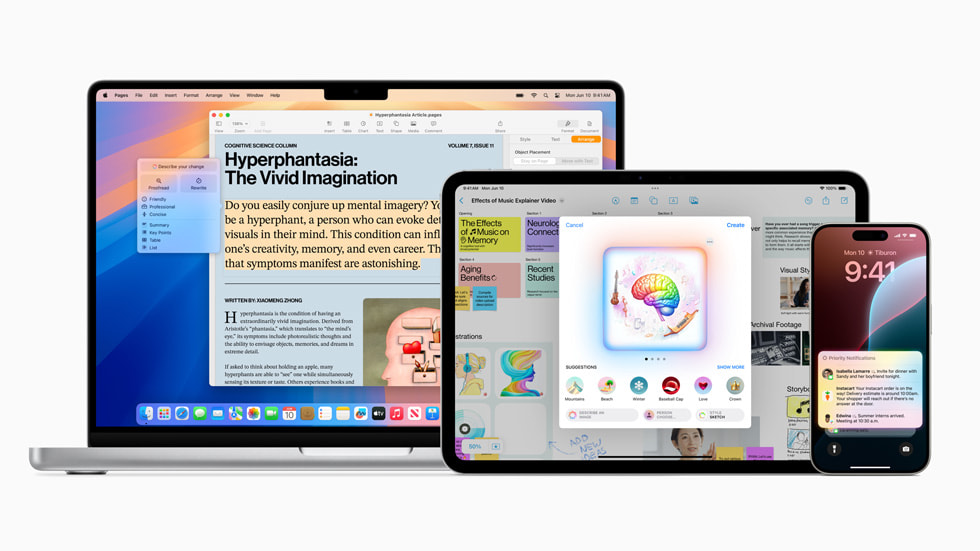
Apple Intelligence is trying to solve the problem every AI company keeps ducking: how do you make artificial intelligence feel less like a demo and more like a default? The answer, if Apple is right, is to hide the complexity, keep the data on device when possible, and make the assistant useful inside the apps people already use every day. That sounds almost boring. It is not. It is the whole game. Consumers are past the point of applauding flashy chatbot tricks. They want fewer taps, fewer app switches, fewer moments where technology interrupts instead of helps. Apple is betting that the next phase of AI will not be won by the loudest model, but by the most invisible product design.
- Apple Intelligence is designed to make AI feel native, not bolted on.
- Privacy and on-device processing are central to Apple’s pitch.
- The real competition is not just feature count, but trust and daily usefulness.
- Success depends on whether users notice the value without feeling overwhelmed.
Apple Intelligence changes the AI question
For months, the tech industry has treated generative AI like a sprint: bigger models, more tokens, more benchmarks, more hype. Apple Intelligence takes a more cautious route. It is less about building the largest model and more about embedding AI features into the operating system so they show up at the moment of need. That is a major strategic shift. Instead of asking users to learn a new interface, Apple is asking them to trust that the software already knows what to do.
That matters because the market for AI is no longer defined by curiosity. It is defined by fatigue. Many users have already tried the obvious chatbot experiences and decided they are interesting, occasionally useful, and often awkward. Apple is betting that if AI is tied to messaging, writing, notifications, summaries, and image generation, it becomes part of the phone rather than another app cluttering the home screen.
Apple is not selling a chatbot. It is selling the idea that AI should disappear into the device and save time without demanding attention.
Why Apple Intelligence has a privacy advantage
Apple’s strongest argument is familiar: privacy. The company has spent years positioning itself as the hardware maker that cares about what happens to your data after you tap accept. Apple Intelligence extends that story by leaning heavily on on-device processing where possible and using larger cloud-based systems only when necessary. That is not just branding. It is a product decision that changes how users perceive risk.
In an era where consumers increasingly wonder who is reading their prompts, what is being stored, and how long it sticks around, that posture can be powerful. Apple knows that AI trust is fragile. A single bad headline about data handling can undo months of polished demos. By keeping many tasks local, Apple is trying to turn privacy from a policy page into a product feature.
The practical tradeoff
There is, of course, a catch. On-device AI has limits. It may be faster and more private, but it is also constrained by hardware and battery life. More complex tasks will still require cloud assistance, and that means Apple has to prove its architecture can scale without compromising the promise. If the system feels inconsistent – local for one request, cloud for another – users may not care about the engineering elegance. They will care about whether it works smoothly.
This is where Apple’s hardware advantage matters. The company controls the chip, the software, and the distribution channel. That vertical integration gives it something most AI rivals lack: a chance to optimize the full stack. If Apple Intelligence works well on the latest devices, it can create a new upgrade incentive that is based on utility rather than spectacle.
Apple Intelligence and the battle for daily relevance
The biggest challenge for any AI product is not launching. It is becoming indispensable. That is why Apple Intelligence is so interesting. Apple is not trying to out-chat OpenAI, or out-search Google, or out-code Microsoft. It is trying to become the layer that quietly handles the tedious parts of digital life. Summarize this. Rewrite that. Clean up the notification chaos. Suggest the next step. That kind of value is easy to underestimate and hard to replace once it becomes habit.
If Apple succeeds, it could reshape expectations for what an operating system should do. The software would not just connect apps. It would interpret intent. That is a meaningful shift. It moves AI from being a destination to being a utility. And utilities, unlike trends, have staying power.
What users actually want
- Fewer repetitive tasks across email, notes, and messaging.
- Smarter summaries that save time without losing context.
- Writing assistance that feels helpful, not robotic.
- Image tools that are easy to use and integrated into existing workflows.
- Controls that make AI feel safe instead of invasive.
This is why the design of Apple Intelligence matters as much as the model underneath it. If the features are buried, users will ignore them. If they are too aggressive, users will disable them. Apple’s challenge is to find the line where AI is useful enough to notice but subtle enough not to annoy.
The hardware story is just as important
Apple Intelligence is also a hardware play, whether Apple says that loudly or not. AI features are a way to give newer devices a reason to matter. The company has long been good at turning software capabilities into upgrade cycles, and this could be one of the cleanest examples yet. Not every AI feature will run equally well on every device, which means the experience itself can become a reason to buy newer hardware.
That is smart business, but it also raises the stakes. If Apple Intelligence is uneven across devices, some users will see it as a premium trick rather than a universal leap forward. The company has to balance segmentation with credibility. Too much restriction and the feature feels exclusionary. Too little and the hardware story weakens.
Apple’s real advantage is not just silicon. It is the ability to make software improvements feel like proof that the device you already own can still get smarter.
How Apple could win the AI trust race
Trust is now a competitive moat. That may sound dramatic, but the AI market has made it true. Users are cautious about hallucinations, wary of privacy violations, and skeptical of inflated promises. Apple can win by being the company that underpromises and integrates well. Its brand is built on reliability, and reliability is exactly what AI still lacks in many mainstream products.
To keep that trust, Apple will need to do three things well:
- Make the features noticeably useful from day one.
- Keep the interface simple enough that non-technical users do not feel lost.
- Be transparent about when the device is handling a task locally versus using external resources.
If Apple gets those details right, it could define the consumer AI standard. If it gets them wrong, Apple Intelligence risks becoming another set of features that sound more impressive in a keynote than in real life.
Why this matters beyond the iPhone
Apple Intelligence is not just about Apple. It is a signal for the entire consumer tech market. If AI becomes a built-in system feature rather than a separate app, every platform company will feel pressure to follow. That could accelerate a broader shift toward ambient AI, where assistance is always available but rarely intrusive. It could also force competitors to rethink their own products, moving away from standalone chat experiences toward deeper OS-level integration.
The stakes extend into enterprise, too. When consumer expectations change, workplace expectations follow. Employees who get used to AI summarization, writing help, and action suggestions on personal devices will eventually expect the same speed and convenience from work tools. That makes Apple Intelligence bigger than a feature drop. It is a possible template for the next generation of personal computing.
Potential ripple effects
- App developers may need to design around AI-first workflows.
- Competitors may push harder on privacy as a differentiator.
- Users may become less tolerant of clunky assistant experiences.
- Hardware upgrades could be driven more by AI performance than camera gains.
The skeptical take
Still, caution is warranted. Apple has a history of entering categories late and making them feel inevitable, but AI is moving faster than most prior platform shifts. The company cannot rely on polish alone. If rival products improve faster, or if Apple Intelligence arrives with limited scope, users may admire the concept and keep using something else for the heavy lifting.
There is also the risk of expectation inflation. Apple’s marketing machine is excellent at turning incremental progress into major cultural moments. But AI exposes weak spots quickly. If the assistant misunderstands intent, creates awkward text, or fails to save real time, the shine fades. And once users decide a feature is optional, habit is much harder to build.
Apple Intelligence is a test of product philosophy
At its core, Apple Intelligence is about philosophy. Apple is arguing that the best AI is not the most dramatic AI. It is the most integrated, the most private, and the least annoying. That thesis may feel conservative compared with the broader industry, but it might also be the only one that scales to hundreds of millions of mainstream users.
The next year will reveal whether Apple has found the right balance between utility and restraint. If it has, AI could finally move out of the novelty phase and become something much more valuable: a habit. And in consumer tech, habits are harder to build than hype, but they are also far more durable.
That is the real story here. Not whether Apple Intelligence can impress a room. Whether it can make people wonder how they ever managed without it.
The information provided in this article is for general informational purposes only. While we strive for accuracy, we make no guarantees about the completeness or reliability of the content. Always verify important information through official or multiple sources before making decisions.