CIA Havana Talks Signal a Risky Cuba Reset
CIA Havana Talks Signal a Risky Cuba Reset
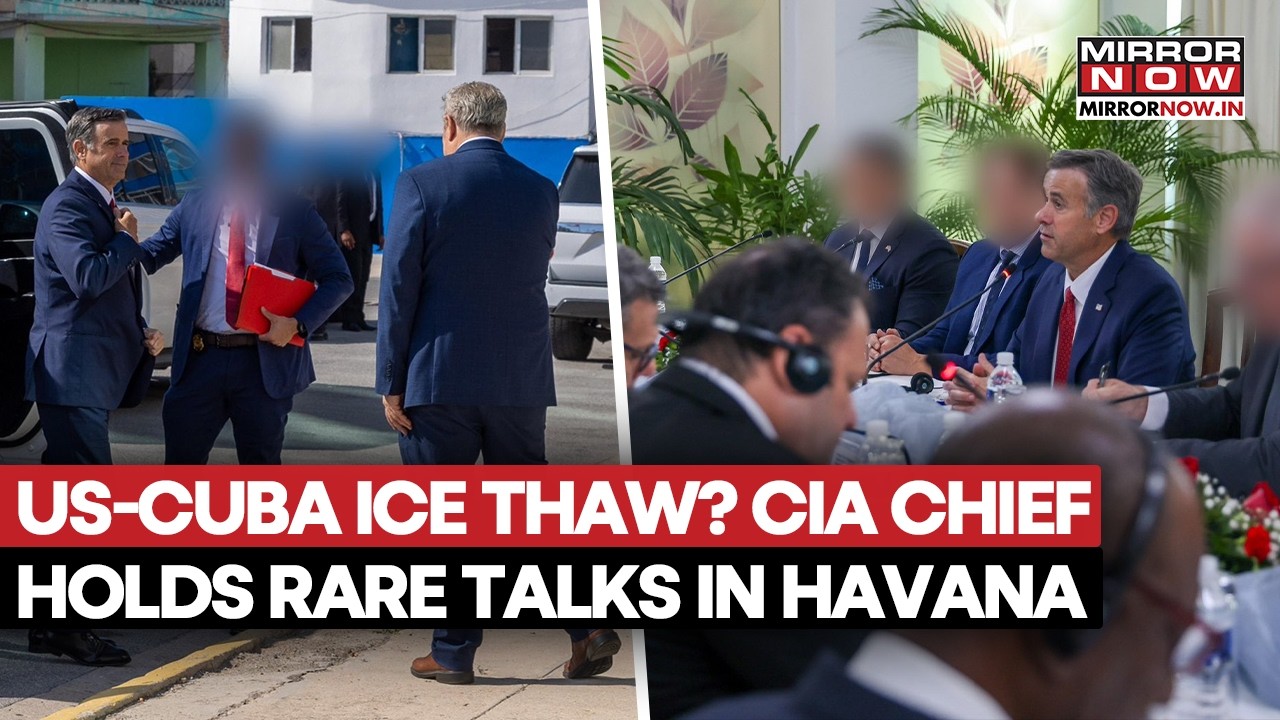
When the head of the CIA is reportedly sitting down with officials in Havana, this is not routine diplomatic housekeeping. It signals that something deeper is moving beneath the frozen surface of US-Cuba relations. For years, Washington and Havana have lurched between cautious engagement and hardline retreat, with intelligence, migration, sanctions, and domestic politics all colliding in the same narrow corridor. Now, the reported CIA Havana talks suggest the US may be testing a more pragmatic channel: not friendship, not normalization, but targeted contact where national interests are too urgent to ignore. That matters because when formal diplomacy stalls, intelligence backchannels often become the real machinery of statecraft. And when those channels reopen with Cuba, the implications stretch far beyond one island.
- CIA Havana talks point to a possible shift from public stalemate to private strategic engagement.
- Intelligence meetings often focus on migration, regional security, counterintelligence, and crisis management.
- Any thaw with Cuba remains politically fragile, especially in US domestic politics.
- Quiet talks can reduce risk even when full diplomatic normalization is off the table.
Why the CIA Havana talks matter now
The significance of these reported meetings is not that Washington and Havana suddenly trust each other. They do not. The significance is that both sides may have concluded that the cost of having no serious channel at all has become too high.
Cuba sits at a strategic crossroads in the Caribbean, just 90 miles from Florida, where migration flows, maritime security, sanctions enforcement, narcotics routes, and foreign influence all intersect. A meeting involving the CIA director is not symbolic in the way a ceremonial diplomatic visit might be. It implies a discussion rooted in operational concerns and hard priorities.
That is the real story: this is less about reconciliation and more about risk management.
When governments cannot agree publicly, they often still need a private mechanism to prevent miscalculation.
For the US, Cuba remains a nearby adversarial state with enduring intelligence relevance. For Cuba, engagement with senior US officials can serve multiple purposes: legitimacy, leverage, and possibly a way to stabilize pressure points without conceding core political ground.
The strategic logic behind a Cuba reset
If these talks happened as described, the move fits a familiar pattern in international affairs. States frequently use intelligence channels when formal diplomacy is politically constrained, too slow, or too visible.
Migration pressure changes the equation
One of the most immediate drivers is migration. Large-scale migration from Cuba has repeatedly become both a humanitarian and political crisis. For US officials, unmanaged migration can rapidly become a domestic issue, especially in an election-driven media environment. For Cuban officials, sustained outflows can reflect internal strain while also creating bargaining leverage.
In that context, intelligence-to-intelligence contact can be more flexible than traditional diplomacy. It allows each side to exchange concerns, set guardrails, and signal intentions without the public choreography that often complicates state department-level negotiations.
Counterintelligence never leaves the room
Cuba has a long history as a serious counterintelligence environment for the United States. Even during periods of detente, intelligence suspicion did not disappear. If a senior US intelligence figure is meeting Cuban officials, one likely purpose is to better understand what Havana is doing, what it fears, and where red lines may exist.
This is especially relevant in an era where geopolitical competition is no longer confined to Cold War-style binaries. The US is now thinking about regional influence through a wider lens, including how rival powers build relationships in politically isolated states.
Regional stability is back on the agenda
The Caribbean is rarely treated as the center of global power politics until a crisis erupts. But policymakers know proximity matters. Any instability in Cuba can ripple across migration systems, coast guard operations, law enforcement cooperation, and wider hemispheric diplomacy.
That helps explain why CIA Havana talks would be strategically rational even if broader bilateral relations remain tense.
What each side likely wants
Intelligence meetings are rarely about grand gestures. They are usually about narrowing uncertainty. In this case, the agenda likely centers on practical objectives rather than ideological breakthroughs.
What Washington may be seeking
- Better visibility into Cuban state intentions and internal stability.
- Communication channels on migration and maritime incidents.
- Insight into third-country influence, intelligence activity, or security cooperation.
- A controlled mechanism to avoid escalation or misunderstanding.
What Havana may be seeking
- Recognition that Cuba remains strategically important to the US.
- Potential relief from pressure through more functional engagement.
- A platform to shape US perceptions on migration and security.
- Diplomatic signaling to domestic and international audiences.
Neither side needs to trust the other for this to work. They only need to believe that talking is less costly than silence.
The political trap around US-Cuba relations
This is where any potential reset gets difficult. Cuba policy in the United States has never been driven solely by strategic logic. It is entangled with electoral politics, exile community influence, congressional signaling, and the symbolic weight of anti-communist policy.
That means even narrowly tailored engagement can be reframed as weakness. A meeting intended to reduce operational risk could quickly become a domestic political flashpoint if opponents choose to characterize it as appeasement.
With Cuba, even pragmatic statecraft is rarely allowed to remain merely pragmatic.
That tension explains why intelligence channels are often more durable than overt diplomatic campaigns. They can function below the level of daily political theater. But they are not immune from it. If public backlash intensifies, the room for maneuver shrinks fast.
What history tells us about backchannel diplomacy
US-Cuba engagement has repeatedly moved in cycles. There are openings, pauses, reversals, and moments when tactical cooperation survives even as public rhetoric hardens. That pattern matters because it shows a key truth: adversarial states can maintain selective cooperation without resolving deeper disputes.
The most realistic interpretation of the current CIA Havana talks is not that normalization is imminent. It is that both governments may be rediscovering an old lesson: even limited communication has strategic value.
Backchannels work best when they are specific. They are not good at solving every grievance. They are good at handling the things that can spiral if ignored. Think migration spikes, detained nationals, maritime incidents, intelligence misunderstandings, or unplanned escalation.
Why this matters beyond Cuba
This story is also a case study in how modern power actually operates. Public foreign policy debates tend to focus on speeches, sanctions, and summits. But in practice, governments often rely on quieter instruments: intelligence liaison, security contacts, deniable feelers, and controlled exchanges of information.
That does not mean these channels are clean or uncomplicated. It means they are often the only mechanisms available when politics blocks everything else.
For readers trying to understand how major states behave, the takeaway is simple: when a spy chief appears in the diplomatic frame, it usually means the issue has moved from symbolic disagreement to operational urgency.
Pro Tip: Watch the follow-through, not the headline
The meeting itself is important, but the more telling signals will come later. Analysts should watch for:
- Changes in official language around migration or bilateral cooperation.
- Unusual restraint in public accusations from either side.
- Small administrative moves that suggest a working channel remains active.
- Regional reactions from neighboring governments and US lawmakers.
Those second-order indicators often reveal more than the initial report.
The risks of reading too much into the meeting
There is also a temptation to overstate what intelligence contact can achieve. A single meeting, even at a high level, does not erase structural hostility. Cuba remains politically and economically constrained. The US remains internally divided on how to handle Havana. And intelligence cooperation, where it exists, tends to be narrow and transactional.
Put differently, there is a large gap between reopening a channel and resetting a relationship.
That gap matters because hype can become its own problem. If expectations rise too fast, disappointment can trigger another backlash cycle. The more useful lens is to see this as a tactical adjustment: a mechanism to manage friction, not a sudden rewrite of the bilateral script.
Could this become a broader diplomatic opening?
Possibly, but only if the talks produce practical benefits that both sides can point to without appearing to surrender politically. That is a very narrow path.
For Washington, the threshold question is whether engagement produces better outcomes on security or migration than isolation does. For Havana, the question is whether contact with the US can ease pressure without exposing internal weakness or provoking political costs at home.
If both sides can claim functional gains, then intelligence dialogue might eventually support broader policy movement. If not, the channel could remain isolated and temporary.
A realistic scenario
The most plausible outcome is a limited, compartmentalized relationship. Think of it like this:
Public tension + private coordination = manageable hostility
That formula is not elegant, but it is common in international politics. It allows governments to preserve their narratives while still reducing risk where interests overlap.
What to watch next in CIA Havana talks
The next phase will be less visible and more important. If these talks are serious, they should produce signs of continuity rather than spectacle. Watch for whether both governments behave as if they have a clearer line to each other. That could show up in calmer crisis responses, more disciplined messaging, or quiet policy adjustments.
It is also worth watching whether other agencies or intermediaries begin to appear around the edges. Intelligence contact often opens the door for more targeted engagement elsewhere, even if formal normalization remains politically impossible.
The bottom line: the reported CIA Havana talks are not a feel-good diplomatic breakthrough. They are something more credible and, in some ways, more consequential: an acknowledgment that strategic problems do not wait for ideological agreement. For the US and Cuba, talking may not solve the relationship. But not talking has become harder to defend.
The information provided in this article is for general informational purposes only. While we strive for accuracy, we make no guarantees about the completeness or reliability of the content. Always verify important information through official or multiple sources before making decisions.