Fight Schistosomiasis Fast
Schistosomiasis is still a brutal public health blind spot
Schistosomiasis rarely makes headlines, but it keeps shaping lives, school attendance, farming, and health systems across parts of Africa, Asia, and Latin America. The disease is caused by parasitic worms that slip into the body through freshwater, then settle in blood vessels and slowly damage organs. That combination makes schistosomiasis especially dangerous: it often starts quietly, spreads through ordinary daily routines, and can become chronic before anyone realizes what is happening. For global health agencies, the challenge is no longer simply whether the disease can be treated. The real pain point is whether communities can interrupt a cycle that is tied to water access, sanitation, and poverty. If those structural problems persist, the parasite does too.
- Schistosomiasis spreads through contaminated freshwater, not person-to-person contact.
- Symptoms can be subtle at first, which delays treatment and increases long-term harm.
- Mass drug administration helps, but prevention depends on safer water and sanitation.
- Climate, migration, and infrastructure gaps could make control harder in the coming years.
What schistosomiasis actually does to the body
Schistosomiasis is caused by Schistosoma parasites. The worms do not multiply directly inside people the way some infections do, but their eggs trigger inflammation that can scar the bladder, intestines, liver, or other organs depending on the species. That is why the disease can look deceptively mild early on and devastating later. Some people develop fever, rash, abdominal pain, blood in urine, or chronic fatigue. Others live with the infection for years and only get diagnosed once complications are obvious.
That delayed detection is a major reason schistosomiasis remains so hard to control. In places where the disease is common, children can be repeatedly exposed while swimming, washing clothes, or fetching water. Over time, repeated infections can reduce growth, learning performance, and overall productivity. In adults, the cumulative burden can become a drag on family income and local economies. This is not just a medical issue. It is an infrastructure issue, a development issue, and a policy failure wrapped into one parasite.
Why the parasite keeps winning
Freshwater exposure is the weak link
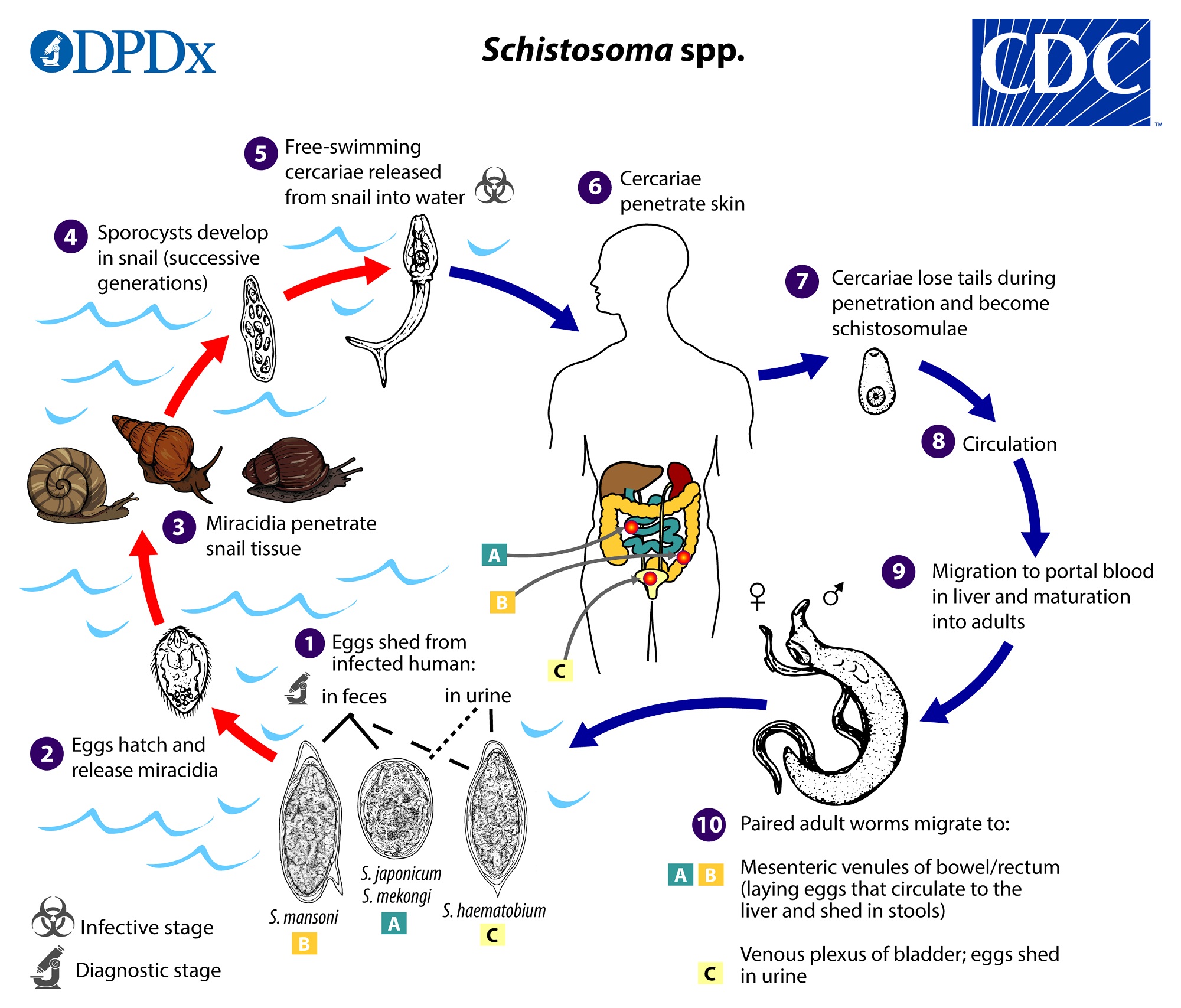
The parasite’s life cycle depends on freshwater snails. Human waste containing eggs reaches water, the eggs hatch, snails become infected, and the parasites later return to human skin when people enter the same water. That loop is alarmingly efficient. It also means the disease thrives where drainage, sewage systems, and safe piped water are unreliable. In practice, families do not choose exposure because they are careless. They are often choosing between a risky water source and no water at all.
Symptoms arrive late
Another reason schistosomiasis persists is that it does not always force people into care quickly. Unlike an acute infection that hits hard and fast, this disease can simmer. That means infections stay hidden in school-age children, agricultural workers, and communities with limited testing. Once a disease is embedded at that scale, a clinic-only response is too slow.
Poverty keeps the loop intact
There is a direct line from neglected tropical diseases like schistosomiasis to poverty traps. If children miss school, households lose time and income. If adults are ill, productivity drops. If local clinics are overloaded, diagnosis falls behind. The parasite benefits from every weak point in that chain.
When a disease depends on unsafe water and poor sanitation, the science is only half the story. The rest is political will, budget discipline, and whether public health is treated like infrastructure.
How schistosomiasis control actually works
The main treatment is a drug called praziquantel, which is effective and relatively inexpensive. That makes the disease unusually frustrating: the tool exists, but delivery is inconsistent. Public health programs often use mass drug administration in schools and communities to reduce the number of infected people at once. This can lower transmission and prevent severe complications, especially among children.
But treatment alone is not enough. A sustainable response usually needs three layers:
- Diagnosis and treatment: Find infected people early and treat them with
praziquantel. - WASH improvements: Expand safe water, sanitation, and hygiene infrastructure.
- Snail and exposure control: Reduce contact with contaminated freshwater and disrupt the parasite’s life cycle.
The hard truth is that the first layer is the easiest to fund and the least durable on its own. The second and third layers are what actually break the cycle, but they require long-term planning, cross-agency coordination, and money that often gets pulled toward more visible crises.
Why the schistosomiasis story is bigger than medicine
This is where schistosomiasis stops being a niche tropical disease story and becomes a broader systems story. If you care about public health resilience, the disease is a test case for whether governments can protect communities before illness becomes entrenched. It also exposes a familiar failure mode: the world tends to invest in treatment after damage is already done, then underinvest in the plumbing, sanitation, and surveillance that would have prevented the damage in the first place.
There is also a climate angle. Changing rainfall patterns, flooding, irrigation projects, and population displacement can all alter where freshwater exposure happens. That does not automatically mean the disease will spread everywhere, but it does mean old maps may stop being reliable. Public health teams will need better local surveillance, updated ecological data, and faster response models to keep pace with shifting conditions.
What communities and policymakers should do next
The best response is not a single intervention. It is a layered defense that recognizes how the parasite moves through everyday life. For communities, that means reducing risky freshwater contact where possible, supporting school-based treatment campaigns, and improving awareness so symptoms are not ignored. For governments, it means funding sanitation, safe water access, and routine surveillance instead of waiting for outbreaks to reveal the problem.
Here are the priorities that matter most:
- Expand access to safe water so families are not forced to use contaminated sources.
- Scale routine screening in high-risk regions, especially for children and agricultural workers.
- Pair drug campaigns with infrastructure so treatment does not become a revolving door.
- Train local health workers to spot symptoms earlier and explain exposure risks clearly.
- Invest in mapping and surveillance to identify where transmission is still active.
Pro tip: The most effective schistosomiasis programs treat water access as a health intervention, not a separate development project. That shift in framing changes budgets, accountability, and results.
The future of schistosomiasis control
The next phase of schistosomiasis control will likely hinge on whether public health leaders can move from periodic campaigns to continuous prevention. That means smarter targeting, better data, and more durable infrastructure. It also means accepting that a cheap pill is not the same thing as a solved problem.
If funding stays fragmented, the disease will keep reappearing in pockets of vulnerability. If countries integrate treatment with sanitation and environmental management, the long-term payoff could be huge: fewer infections, healthier children, lower healthcare costs, and stronger local economies. That is the real upside here. The parasite is stubborn, but it is not magic. Its survival depends on conditions humans created. Those conditions can be changed.
Why this matters now
Schistosomiasis is a reminder that the most persistent health threats are often the least glamorous. They do not always spread with dramatic speed or trigger emergency briefings. Instead, they exploit broken infrastructure, invisible exposure, and policy neglect. That makes them easy to overlook and expensive to ignore. The opportunity now is to treat this disease less like an isolated infection and more like a signal. If a parasite can keep winning because water is unsafe and sanitation is weak, the solution is not just more medicine. It is a more serious commitment to the basics that make medicine work in the first place.
The information provided in this article is for general informational purposes only. While we strive for accuracy, we make no guarantees about the completeness or reliability of the content. Always verify important information through official or multiple sources before making decisions.