Japan Rewires Its Geopolitics
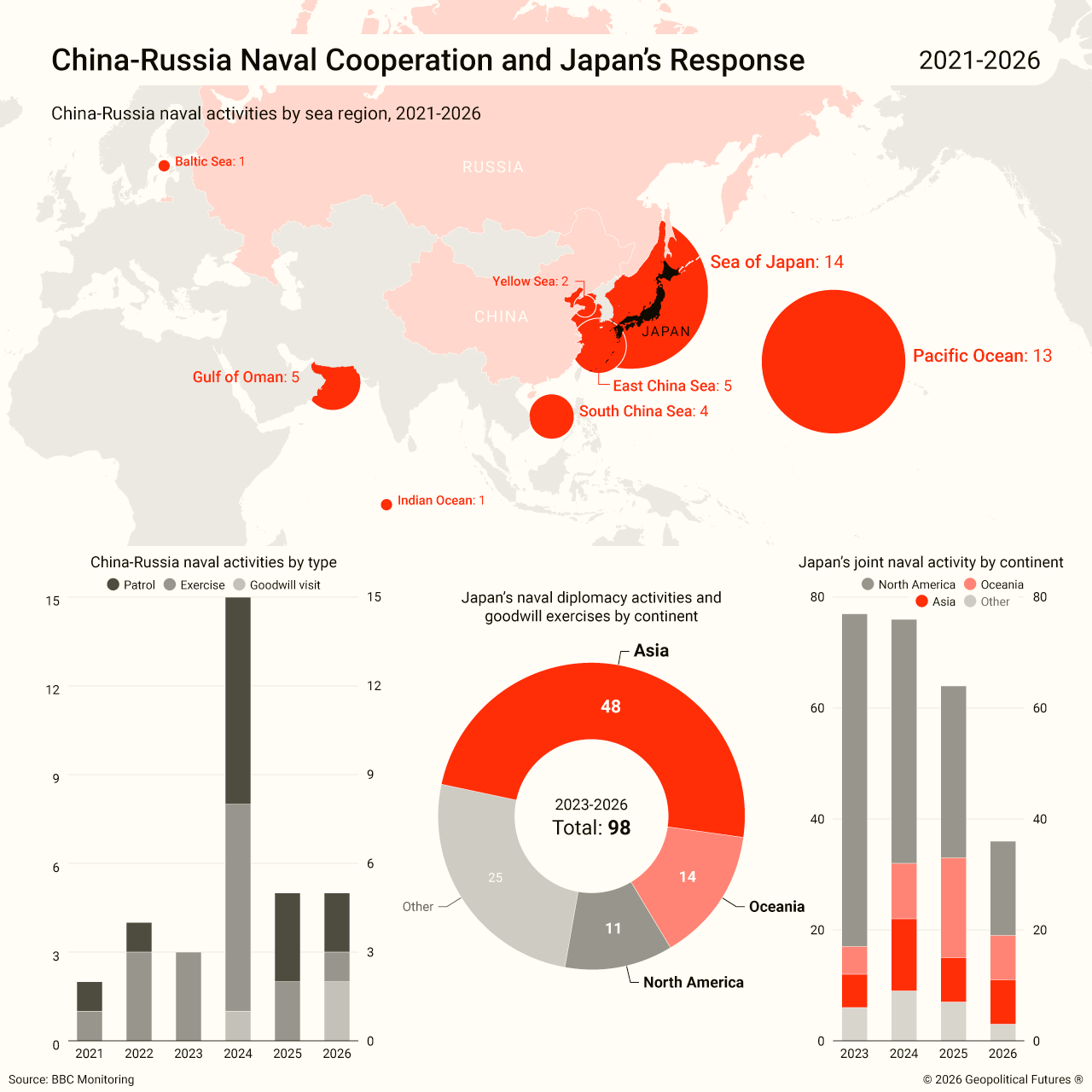
Japan Rewires Its Geopolitics
Japan’s strategic room for error is shrinking fast. As China flexes military and economic power, and the Russian Federation deepens its own pressure campaign across Eurasia, Tokyo is being pushed into a more exposed, more expensive, and far less forgiving geopolitical posture. This is no longer a debate about abstract diplomacy. It is about shipping lanes, energy security, semiconductor supply chains, alliance credibility, and whether Japan can preserve autonomy while sitting inside an increasingly hard-edged regional contest. The old formula – economic interdependence plus cautious diplomacy – is looking brittle. Japan is now forced to answer a blunt question: how do you deter two revisionist powers without becoming trapped by either of them?
- Japan is moving from hedging to harder deterrence as regional pressure rises.
- China remains the primary strategic challenge, while Russia adds volatility and leverage.
- Energy, trade, and defense policy are now tightly connected.
- Tokyo’s alliance with the United States remains central, but not sufficient on its own.
- The next phase of
Japan geopolitics China Russian Federationwill be defined by resilience, not comfort.
Why Japan geopolitics China Russian Federation matters now
Japan has always lived with strategic constraint, but the current environment is harsher than the familiar postwar playbook allows. China is the dominant variable. It has a larger military, a deeper industrial base, and a long-term vision that reaches from the East China Sea to Taiwan and beyond. Russia, meanwhile, is not Japan’s primary adversary in the same way, but it is a destabilizing force that complicates Tokyo’s calculus on energy, sanctions, territorial disputes, and alignment with Western partners. Together, they create a pincer effect: one power pressures Japan economically and militarily in the near seas, while the other injects uncertainty into the broader security architecture.
That means every Japanese policy choice now has second-order effects. A defense budget increase is not just a military signal. It is a message to markets, allies, and rivals. A shift in energy sourcing is not just about utilities. It is a national-security decision. Even language in a diplomatic statement can influence how Beijing or Moscow interprets Tokyo’s intent. The stakes are much larger than one bilateral relationship. Japan is trying to keep its options open while the options themselves are narrowing.
China is the main stress test
Japan’s relationship with China is the defining strategic contest in East Asia. The relationship remains deeply interdependent, but that interdependence no longer guarantees stability. Trade continues, investment remains significant, and supply chains are still entangled. Yet beneath those flows is a growing security problem that Japan cannot ignore. Chinese naval and air activity around the Senkaku Islands, pressure in the Taiwan Strait, and broader military modernization all force Tokyo to think in terms of deterrence rather than reassurance.
Economic ties are no longer a shield
For years, a common assumption held that commerce would moderate rivalry. That logic is fading. Beijing has shown it is willing to use trade as leverage, and Tokyo has learned that economic dependence can become a vulnerability overnight. Japan’s industrial ecosystem is especially exposed in areas such as critical minerals, advanced manufacturing, and electronics. The lesson is blunt: supply chain resilience is now a strategic capability, not a procurement afterthought.
Pro tip: watch how Japan diversifies sourcing in batteries, chip tools, and rare earth inputs. Those adjustments often reveal more about strategic priorities than summit communiques do.
Taiwan changes the equation
Japan cannot treat Taiwan as someone else’s problem. Geography makes that impossible. Any conflict across the strait would have immediate implications for Japanese sea lanes, U.S. military operations, and the security of Japan’s southwestern islands. That is why Tokyo has become more vocal about peace and stability in the Taiwan Strait. It is not a symbolic choice. It reflects a hard recognition that a regional war would hit Japan’s core interests on day one.
Japan’s real challenge is not choosing between peace and preparedness. It is learning how to prepare in a way that keeps peace credible.
Russia adds pressure where Japan is already vulnerable
Russia does not define Japan’s strategic outlook as completely as China does, but it remains highly consequential. Tokyo still faces the unresolved Northern Territories dispute, energy exposure, and the diplomatic fallout from Moscow’s broader confrontation with the West. Russia’s war-driven alignment with China has made matters worse. What used to be a limited bilateral problem has become part of a wider authoritarian alignment that Tokyo cannot easily separate.
Japan’s response to Russia has also become more rigid. Sanctions policy, export controls, and diplomatic distancing have all signaled that Tokyo is no longer interested in a transactional reset without real strategic gains. That is a notable shift. Japan once hoped economic engagement could keep Moscow from drifting too far into Beijing’s orbit. That bet has failed. The Kremlin’s choices have made Russia less of a balancing actor and more of a multiplier for regional instability.
Energy dependence remains the quiet risk
Japan is still an energy-import dependent economy, which gives Russia leverage even when political ties are strained. Liquefied natural gas, shipping routes, and long-term contracts all matter. Tokyo can reduce exposure over time, but not instantly. That is why energy security is now inseparable from foreign policy. Japan is being forced to build redundancy into its system, even if redundancy is costly.
Why this matters: the less Japan depends on any single external supplier, the more freedom it has to respond to geopolitical shocks without self-inflicted damage.
Japan’s answer is a broader security state
Japan is not standing still. It is expanding defense spending, strengthening ties with the United States, and deepening security cooperation with partners such as Australia, India, South Korea, and members of Europe. The country’s strategic evolution is subtle but unmistakable: Tokyo is moving from a posture of cautious restraint to one of calibrated deterrence.
Defense buildup is only the visible layer
Headline numbers on military spending matter, but the deeper story is institutional. Japan is investing in missile defense, counterstrike capability, cyber resilience, and maritime awareness. These are not glamorous capabilities, but they are exactly what a state needs when the threat environment is ambiguous and persistent. The emphasis is on surviving the first shock, denying an adversary quick gains, and buying time for allies to respond.
That approach fits Japan’s political reality. Public support for full-spectrum militarization remains limited, and constitutional constraints still shape the debate. But the security conversation has clearly shifted. The question is no longer whether Japan should adapt. It is how far adaptation can go before it collides with domestic political limits.
Alliance management is becoming more complex
Japan’s alliance with Washington remains the backbone of its defense strategy, but the alliance is not a substitute for national capability. If anything, it creates a higher standard. Tokyo must show that it can contribute meaningfully to deterrence, not just rely on the U.S. umbrella. That is especially important in a crisis scenario where American bandwidth may be stretched across multiple theaters.
At the same time, Japan has to avoid appearing like a passive junior partner. A stronger Japanese role in regional security helps the alliance, but it also gives Tokyo more leverage in shaping strategy. That matters because Japan’s own interests will not always perfectly align with Washington’s sequencing or priorities.
The strategic guide to Japan’s next moves
Japan’s best path forward is not dramatic confrontation. It is disciplined resilience. That means reducing dependencies, hardening infrastructure, improving deterrence, and building coalitions that are flexible rather than ceremonial. The goal is not to decouple from China or isolate Russia completely. That is unrealistic. The goal is to avoid being strategically cornered.
- Diversify critical supply chains so Japan can withstand coercive economic shocks.
- Harden maritime and cyber defenses to reduce vulnerability in the grey zone.
- Strengthen energy resilience through diversified imports, storage, and alternatives.
- Deepen minilateral partnerships that can respond quickly without requiring massive institutional buildup.
- Keep diplomacy open without confusing dialogue with trust.
Pro tip: the most effective Japanese strategy may be boring by design. Quiet redundancy often beats loud signaling when the threat is persistent and asymmetric.
What happens next in the region
The next phase of Japan geopolitics China Russian Federation will likely be defined by three trends. First, Japan will keep upgrading its defense posture, even if the pace remains politically managed. Second, China will continue testing regional resolve through pressure that stays below the threshold of open conflict. Third, Russia will remain a spoiler, less because it can directly dominate Japan and more because it can compound instability across energy, sanctions, and alliance politics.
For Tokyo, the central challenge is strategic endurance. Japan does not need to outmuscle China or outmaneuver Russia in every domain. It needs to stay coherent under pressure. That is harder than it sounds. Democracies often struggle with long-term threat perception, especially when economic ties muddy the picture. Yet Japan has a rare advantage: a clear-eyed public debate, a sophisticated industrial base, and a growing sense that the regional order is changing whether it likes it or not.
The next era of Japanese statecraft will be judged less by grand speeches and more by whether Tokyo can make vulnerability less profitable for its rivals.
The bottom line
Japan is no longer managing a comfortable balance between economics and security. It is operating inside a tougher structure where China applies sustained pressure and Russia adds opportunistic strain. That reality is pushing Tokyo toward a more durable, more alert, and more expensive strategic model. The shift will not be linear, and it will not be painless. But it is necessary. Japan’s future influence will depend on whether it can translate anxiety into capability before the region forces its hand.
The information provided in this article is for general informational purposes only. While we strive for accuracy, we make no guarantees about the completeness or reliability of the content. Always verify important information through official or multiple sources before making decisions.