Southern Baptists Face a Quiet Collapse
Southern Baptists Face a Quiet Collapse
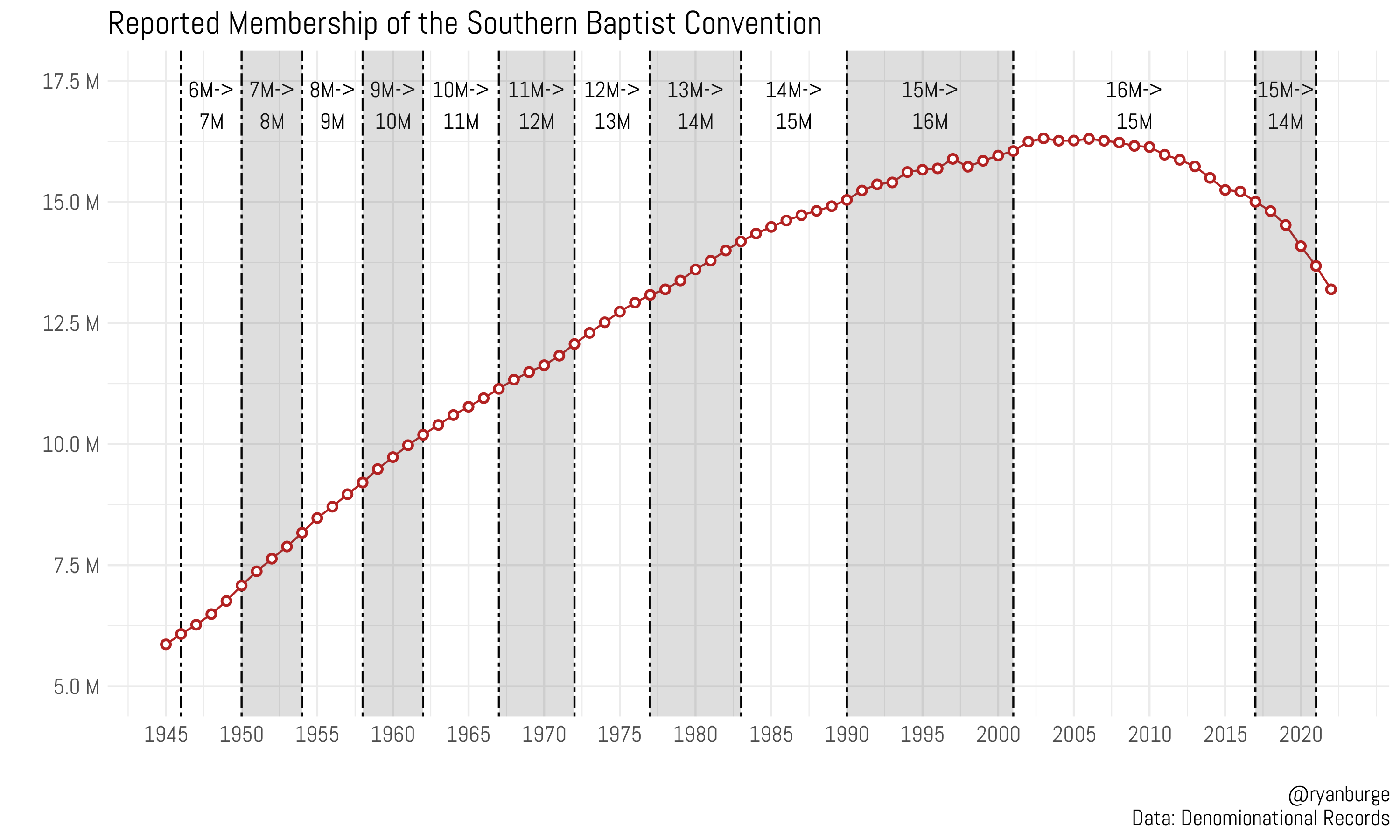
The Southern Baptist Convention decline is no longer a niche denominational story. It is a stress test for American religion, conservative politics, and the institutions that once seemed too big to fail. For decades, the SBC functioned like a national machine: massive membership, reliable cultural influence, deep regional roots, and an ecosystem of churches, seminaries, activists, and donors. That machine now looks strained from every angle. Membership is falling. Baptisms are down from historic highs. Public trust has been battered by abuse scandals and internal warfare. Younger Christians are less patient with hierarchy, less loyal to labels, and more willing to walk away.
What makes this moment so consequential is not just that one denomination is shrinking. It is that the largest Protestant body in the United States appears to be losing its ability to define itself, hold coalitions together, and persuade the next generation that its model still works.
- The Southern Baptist Convention decline is being driven by both long-term demographic erosion and self-inflicted political conflict.
- Abuse scandals and internal power struggles have weakened trust in denominational leadership.
- Younger evangelicals are less attached to institutions, making recovery harder than previous downturns.
- The SBC still has money, property, and influence – but scale alone no longer guarantees stability.
Why the Southern Baptist Convention decline feels different this time
Religious groups in America have always cycled through expansion and retrenchment. What is different here is the combination of pressures arriving at once. The SBC is not dealing with a single crisis that can be solved by better messaging or a new slate of leaders. It is confronting a stack of overlapping problems: demographic decline, reputational damage, ideological fragmentation, and a rapidly changing culture that no longer defaults to church attendance.
That distinction matters. Institutions can survive scandal if they retain loyalty. They can survive aging demographics if they continue attracting younger members. They can survive internal debate if their core mission remains clear. The SBC is struggling on all three fronts simultaneously.
When a denomination loses members, moral authority, and internal cohesion at the same time, decline stops looking cyclical and starts looking structural.
The numbers tell only part of the story
Membership losses are the easiest metric to track, and they are often the first data point observers reach for. But raw numbers can also flatten the real problem. A denomination of this size can lose members for years and still appear formidable. It still owns buildings. It still runs seminaries. It still shapes state and national politics through aligned churches and advocacy networks. The danger is that this visible infrastructure can mask a deeper weakening.
In practical terms, lower membership means fewer committed volunteers, fewer families moving through the pipeline from Sunday school to church leadership, and fewer young adults willing to inherit the institution. Declining baptisms are especially important because they signal weakness at the point where evangelical denominations traditionally measured vitality and future growth. A church can offset aging for a while. It cannot ignore a thinning next generation forever.
Why scale can hide fragility
Large institutions often look healthy long after their core engine has started sputtering. A denomination with legacy assets can keep operating even while local churches stagnate. But the operating model changes. Leaders spend more time managing decline than pursuing expansion. Messaging becomes defensive. Internal fights consume energy that once went toward evangelism, missions, and community building.
That shift is easy to underestimate because the SBC still has cultural recognition. Yet recognition is not renewal. The question is no longer whether the denomination remains visible. The question is whether it can remain generative.
Abuse scandals did more than damage the brand
Any serious analysis of the Southern Baptist Convention decline has to confront the abuse crisis directly. The public fallout was devastating, but the internal damage may be even more significant. Trust is the operating system of a faith institution. Members trust pastors, churches trust conventions, parents trust ministries, and survivors trust leaders to take allegations seriously. Once that trust is broken, every reform effort is viewed through suspicion.
This is where the crisis cuts deeper than a standard public relations disaster. Abuse scandals do not simply create bad headlines. They force members to ask whether the system itself protected insiders, prized reputation over accountability, and confused institutional defense with moral leadership. For younger Christians already skeptical of centralized authority, those questions can become exit ramps.
The credibility gap is now institutional
Leaders can promise transparency. They can adopt task forces, reporting systems, and policy language. Those steps matter. But credibility is not restored by procedure alone. It is restored when members believe the institution has changed its instincts, not just its paperwork. The challenge for the SBC is that every new controversy now lands in an environment where many people assume the worst first.
Pro Tip: When assessing whether a religious institution is stabilizing, watch behavior rather than branding. Do local churches embrace outside scrutiny? Do leaders speak clearly about accountability? Do reforms survive leadership transitions? Those signals matter more than convention-stage rhetoric.
Politics turned a theological coalition into a permanent battleground
The SBC has long been politically significant, especially in the South and within conservative activism. But political alignment can be both an amplifier and a solvent. It can mobilize members around shared values, while also pulling religious identity into the nonstop logic of factional combat. Over time, that turns denominational debates into proxy wars over power, purity, and media attention.
For the SBC, this has created a punishing dynamic. Some members believe leadership has not fought hard enough on cultural issues. Others believe political maximalism has eclipsed spiritual mission. The result is not a clean split so much as a constant low-grade insurgency. Every annual meeting, personnel dispute, or policy argument becomes another test of ideological loyalty.
Once a church movement starts behaving like a political coalition with hymnals, governing it becomes much harder than preaching to it.
The cost of permanent internal war
Institutional combat rarely stays confined to elites. Pastors absorb it. Congregants feel it. Young families notice it. Instead of offering stability in a chaotic culture, the denomination starts mirroring the same outrage cycles people are trying to escape. That is a serious competitive disadvantage in a broader religious environment where many Americans already doubt organized religion can provide moral clarity without becoming partisan theater.
Younger believers are changing the rules
One of the biggest strategic problems facing the SBC is that its future audience does not behave like its historic base. Younger Christians are less denominational, less geographically rooted, and less likely to inherit affiliations by default. They are often willing to mix online teaching, local community, and independent identity without feeling the need to pledge themselves to a massive formal institution.
That trend is bigger than the SBC, but it hits legacy denominations especially hard. Their scale was built in an era when institutional belonging was normal. Today, belonging has to be earned repeatedly. That means a younger person weighing church participation may care less about denominational prestige and more about whether a local congregation feels credible, safe, and emotionally honest.
Why institutional loyalty is harder to rebuild
Once a generation stops assuming institutions deserve patience, decline accelerates. Missteps that older members might tolerate can look disqualifying to younger adults. Bureaucratic language sounds evasive. Power struggles look absurd. Scandals are not isolated failures but evidence that the model itself is suspect.
This does not mean younger Christians are uniformly progressive or anti-church. It means they are more transactional about affiliation. If a denomination does not provide trust, clarity, and community, they will not wait decades for it to improve.
What still gives the SBC staying power
To say the SBC is in decline is not to say it is disappearing tomorrow. It remains one of the most resource-rich religious networks in the country. It has seminaries, publishing infrastructure, donor ecosystems, and a vast local church footprint. In many communities, Southern Baptist churches are still among the most visible institutions around. That matters.
It also means the most likely future is not sudden collapse but prolonged contraction. Think less cinematic implosion, more drawn-out erosion. Churches merge or close quietly. Members age out faster than they are replaced. National fights continue while local capacity thins. The institution keeps functioning, but with less confidence and less reach.
Why quiet decline can be more dangerous than open crisis
Open crisis forces response. Quiet decline invites denial. Leaders can point to isolated wins, healthy flagship churches, or headline-grabbing convention battles and argue that the movement remains strong. But if the base keeps shrinking and trust keeps eroding, those visible moments become distractions rather than signs of renewal.
Why This Matters: American institutions often fail gradually enough that insiders can mistake endurance for health. The SBC may still be powerful in pockets, yet structurally weaker than its public presence suggests.
The bigger meaning of the Southern Baptist Convention decline
This story is ultimately about more than one denomination. It reflects a broader unraveling of twentieth-century institutional Christianity in America, especially forms tied to regional identity, mass membership, and centralized authority. The forces weakening the SBC are also reshaping universities, media companies, political parties, and civic associations: declining trust, fragmented audiences, generational churn, and endless ideological sorting.
That is why observers outside Baptist life should pay attention. The SBC has long served as a kind of laboratory for conservative Protestant power. If it cannot maintain coherence under current pressures, that says something important about the durability of similarly structured organizations across American public life.
There is also a moral lesson embedded in the decline. Institutions that demand authority without earning accountability eventually hit a wall. Institutions that confuse cultural dominance with spiritual health can grow large while becoming brittle. And institutions that spend too much time fighting over control often discover they have lost the people they hoped to control in the first place.
Can the denomination recover
Recovery is possible, but only under conditions that look harder than many insiders may want to admit. Real renewal would require more than electing a new president, sharpening doctrine, or winning another internal policy fight. It would demand a durable culture of accountability, a lower appetite for factional warfare, and a persuasive case to younger Christians that denominational life still offers something no looser network can match.
That is a steep climb. Institutions built for one era often struggle to redesign themselves for another. The SBC knows how to mobilize. It knows how to raise money. It knows how to fight. The open question is whether it still knows how to rebuild trust.
The future of the SBC may depend less on whether it can preserve its old power than on whether it can imagine a humbler form of legitimacy.
Final verdict
The phrase Southern Baptist Convention decline can sound abstract until you see what it really captures: fewer members, less trust, weaker cohesion, and a generation no longer convinced the institution deserves inheritance by default. That is not a messaging problem. It is an identity problem.
The SBC is unlikely to vanish. It is too large, too embedded, and too historically significant for that. But it may continue to shrink into a version of itself that is louder than it is strong and more visible than it is vital. For an institution that once projected certainty across American religious life, that may be the most consequential collapse of all: one that happens slowly, publicly, and almost quietly enough for insiders to pretend it is not happening.
The information provided in this article is for general informational purposes only. While we strive for accuracy, we make no guarantees about the completeness or reliability of the content. Always verify important information through official or multiple sources before making decisions.