Spain Seize the World Cup With Late Extra Time Breakthrough
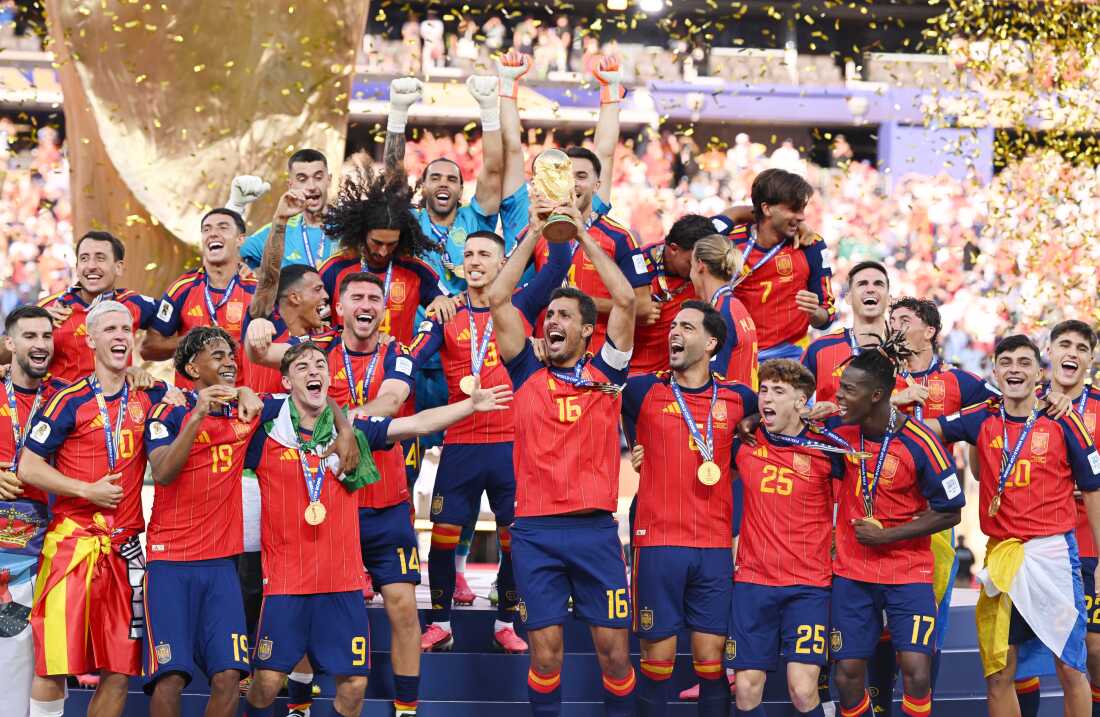
Spain Seize the World Cup With Late Extra Time Breakthrough
Spain’s 2026 World Cup triumph over Argentina was not a procession. It was a pressure test. A final that narrowed the sport to its harshest logic: one mistake, one opening, one moment of composure when everyone else is running on fumes. After Argentina were reduced to 10 men, Spain still had to force their way through a stubborn, exhausted, and dangerous opponent before finally landing the decisive blow in extra time. That is what makes a title like this feel bigger than a trophy lift. It is a reminder that elite football is often less about dominance than survival, adaptation, and nerve when the margins collapse.
- Spain won the
2026 World Cupafter beating Argentina 1-0 in extra time. - Argentina’s red card changed the tactical balance, but did not instantly decide the match.
- Spain’s patience and control eventually broke through a low-margin final.
- The result reinforces how modern tournament football rewards depth, structure, and composure.
- This final could shape how national teams think about risk, rotation, and in-game adjustment going forward.
Spain’s 2026 World Cup win was about control, not spectacle
This was not a final built for highlight reels. It was built on tension. Spain did what the best tournament teams do when the game stops offering clean chances: they stayed patient, kept the ball moving, and trusted the structure behind the stars. That matters because finals rarely reward recklessness. The team that can keep its shape while the game becomes increasingly chaotic usually ends up with the decisive chance.
Argentina, even after going down to 10 men, refused to become a passive bystander. That made Spain’s job harder, not easier. The red card changed the geometry of the match, but not the emotional pressure. Every Spain attack had to be precise. Every turnover could have become a counterattack. And every minute that passed pushed the game further into the territory where one mistake could define an entire four-year cycle.
Spain did not simply outplay Argentina. They outlasted them, which is often the more valuable skill in knockout football.
Why the red card changed everything and almost nothing
A sending-off in a final usually triggers a dramatic shift in how the match is played. The team with 10 players tends to sit deeper, compress space, and force the opponent to overcommit. That happened here, but the deeper lesson is that numerical advantage does not automatically translate into scoreboard advantage. Modern international football is too organized for that. A disciplined 10-man team can still deny central lanes, slow tempo, and drag the match toward penalty-box anxiety.
Spain had to solve a problem that was partly tactical and partly psychological. They needed width without becoming predictable. They needed tempo without getting reckless. They needed patience without drifting into sterile possession. That is a difficult balance, and it is why extra time often exposes the limits of possession-based systems that look elegant for 90 minutes but struggle to generate quality when the opponent is hanging on by sheer discipline.
The tactical lesson for Spain
Spain’s biggest edge was not just technical quality. It was their ability to keep attacking without losing the game behind the ball. That is a rare trait in knockout football. The team likely benefited from a structure that allowed them to recycle possession, reset attacks, and keep the field stretched enough to prevent Argentina from packing the box too efficiently.
Pro tip for analysts: when evaluating finals like this, do not focus only on possession percentage. Look at how often a team can force the defense to shift horizontally, then attack the second phase. That is where tired legs and mental errors start to show.
How Spain won the 2026 World Cup in extra time
Extra time strips football down to essentials. There is less energy, fewer tactical disguises, and far more dependence on habit. Teams do not usually invent new patterns in the 100th minute. They return to what they trust. Spain’s breakthrough therefore says a lot about their squad depth and their ability to keep enough quality on the field to capitalize when the decisive opening finally appeared.
Winning in extra time also demands emotional management. Players have to fight the instinct to rush the moment. The more desperate a final becomes, the more valuable the team that can stay calm enough to wait for the right pass, the right run, or the right shot selection. Spain found that moment while Argentina were still trying to survive with one fewer player and a shrinking reservoir of stamina.
The hidden value of squad depth
In tournaments, depth is not only about replacing injured players. It is about preserving tactical intensity deep into games that are no longer being played at the same speed. A bench that can keep the team’s shape intact matters just as much as the starting XI. Spain’s ability to win late suggests they entered the final with a roster capable of maintaining pressure into extra time, which is often where title-winning campaigns are separated from nearly-great ones.
- Depth keeps pressing triggers alive late in matches.
- Fresh legs can create overloads against a tired back line.
- Substitutions can restore tempo when possession starts to flatten.
- A balanced bench reduces the risk of emotional panic in extra time.
Argentina’s resistance made the final harder than the score suggests
A 1-0 result in extra time can make a match sound straightforward. It rarely is. Argentina’s performance, especially after the red card, likely forced Spain into a far more difficult contest than casual observers will appreciate. Teams with a man down do not only defend. They disrupt rhythm. They make every touch more expensive. They ask the favorite to prove that it can remain sharp while the game repeatedly stalls.
That resistance matters because it reveals a core truth about elite finals: the underdog does not need to control the game to influence it. Argentina may not have had the same territory or numbers, but they still shaped the match by forcing Spain to attack against a compressed defensive block. In doing so, they turned the final into a patience contest, and patience is one of the hardest things to sustain when a title is sitting in front of you.
In finals, the losing side often decides the tone more than the winner does. Argentina turned this into a grind, and Spain had to earn every inch.
Why this matters beyond one trophy
This result will travel far beyond the final whistle. For Spain, it validates a footballing identity built on technical security, collective movement, and game management. For the rest of the international field, it reinforces a strategic trend that has become impossible to ignore: the teams that win modern tournaments usually combine artistry with ruthless control. Style still matters, but only if it survives contact with chaos.
For coaches, this final is a study in tournament realism. You can dominate the ball and still be forced into extra time. You can control territory and still struggle to create. And you can hold the advantage after a sending-off without ever feeling safe. That is why title contenders increasingly invest in multi-phase attacking patterns, versatile defenders, and midfielders who can switch between tempo control and vertical acceleration without breaking structure.
What teams will copy next
Expect future national teams to chase a similar blend of technical poise and structural discipline. The template is clear:
- Build systems that remain stable when the match state changes.
- Train for low-block problem solving, not just open-field combinations.
- Prioritize players who can execute in both possession and transition.
- Prepare explicit extra-time plans instead of treating those minutes as improvisation.
Pro tip for coaches: if your team only works when the game is calm, it is not tournament-ready. Finals are about surviving volatility without losing your identity.
The bigger picture for the sport
Spain’s win also says something about where football is heading. The romantic idea that a final will be settled by a single burst of brilliance is still alive, but increasingly filtered through organization and data-driven preparation. Teams do not stumble into titles anymore. They engineer them through depth charts, press resistance, set-piece detail, and minute-by-minute risk management.
That does not make the sport colder. It makes it more demanding. The best sides must now be both expressive and efficient, able to improvise while still protecting themselves from the one swing that can undo everything. Spain managed that balance when it mattered most, and that is why the trophy feels earned rather than merely won.
Argentina, meanwhile, will leave with the kind of painful lesson that can define a program for years: a final can be competitive even when the numbers are against you, but eventually the math catches up. Spain were the team that stayed patient long enough to let the equation work in their favor.
In the end, this 2026 World Cup final will be remembered less as a blowout than as a test of endurance. Spain passed. Argentina nearly did too. But in a final this tight, nearly is just another way of saying not enough.
The information provided in this article is for general informational purposes only. While we strive for accuracy, we make no guarantees about the completeness or reliability of the content. Always verify important information through official or multiple sources before making decisions.


