Trump Tariffs Rattle Apple
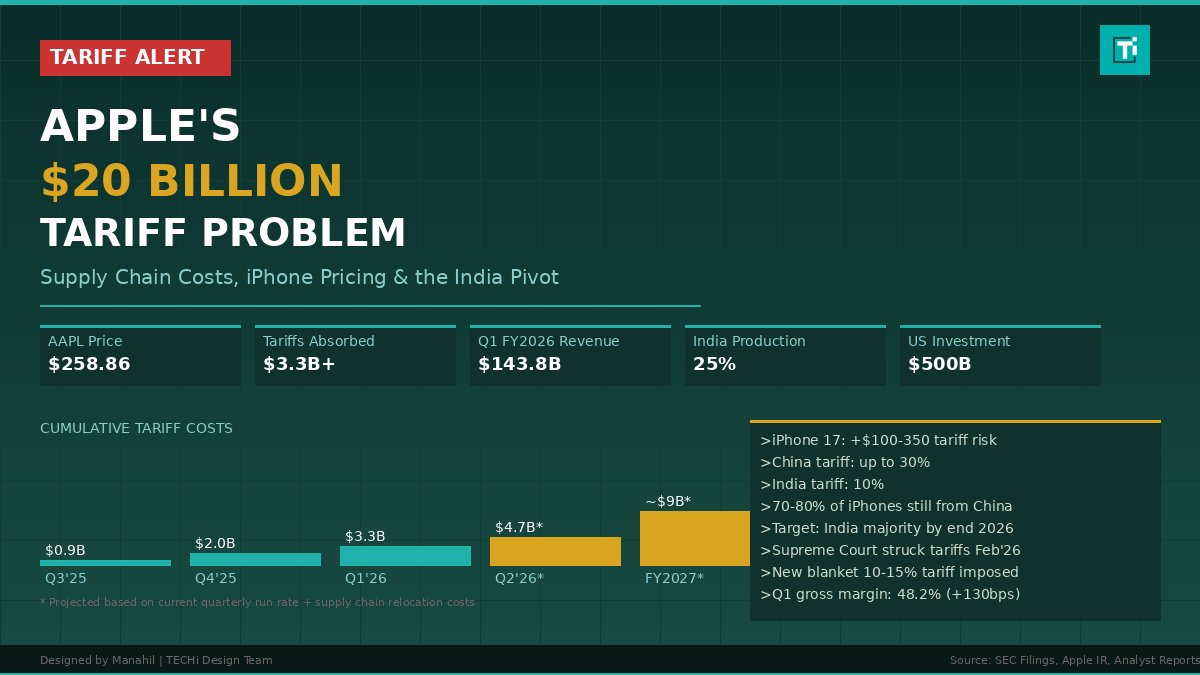
Trump Tariffs Rattle Apple
Apple has spent years building one of the most sophisticated supply chains on the planet. Now it is being pulled back into a political fight it cannot fully control. Fresh tariff threats tied to Donald Trump have reopened a familiar question with much bigger consequences: what happens when the world\’s most valuable consumer tech company becomes a pressure point in a trade war?
For consumers, the answer could be painfully simple: higher prices, slower product planning, and more uncertainty around the devices they buy every day. For investors and competitors, the issue is even larger. This is not just about one company or one product cycle. It is a test of whether global hardware giants can still operate efficiently when geopolitics starts dictating the bill of materials.
- Apple tariff pressure is back at the center of the US political and business debate.
- New import taxes could hit
iPhonepricing, margins, and supply chain planning. - Apple has diversified beyond
China, but it is still deeply exposed to global trade policy. - The bigger story is how tariffs can reshape consumer tech strategy across the industry.
Why Apple tariff pressure matters right now
Apple is uniquely vulnerable to tariff threats because its business model depends on precision at extreme scale. The company designs products in the US, sources components globally, and assembles major devices across a tightly tuned manufacturing network. When tariffs enter that system, they do not act like a minor line-item inconvenience. They hit at the exact point where volume, timing, and price discipline matter most.
That matters because Apple sells premium hardware while also trying to protect gross margins that Wall Street watches obsessively. Even a relatively small tariff can create ugly choices: absorb the cost, pass it on to customers, renegotiate supplier contracts, or reconfigure logistics in ways that take months or years to stabilize.
Tariffs are rarely just taxes on imports. In consumer tech, they become taxes on planning, speed, and flexibility.
The renewed focus on Apple also reflects its symbolic role in American industry. Politicians like using Apple as proof that manufacturing, trade, and national competitiveness still matter. The problem is that symbolism does not assemble a phone at scale. Supply chains are built over decades, not election cycles.
How Trump tariffs could hit the iPhone
Price increases are the most obvious risk
If broad import tariffs land on devices or core components, the cleanest way for Apple to preserve profitability is to raise prices. That sounds straightforward, but Apple already operates in a market where premium smartphones are expensive enough to trigger consumer hesitation. A visible jump in iPhone pricing could pressure upgrade cycles, especially in markets where carriers are less aggressive about subsidies.
Apple has historically been careful with pricing psychology. It can shift storage tiers, services bundles, and trade-in offers to soften the blow. But tariffs reduce room to maneuver. At some point, the math becomes impossible to hide.
Margins could take a direct hit
Apple could also choose to absorb part of the tariff burden. That might help preserve demand in the short term, but it would come at the expense of margins. Investors tend to reward Apple for operational discipline, not for acting as a shock absorber for trade policy. If tariffs become meaningful enough, margin compression stops being a theoretical risk and starts showing up in quarterly results.
Product strategy gets more complicated
There is also a quieter effect that matters just as much: tariffs distort product planning. Hardware roadmaps rely on forecasts for components, assembly capacity, shipping windows, and launch timing. Once tariffs become a variable, every one of those assumptions gets shakier. Apple can adjust, but adjustment carries cost.
This is why tariff pressure is not only about whether the next phone costs more. It is about whether Apple can keep executing with the consistency that made it dominant in the first place.
Apple has diversified, but not enough to ignore the risk
Over the last several years, Apple has worked hard to reduce its dependence on China. Manufacturing growth in places like India and Vietnam is part of a larger strategy to spread geopolitical risk. That strategy is real, and it matters. But diversification is not the same thing as insulation.
Apple still relies on a deeply interconnected ecosystem of suppliers, assemblers, and logistics partners. Many of those links still run through China directly or indirectly. Even when final assembly moves, the surrounding infrastructure often does not move as quickly. Specialized tooling, skilled labor pools, supplier clustering, and transportation efficiency are all hard to replicate.
That is the key reality often lost in political rhetoric. You can announce a shift in manufacturing. You cannot instantly clone the industrial network that supports it.
Why moving production is so difficult
- Supplier concentration: Critical parts and subassemblies are often sourced from tightly grouped regional networks.
- Workforce expertise: High-volume electronics assembly depends on trained labor and management systems built over years.
- Infrastructure: Ports, roads, customs processes, and component transit all shape efficiency.
- Scale timing: Apple cannot risk disruption during major launch windows for products like
iPhoneorMacBook.
So yes, Apple is more diversified than it used to be. But no, that does not mean tariffs have become irrelevant.
The strategic guide to reading Apple tariff pressure
For readers trying to make sense of the bigger picture, it helps to track a few practical signals instead of getting lost in political theater.
Watch pricing behavior, not just political statements
If Apple starts adjusting list prices, trade-in incentives, or regional pricing structures, that tells you more than campaign rhetoric. Pricing is where strategy meets reality.
Follow manufacturing geography carefully
Look for changes in where key devices are assembled. If more iPhone production shifts to India or more accessories move to Vietnam, that is a sign Apple is preparing for longer-term trade friction rather than a temporary headline cycle.
Pay attention to product mix
Apple may try to protect margins by steering buyers toward higher-end configurations, services bundles, or premium devices. Tariff pressure does not always show up as a blunt price increase. Sometimes it appears as a subtle change in what Apple wants you to buy.
Read earnings language closely
Companies rarely provide a dramatic real-time confession that tariffs are hurting them. Instead, you may see careful phrasing around costs, uncertainty, sourcing, or macro conditions. In executive language, that is often where the real story lives.
Pro tip: When a hardware company starts talking more about resilience, flexibility, and supply chain optionality, it usually means external pressure is already shaping decisions behind the scenes.
Why this matters beyond Apple
Apple is the headline name, but the implications are much wider. If tariffs return as a serious policy tool, the entire consumer electronics sector will feel it. That includes smartphone makers, PC brands, semiconductor suppliers, wearables companies, and even retailers that depend on predictable import costs.
Once tariffs rise, companies across the stack have to make similar decisions:
- Should they absorb higher costs?
- Should they raise consumer prices?
- Should they move production?
- Should they redesign products to protect margins?
None of those choices are painless. For smaller firms, they can be existential. Apple at least has the scale, cash reserves, and brand power to navigate shocks. Many rivals do not.
When trade policy hits a company like Apple, it is not just one giant taking a punch. It is a warning shot for the whole hardware economy.
This is also why the issue matters to consumers who do not care about corporate earnings calls. Trade policy can directly influence what gadgets cost, how quickly new devices arrive, and whether companies keep experimenting aggressively with new categories.
The politics are simple. The economics are not.
Trump\’s tariff rhetoric is politically legible because it promises leverage, toughness, and domestic advantage. The business reality is far messier. Tariffs can create negotiating pressure, but they also increase friction for companies operating inside globalized production systems. Apple is a perfect example of that contradiction.
There is an understandable instinct to ask why a company with Apple\’s resources cannot just build everything in America. The answer is not ideology. It is industrial capacity. Modern electronics production depends on ecosystems, not just factories. A final assembly site is only one piece of the puzzle. The deeper challenge is whether the surrounding network of suppliers, skills, and logistics exists at the necessary scale.
That is why reshoring is much harder than campaign slogans suggest. It is also why investors react nervously when politicians frame complex manufacturing systems as if they can be reassembled on command.
What Apple does next
Apple\’s most likely response is the same one it has used before: stay publicly measured, keep building optionality, and avoid overcommitting to any one geopolitical outcome. Expect more diversification, more quiet negotiations, and more operational hedging.
Internally, that can look something like this:
if tariff_risk increases:

    diversify_assembly()

    renegotiate_supplier_terms()

    protect_margin_where_possible()

    adjust_pricing_selectively()
That code snippet is simplified, but the strategy is not. Apple is effectively trying to preserve speed, protect margins, and reduce concentration risk all at once. Few companies can even attempt that balancing act. Fewer still can do it under the public scrutiny Apple faces.
The challenge is that no supply chain is infinitely adaptable. There are limits to how quickly production can move and how much cost can be hidden. If tariff pressure intensifies, Apple may be forced into more visible decisions on pricing and product structure.
Apple tariff pressure is the new stress test
The biggest takeaway is not that Apple is suddenly fragile. It is that even the best-run hardware company in the world can be exposed when politics collides with manufacturing reality. Apple tariff pressure has become a stress test for global tech itself: can premium devices remain predictable, affordable, and scalable in a more fragmented political era?
That is the real story here. Not just whether one administration threatens one company, but whether the economic model that built modern consumer electronics can survive repeated geopolitical shocks without passing the pain directly to buyers.
Apple will keep adapting. It always does. But adaptation has a cost, and tariffs are one of the bluntest ways to impose it. If this pressure escalates, the next big change in tech may not be a breakthrough feature. It may be the price tag.
The information provided in this article is for general informational purposes only. While we strive for accuracy, we make no guarantees about the completeness or reliability of the content. Always verify important information through official or multiple sources before making decisions.


