Trump’s Crypto Windfall Reshapes the Political Money Game
Trump’s Crypto Windfall Reshapes the Political Money Game
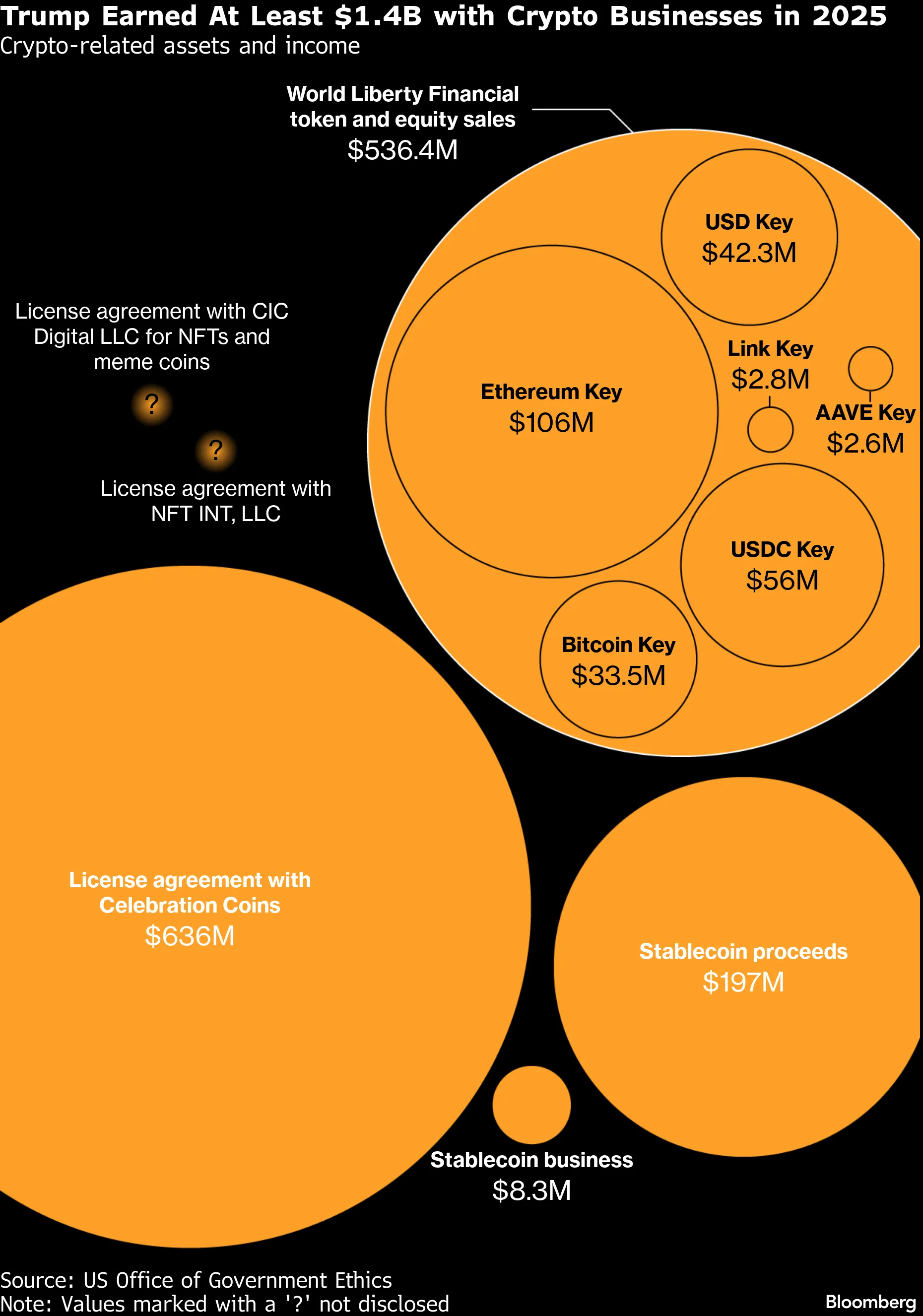
Donald Trump’s latest financial disclosure does more than reveal a staggering personal gain – it signals a deeper shift in how political brands are being monetized in the crypto era. A windfall tied to cryptocurrency, including meme coins, puts a hard number on something Washington has been dancing around for years: influence now has a tokenized market value. For voters, ethics watchdogs, and crypto investors alike, the question is no longer whether politics and digital assets will collide. It is how far that collision can go before the line between public office, private enrichment, and speculative hype disappears entirely. That is why the latest disclosure matters. It is not just about one man making money. It is about the evolving playbook for power, attention, and profit.
- Trump’s reported
cryptocurrencyearnings underscore how political identity can be converted into digital asset value. Meme coinsremain highly speculative, but they are now part of a broader political-financial ecosystem.- The disclosure intensifies scrutiny around ethics, transparency, and conflicts of interest.
- This moment may shape how campaigns, donors, and regulators approach token-based fundraising and branding.
Why the Trump crypto disclosure matters now
Trump’s reported earnings from cryptocurrency are eye-popping, but the real story is bigger than the dollar figure. Political figures have always found ways to monetize fame, from book deals to speaking fees to media empires. What feels different here is the speed and scale of the conversion. A meme-fueled digital asset can catch fire, trade on sentiment, and funnel enormous gains toward the person whose name or image powers the market.
That creates a modern political economy with fewer guardrails. Traditional fundraising still has disclosure rules and institutional norms. Crypto, especially highly speculative tokens, often moves faster than regulators can track and faster than the public can react. When a politician’s brand becomes a financial product, the usual categories start breaking down.
Politics has always been a business, but tokenized politics turns identity itself into an asset class.
The crypto earnings story is bigger than one disclosure
The disclosure points to a broader truth about the crypto market: attention is capital. In this environment, meme coins are not just jokes with tickers. They are expression wrapped in speculation, and they thrive on community, virality, and controversy. A single endorsement, image, or narrative can trigger a trading frenzy. That makes them uniquely powerful and uniquely unstable.
For Trump, the financial upside appears to come from a brand ecosystem that is unusually well suited to crypto’s hype-driven mechanics. If a political figure already commands a massive audience, then a token linked to that identity can function like a live wire. Supporters buy in because they believe in the person, the movement, or the short-term price action. Critics buy in to bet against it. Either way, liquidity follows attention.
What makes meme coins different
Meme coins are not built like conventional financial assets. They often lack the fundamentals investors use to assess stocks, bonds, or even many established cryptocurrencies. Instead, their value is driven by narrative, scarcity, and collective belief.
- Brand power: The stronger the public persona, the easier it is to spark demand.
- Network effects: More chatter can create more trading volume, even without utility.
- Speculative reflexes: Prices often rise and fall on headlines, not product milestones.
- Low accountability: The token may outlive the news cycle even if the thesis is weak.
That is why a political figure’s involvement changes the equation. The brand is not incidental. It is the product.
Trump’s crypto earnings and the ethics problem
Whenever a high-profile public figure benefits from a market tied to their own name, conflicts of interest become impossible to ignore. Even if the arrangement is technically legal, the ethical optics are combustible. Does the value of the asset rise because of market demand, or because the figure continues to command public attention through their official or political role? In practice, it can be both.
This is where disclosure becomes necessary but not sufficient. Yes, financial transparency gives the public a window into potential risks. But disclosure alone does not solve the underlying problem: a political ecosystem that can be financially enriched by constant visibility.
For watchdogs, this is a test case. If the market rewards political branding with outsized returns, then future candidates may be tempted to imitate the model. That could blur the boundary between campaigning and monetization even further.
The real risk is not that crypto creates new wealth. It is that it normalizes a system where public influence can be directly priced and traded.
How the crypto market benefits from political spectacle
Crypto has always been excellent at turning controversy into activity. Every scandal, rumor, or celebrity tie-in can produce a burst of trading. For token issuers and exchanges, that means more attention, more volume, and often more revenue. The Trump disclosure is therefore not only a political story. It is also a market signal.
Speculative assets thrive when they can borrow legitimacy or curiosity from institutions outside finance. Politics is one of the most powerful attention engines available. It has a built-in audience, a permanent news cycle, and emotionally charged tribes. When those ingredients mix with token speculation, the result can be explosive.
Why investors should be cautious
Anyone looking at a politically branded token or a hot meme coin should treat it as a high-risk trade, not a long-term investment thesis. Here are the main hazards:
- Extreme volatility: Prices can swing violently on a single headline.
- Liquidity traps: A token can rise fast and become hard to exit.
- Regulatory uncertainty: Rules can change suddenly, especially around elections.
- Reputation risk: Association with political figures can cut both ways.
That does not mean all politically adjacent crypto assets are doomed. It means the fundamentals are usually weaker than the marketing. The ticker may be new, but the dynamics are old: speculation, crowd psychology, and the fear of missing out.
Trump’s crypto earnings could change the playbook
The most important long-term implication is precedent. If a former or current political leader can generate massive cryptocurrency income through branded assets, then other public figures may follow. That includes candidates, pundits, influencers, and even movement leaders who see digital assets as a way to monetize loyalty.
This could push campaigns toward a more financialized model of engagement. Instead of just asking supporters to donate, they may ask them to buy. That shift would be profound. Donations are political speech. Token purchases can become speculative bets on a person’s future relevance, power, or legal survival. Those are not the same thing.
Regulators may eventually respond with stricter disclosure rules, clearer conflict-of-interest standards, or limits on political figures profiting from assets tied to their identity. But enforcement will be tricky. Crypto moves fast, jurisdictional lines are fuzzy, and the market often outruns the law.
What to watch next
The next phase of this story will likely focus on three questions:
- Will lawmakers treat politically branded tokens as a transparency problem or a campaign finance problem?
- Will new disclosures force more scrutiny of how these assets are launched and marketed?
- Will other political figures copy the strategy if the financial upside proves durable?
If the answer to any of those is yes, then this disclosure may be remembered less as a curiosity and more as a turning point.
Why this matters beyond Trump
Strip away the noise and the pattern is clear: the fusion of politics and crypto is becoming a real economic model. It rewards spectacle, punishes nuance, and favors personalities who can dominate attention at scale. That should worry anyone who cares about clean governance, market integrity, or the public’s ability to tell influence from investment.
Trump’s reported crypto earnings are not just a personal fortune story. They are evidence that the attention economy has matured into a financial system of its own. And in that system, the most valuable asset may not be code, utility, or decentralization. It may be the ability to command a crowd.
That is the uncomfortable lesson here. The market is not merely pricing tokens. It is pricing power.
The information provided in this article is for general informational purposes only. While we strive for accuracy, we make no guarantees about the completeness or reliability of the content. Always verify important information through official or multiple sources before making decisions.
