US Graduates Hit a Brutal Job Market
US Graduates Hit a Brutal Job Market
The US graduate job market has turned into a stress test at exactly the wrong moment. Students spent years hearing that a degree was the safest route into the middle class. Now they are walking into a hiring environment defined by caution, slower expansion, tighter budgets, and employers that want experience before they offer opportunity. That mismatch is not just frustrating – it is reshaping how a generation enters adult life. Delayed career starts, rising debt anxiety, and more intense competition for entry-level roles are becoming the norm. For employers, universities, and policymakers, this is not a temporary inconvenience. It is a warning sign that the pipeline from education to employment is under serious strain, and young workers are absorbing the shock first.
- New graduates are facing weaker hiring demand, especially for traditional entry-level roles.
- Economic uncertainty is making employers more selective, stretching recruitment timelines and raising expectations.
- The US graduate job market is shifting toward skills, internships, and adaptability, not just credentials.
- Delayed starts can have long-term consequences for earnings, confidence, and career mobility.
- This moment matters beyond graduates because it signals broader caution across the economy.
Why the US graduate job market suddenly feels much worse
Fresh graduates do not need a data dashboard to know something is off. They see it in job boards packed with listings that demand two to five years of experience, in interview processes that drag on for weeks, and in rejection emails that arrive after multiple rounds. The underlying problem is straightforward: businesses are nervous.
When economic conditions feel unstable, companies do what they always do. They slow hiring, protect margins, and prioritize workers who can contribute immediately. That instinct is rational for employers, but punishing for people just starting out. Entry-level hiring is often one of the first places businesses get cautious because training new workers costs time, money, and managerial attention.
The cruel math of a softening labor market is simple: when employers can choose from a larger pool of applicants, they raise the bar even for jobs that used to serve as the first rung on the ladder.
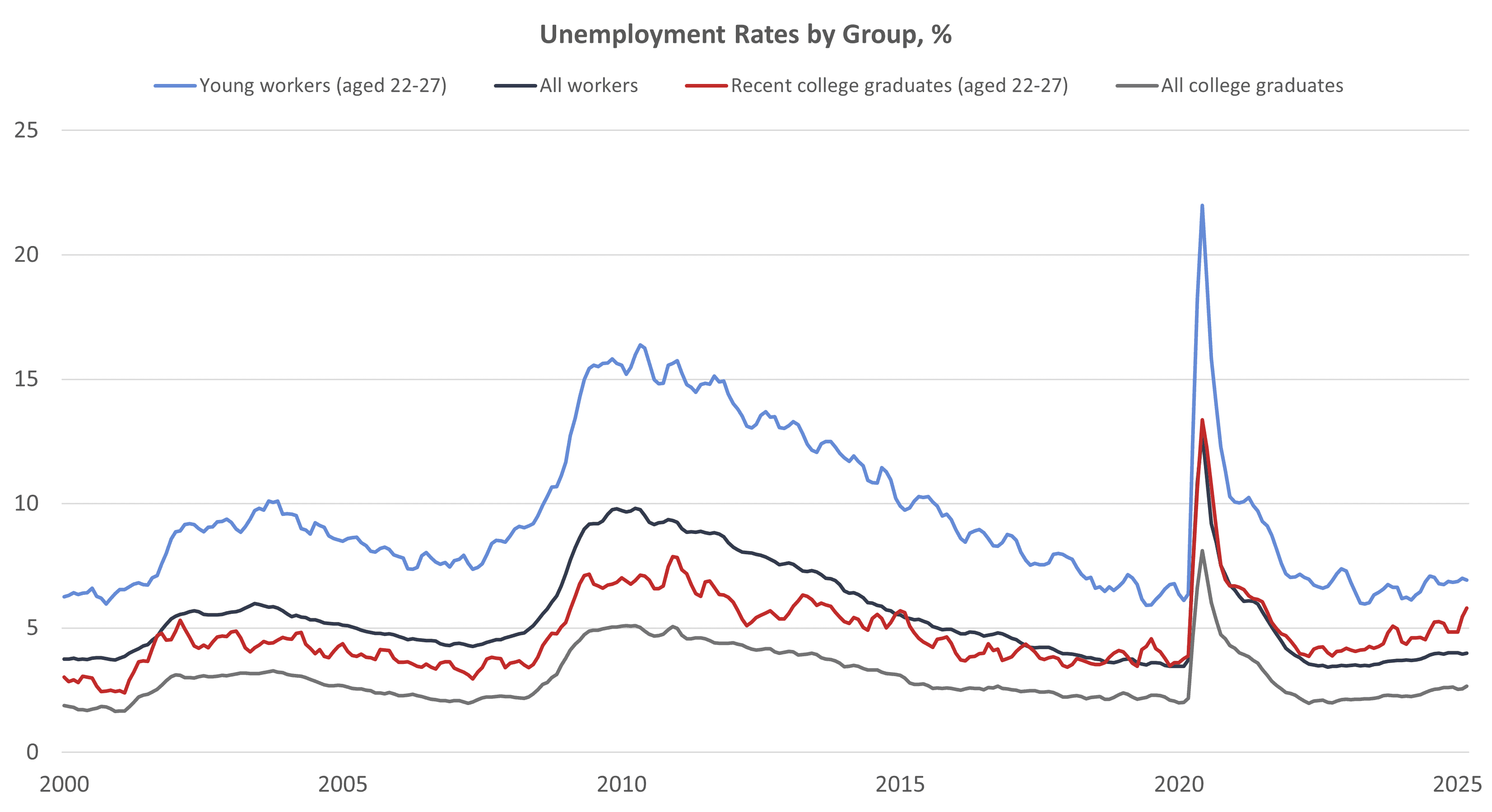
This is why recent graduates can hear that overall unemployment remains manageable and still feel like the ground has shifted beneath them. Aggregate labor numbers often hide where pain lands first. Young workers, recent degree holders, and career switchers tend to absorb disproportionate damage during uncertain cycles.
Entry-level work is no longer reliably entry-level
One of the biggest structural shifts is that many so-called junior roles have become hybrid jobs. Employers may advertise a starter position, but they want someone who can already use CRM tools, analyze spreadsheets, manage projects, understand AI-assisted workflows, and communicate like a seasoned employee. In theory, that is about efficiency. In practice, it pushes risk onto the applicant.
Graduates are being asked to arrive fully formed in a labor market that historically existed to train them. That is a profound change, and it helps explain the growing sense of betrayal among younger workers who followed the script and still feel locked out.
What is driving employer caution
The obvious factor is economic uncertainty. Businesses facing unclear demand, sticky costs, geopolitical risk, or slower consumer spending become defensive. Hiring plans get revised. New headcount needs extra approval. Managers may be told to fill fewer roles or leave some open positions unfilled.
But there is more going on here than broad macro nerves.
Companies are optimizing for immediate productivity
After years of disruption, many employers are still trying to do more with leaner teams. They want hires who can plug directly into existing workflows with minimal training. That preference hurts recent graduates because potential is harder to model than proven output.
At the same time, digital tools have changed expectations. If a worker can use automation, data analytics, or generative AI to move faster, employers increasingly treat those skills as baseline advantages rather than optional bonuses.
White-collar hiring has lost some of its momentum
For many graduates, the promise of college was tied to professional office work: finance, consulting, media, tech, marketing, human resources, administration. These sectors can be especially sensitive to cost controls and changes in business confidence. When hiring slows there, the bottleneck becomes visible fast because so many graduates aim for the same lanes.
That does not mean jobs vanish everywhere at once. It means the path becomes narrower. More applicants compete for fewer openings, and employers gain leverage.
Why this matters beyond this year’s graduating class
A weak start can echo for years. Economists have long warned that entering the workforce during a downturn or hiring slowdown can depress earnings and advancement well beyond the first job. Missed early opportunities can delay promotions, reduce confidence, and push talented workers into roles that do not match their training.
First jobs are not just paychecks. They are launch platforms for networks, identity, and future bargaining power.
That is why the current stress in the US graduate job market matters at a national level. If large numbers of degree holders struggle to convert education into work, trust in the value proposition of higher education erodes. Families begin to question tuition costs more aggressively. Students reconsider majors through a purely defensive lens. Employers complain about talent gaps while offering fewer true entry points. Everyone becomes more cynical.
There is also a political and social layer. Graduates facing underemployment often delay renting apartments, buying homes, starting families, or moving for opportunity. Those choices shape consumer demand and social mobility. A difficult labor market for young workers is not a niche problem. It ripples outward.
The hidden damage of prolonged job searching
Long searches do not only affect bank accounts. They affect behavior. Graduates begin to self-edit, aiming lower out of fear. Some stop applying to ambitious roles. Others flood the market with generic applications and burn out when nothing lands. The psychological toll is real.
Confidence can erode quickly
The transition from campus to career already involves uncertainty. Add repeated rejection and silence, and many candidates start treating every interview as a referendum on their worth. That mindset can become self-defeating. It narrows ambition and undermines performance in the moments that matter most.
Underemployment becomes a trap
Taking a stopgap role is often necessary and sensible. The risk appears when temporary work turns into a stalled trajectory. Employers may later question why a candidate did not build directly relevant experience, even when the labor market gave them little choice. That is one reason early hiring slowdowns have lasting effects.
How graduates can respond strategically
No advice can fully cancel out a difficult market, but tactics matter more when openings are scarce. The goal is to reduce employer uncertainty and make your value easier to see.
- Treat internships, campus projects, and freelance work as proof of output. If you used
Excel,SQL,Python,Figma, or campaign analytics, show what changed because of your work. - Build a skills-first resume. Degrees open doors, but hiring managers often scan for capabilities and measurable outcomes first.
- Customize applications for role families, not just single listings. Create tailored versions for operations, marketing, analysis, customer success, or research.
- Use networking as signal, not desperation. Conversations with alumni, professors, and former interns help clarify hiring needs and hidden openings.
- Prepare for practical interviews. Many employers now test candidates with case prompts, short assignments, or software fluency checks.
Pro tip: show applied skill, not just exposure
There is a big difference between saying you are familiar with a tool and proving what you accomplished with it. A line like analyzed customer churn data in SQL and presented retention insights is stronger than basic SQL knowledge. Specificity lowers employer risk.
What colleges and employers are getting wrong
Higher education still sells a broad promise of career mobility, but many institutions have not fully adapted to a labor market where students need earlier exposure to practical tools, internships, and employer expectations. Career centers can help, but they are often underpowered relative to the scale of the problem.
Employers, meanwhile, complain about readiness while quietly shrinking the on-ramps that produce ready workers. That contradiction deserves more scrutiny. If companies want adaptable talent, they have to invest in training, apprenticeships, rotational programs, and genuine junior roles.
You cannot demand a pipeline of experienced young workers while dismantling the systems that let them become experienced.
This is where the debate gets bigger than any one graduating class. A healthy economy needs mechanisms that turn education into productivity. If that bridge weakens, talent is wasted and inequality hardens.
The next phase of the US graduate job market
The market will not stay frozen forever. Hiring conditions can improve quickly once business confidence returns. But some changes are likely to stick. Employers will probably continue valuing applied digital fluency, portfolio evidence, and cross-functional communication more than they did a decade ago.
Expect a more fragmented launch path
For many graduates, the old formula of degree, resume, interview, and office job offer is giving way to something messier. Short-term contracts, internships that convert later, project-based work, and internal mobility may define more early careers. That path can still lead somewhere strong, but it requires more persistence and more self-direction.
US graduate job market pressure may accelerate skills-based hiring
There is one potentially constructive outcome here. If employers become more honest about what they actually need, hiring may shift further toward demonstrable skills rather than prestige filters alone. That could help candidates from less traditional backgrounds compete more effectively. But it only works if businesses stop using inflated requirements as a lazy screening tool.
The bottom line
The anxiety surrounding new graduates is not overblown. It reflects a real collision between educational expectations and a labor market that has become more selective, more skeptical, and less willing to train. The US graduate job market is exposing a broader truth about this economy: uncertainty does not hit everyone equally. It lands hardest on people trying to get their first shot.
That makes this more than a seasonal headline about commencement and job offers. It is a strategic warning for universities, employers, and policymakers. If the first rung of the career ladder keeps moving higher, talented people will not stop reaching for it – but more of them will slip before they ever get started.
The information provided in this article is for general informational purposes only. While we strive for accuracy, we make no guarantees about the completeness or reliability of the content. Always verify important information through official or multiple sources before making decisions.


