AI Deepfake Scams Escalate Fast
AI deepfake scams are turning trust into a liability
AI deepfake scams are no longer a novelty or a future threat. They are already rewriting the basic rules of online trust, and that should make every business leader, employee, and consumer nervous. A voice that sounds exactly like a CEO. A video call that looks real enough to move money. A message that arrives with the right tone, the right urgency, and the wrong intent. The old advice – look closer, listen harder, trust your instincts – is getting weaker by the month because the fakes are getting better faster than our habits can adapt. That shift matters because fraud is no longer just about stealing credentials. It is about hijacking identity itself.
- AI deepfake scams can impersonate people convincingly enough to bypass human judgment.
- Traditional security training is useful, but it is no longer sufficient on its own.
- Verification workflows now matter as much as passwords and access controls.
- Organizations that move fast on policy and tooling will reduce their exposure.
Why AI deepfake scams are so effective
The core problem is simple: humans are built to trust familiar signals. A recognizable face, a familiar voice, a confident cadence, a logo in the corner of an email – those cues used to be enough. AI systems now reproduce them cheaply and at scale. That makes AI deepfake scams unusually dangerous because the attacker does not need to break into a system first. They can often persuade someone to open the door for them.
What used to be a crude phishing email can now become a layered social engineering attack. An employee may receive a synthetic voicemail from a “manager,” a text that references a real project, and then a video call that confirms the request. Each piece reinforces the illusion. The scam works not because the fake is perfect, but because it is just convincing enough at the moment of decision.
Security teams should stop asking whether a message looks real and start asking whether it can be independently verified.
The new playbook behind the scam
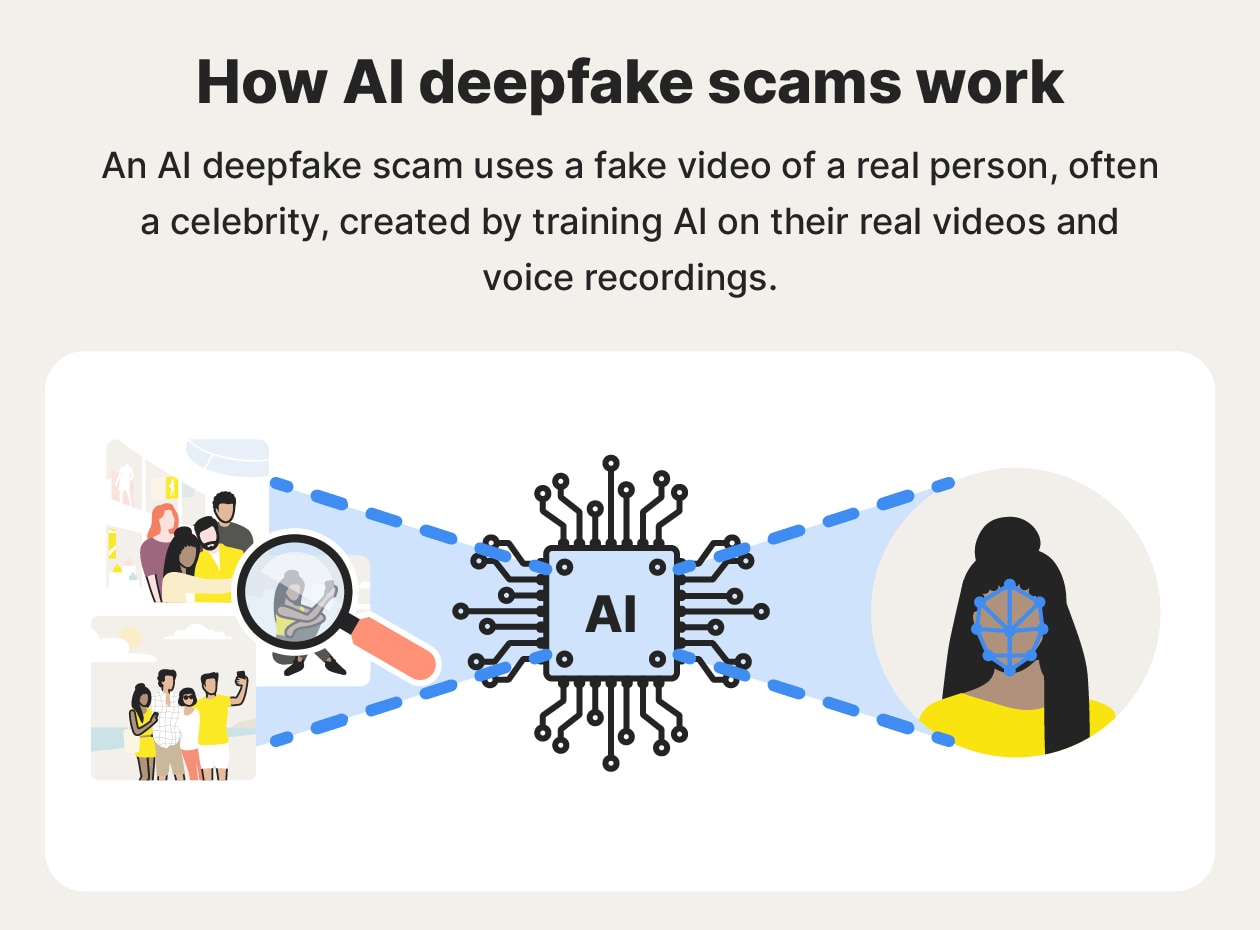
Attackers are blending automation, public data, and generative tools into a far more efficient fraud pipeline. Publicly available voices, LinkedIn profiles, conference interviews, and company org charts provide enough raw material to create a credible impersonation. Once the target is identified, the fake can be tailored to their role, their schedule, and their decision-making habits.
How the attack typically unfolds
- First, the attacker collects open-source details about the target and their organization.
- Next, they generate a voice clone, synthetic image, or short video clip.
- Then they craft a high-pressure request that bypasses routine caution.
- Finally, they exploit the fact that people tend to defer to authority under time pressure.
The result is a scam that feels personal because it is personal. That is what makes AI deepfake scams more than a technical problem. They are a behavioral threat dressed up as a communications problem.
AI deepfake scams and the collapse of visual proof
For years, digital security relied on a basic assumption: if you could see it or hear it, you could trust it more than a text-only message. That assumption is now broken. Images can be generated, voices can be cloned, and live video can be manipulated in real time. The consequence is bigger than fraud losses. It is a slow erosion of confidence in every remote interaction.
This is especially damaging in executive workflows, financial approvals, and customer support channels. If a team begins to doubt every urgent request, operations slow down. If they keep trusting everything, fraud gets through. That tension is the new reality.
Where the biggest risks sit
- Finance teams handling wire transfers or invoice changes.
- HR and payroll staff verifying employee identity changes.
- Customer service teams exposed to account takeover attempts.
- Executives whose voices and faces are easy to scrape from public sources.
The highest-risk organizations are often the ones that already operate on speed. Startups, agencies, distributed teams, and fast-moving enterprises all benefit from low-friction approvals. Unfortunately, that same speed is exactly what fraudsters target.
What businesses should do now
The response to AI deepfake scams cannot be limited to awareness training, though training still matters. The fix has to be procedural, technical, and cultural. Security teams need to design for the assumption that any single channel can be forged.
Build verification into the workflow
Instead of relying on voice or video alone, require a second channel for sensitive actions. For example, payment changes can be confirmed through a separate internal system, a pre-registered callback number, or a ticketing workflow with approval history. The point is not to make work unbearable. It is to make fraud harder than legitimate business.
Useful control points include:
- Out-of-band confirmation for financial or access changes.
- Role-based approval rules for urgent requests.
- Callback policies using known numbers, not caller-provided ones.
- Mandatory pause steps before transferring money or credentials.
Train for skepticism, not paranoia
Security awareness programs often fail because they are too abstract. Employees hear “be careful” but are not shown how attackers actually work. Better training uses realistic examples: a cloned voice asking for a same-day transfer, a fake vendor changing bank details, or a supposed executive demanding secrecy. The lesson should be simple: urgency is a red flag, secrecy is a red flag, and unusual process changes are a red flag.
The best defense is not perfect detection. It is making the attack expensive enough that it no longer scales.
Why this matters beyond fraud teams
It would be easy to frame this as a cybersecurity niche, but that misses the bigger picture. AI deepfake scams threaten trust across the digital economy. If people stop believing what they hear and see online, then remote hiring, financial services, customer support, journalism, and even politics all become harder to navigate.
That creates a strange asymmetry. The attacker only needs one convincing moment. The defender needs a durable system. That is why the conversation is shifting from content moderation to identity verification. Stronger identity proofs, better access controls, and more resilient internal processes are becoming business necessities rather than optional upgrades.
The future will reward verification-first organizations
The next phase of this problem is likely to be worse before it gets better. Tools for voice cloning and video generation are improving quickly, and the cost of producing convincing fakes keeps falling. At the same time, attackers are learning how to use these tools in combination with real-time social engineering. That means the most effective scams will not look like obvious fraud. They will look like normal work.
Organizations that win this phase will probably share a few traits. They will have clear approval chains. They will use multi-step identity checks for sensitive actions. They will treat AI-generated media as untrusted by default unless independently verified. And they will make security a product design problem, not just an IT issue.
There is also a broader policy question here. Platforms, regulators, and security vendors will eventually need stronger standards for provenance, authentication, and detection. But businesses should not wait for that consensus. The threat is already here, and the cheapest time to adapt is before your first incident.
Practical steps to reduce exposure now
If you are responsible for a team or a business process, start with a simple audit. Where do people rely on voice, video, or urgent messages to authorize action? Where can a single conversation trigger financial, legal, or access changes? Those are your weak points.
- Map the top five decisions that can be executed too quickly.
- Add a required verification step for each one.
- Limit who can approve urgent exceptions.
- Document a response plan for suspected impersonation.
- Review how much executive audio and video is publicly available.
None of this eliminates the threat entirely. But it lowers the odds that one convincing fake becomes a costly breach. And that is the right goal. With AI deepfake scams, the question is not whether the next fake will be perfect. It is whether your organization will still trust itself when it arrives.
The information provided in this article is for general informational purposes only. While we strive for accuracy, we make no guarantees about the completeness or reliability of the content. Always verify important information through official or multiple sources before making decisions.