Artemis II Astronauts Gear Up For A High-Stakes Lunar Flyby
The race to return humans to lunar orbit just tightened: the Artemis II mission is no longer an abstract roadmap but a cockpit checklist, with four astronauts rehearsing every abort scenario while engineers harden the life-support stack that will push them beyond low-Earth orbit. The promise of renewed lunar exploration collides with the fear of a high-profile delay, and that tension is exactly why NASA is treating this crewed flight as a make-or-break proving ground for deep-space operations and public trust.
- First crewed
Artemis II missiontargets a 2026 lunar flyby to validate Orion systems - Mission will stress-test life support, comms, and navigation before a Moon landing attempt
- Crew composition signals NASA’s push for diversity and international collaboration
- Key risks: schedule compression, supply-chain fragility, and unflown hardware integration
Why the Artemis II Mission Matters Now
The Artemis II mission serves as NASA’s first crewed deep-space loop since Apollo, turning the Orion capsule and Space Launch System into operational hardware rather than demo pieces. It is also the capstone for a decade of lobbying, budget fights, and industrial consolidation. If Artemis II slips, every downstream element – including the lunar landing hardware and Gateway modules – stalls, making this flight a critical inflection point for the agency and its partners.
Beyond prestige, Artemis II is designed to test how humans fare in cislunar radiation, how the new ECLSS life-support stack holds up under real loads, and whether updated navigation and comms can maintain lock at lunar distances. It is also a social contract: NASA needs to prove to lawmakers and the public that crew safety and schedule realism can coexist.
Mission Architecture: From Pad to Pacific Splashdown
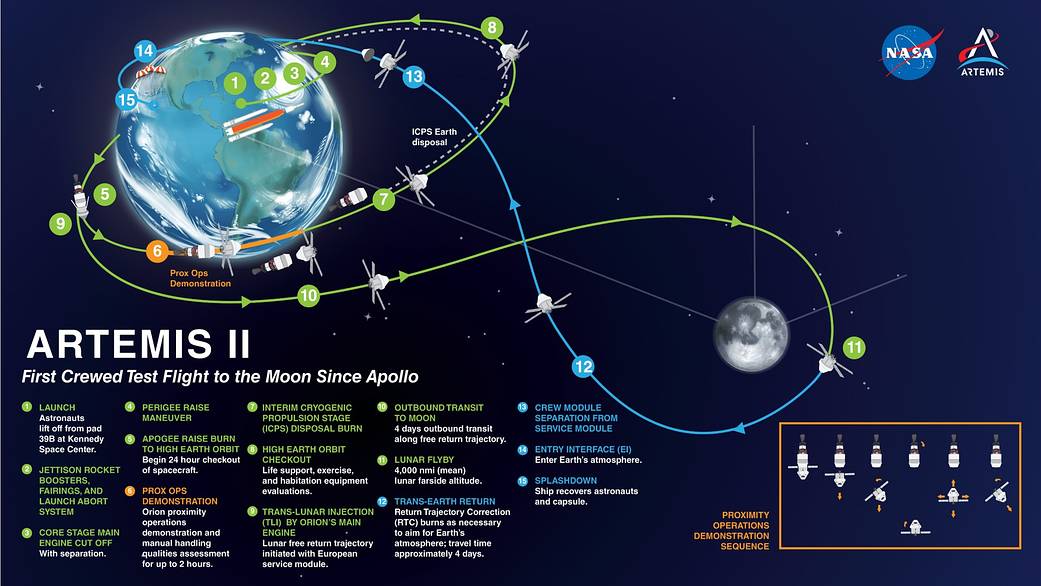
Launch rides on the SLS Block 1 lifting Orion into a high Earth orbit before a translunar injection burn. The crew will spend roughly ten days in flight, executing a free-return trajectory that swings around the Moon and back to Earth without requiring an engine burn to come home. This profile reduces propellant risk while still stressing avionics, comms, and environmental controls.
Orion’s European Service Module powers the mission with solar arrays and engine firings for orbital shaping. The crew will manually pilot segments to validate human-in-the-loop controls, particularly during proximity ops simulations. Reentry will test the Avcoat heat shield at lunar return velocities, a vital check before attempting landing missions.
Who’s On Board and Why It Signals a New NASA
The crew blend – a seasoned commander, a test pilot, a mission specialist with spacecraft systems expertise, and a Canadian Space Agency representative – is curated to send messages about diversity, alliances, and operational redundancy. This mix ensures complementary skill sets for manual control, systems troubleshooting, and public engagement. The international slot underscores NASA’s commitment to partnership-based exploration rather than go-it-alone nationalism.
Systems Under the Microscope
Life Support: The ECLSS Shakeout
Unlike Apollo’s single-mission consumable model, Orion’s ECLSS is designed for repeatable deep-space use. Artemis II will push its carbon dioxide scrubbing, humidity control, and cabin pressure regulation through crewed stress cycles. Engineers will monitor how the thermal control loop handles prolonged sun-shade transitions and whether LiOH canisters and rapid cycling amine systems keep cabin air within spec.
Comms and Navigation: Holding the Link at Lunar Distance
The mission will exercise Ka-band and S-band paths while validating Deep Space Network handoffs. Orion’s optical navigation camera suite will cross-check position estimates against star trackers, offering autonomous redundancy if ground control encounters latency or outage. Success here informs how future landers coordinate descent with Gateway in the loop.
Propulsion and Guidance: Free-Return with Escape Options
While the free-return trajectory is designed to self-correct, Orion still needs precise RCS and Main Engine burns for insertion and course trims. The crew will drill abort-to-Earth options throughout the flight, ensuring that guidance software and human procedures remain aligned. This redundancy is central to meeting updated human-rating rules.
Operational Risks and Schedule Reality
Artemis II inherits the usual suspects of aerospace risk: supply-chain fragility for avionics components, qualification creep for late design tweaks, and the challenge of integrating unflown hardware stacks. Any delays ripple into Artemis III, where lander teams need flight-proven data to finalize descent software and fuel margins.
There is also public risk. A scrubbed or postponed launch erodes confidence and congressional patience, potentially narrowing future budgets. Conversely, launching too early could jeopardize crew safety. NASA has shifted to more transparent risk communication, publishing incremental readiness reviews to avoid surprise slips.
Testing Playbook Before the Pad
Between now and roll-out, engineers will push hardware through a combined Integrated System Test, rehearsing launch day sequences with simulated faults. Software-in-the-loop campaigns will inject sensor noise and comms dropouts. Crew will run procedural sims to verify cockpit ergonomics under pressure. Every green light must be earned twice: once by automation, once by humans.
Industrial Base and Budget Tension
Artemis II is the first time the post-shuttle industrial base is building and flying crew-rated deep-space hardware at scale. The program’s fixed-price and cost-plus hybrid contracts have drawn scrutiny. Any overrun could trigger rebaselining that would delay later missions or force descopes in science payloads. NASA is leveraging commercial partners for logistics and parts, but strategic components remain single-source, making schedule resilience brittle.
MainKeyword in the Future: From Flyby to Sustained Presence
A successful Artemis II mission unlocks the pathway to Artemis III’s surface operations, where the lander will hinge on the data gathered from Orion’s thermal and radiation profiles. It also informs how the Gateway station configures power, docking, and life support for multi-month rotations.
Long term, Artemis II is the rehearsal for Mars-era ops: extended comms latency, autonomy, and crew psychology in confined habitats. Lessons learned will shape training pipelines, with augmented reality checklists and smarter fault detection algorithms built into future spacecraft.
Why This Matters for Industry and Policy
The mission’s success or failure will recalibrate how lawmakers view large-scale crewed exploration. A clean flight strengthens arguments for sustained funding and accelerates commercial lunar services. A rocky campaign could pivot investment toward smaller, robotic missions. For emerging aerospace startups, Artemis II sets procurement patterns that will influence vendor selection for years.
Key insight: Artemis II is less about planting flags and more about proving that modern deep-space operations can be repeatable, data-rich, and commercially inclusive.
Pro Tips and Playbook for Observers
If you want to track progress like a mission insider, anchor on three signals: integrated testing milestones, hardware shipment dates to the pad, and final Flight Readiness Review outcomes. When NASA updates any of these, you can recalibrate launch probability more accurately than with buzz alone.
- Bookmark NASA’s published test milestones and watch for slips of more than two weeks.
- Follow cargo flow: late arrivals to the Vehicle Assembly Building often signal hidden integration issues.
- Listen for wording changes in press briefings – “review complete” vs. “review in work” hints at unresolved items.
- Expect at least one launch window adjustment to accommodate weather and pad scheduling.
Bottom Line
Artemis II is NASA’s audacious but calculated gamble to restore human presence near the Moon. It blends legacy flight discipline with twenty-first-century systems and international crews, aiming to prove that deep-space travel can be safer, more transparent, and more scalable than Apollo. If the agency threads the needle on schedule and safety, Artemis II will be remembered not as a cameo before the main event, but as the mission that rebooted humanity’s lunar ambitions on modern terms.
The information provided in this article is for general informational purposes only. While we strive for accuracy, we make no guarantees about the completeness or reliability of the content. Always verify important information through official or multiple sources before making decisions.