Artemis II Mission Timeline Unpacked
Artemis II Mission Timeline Unpacked
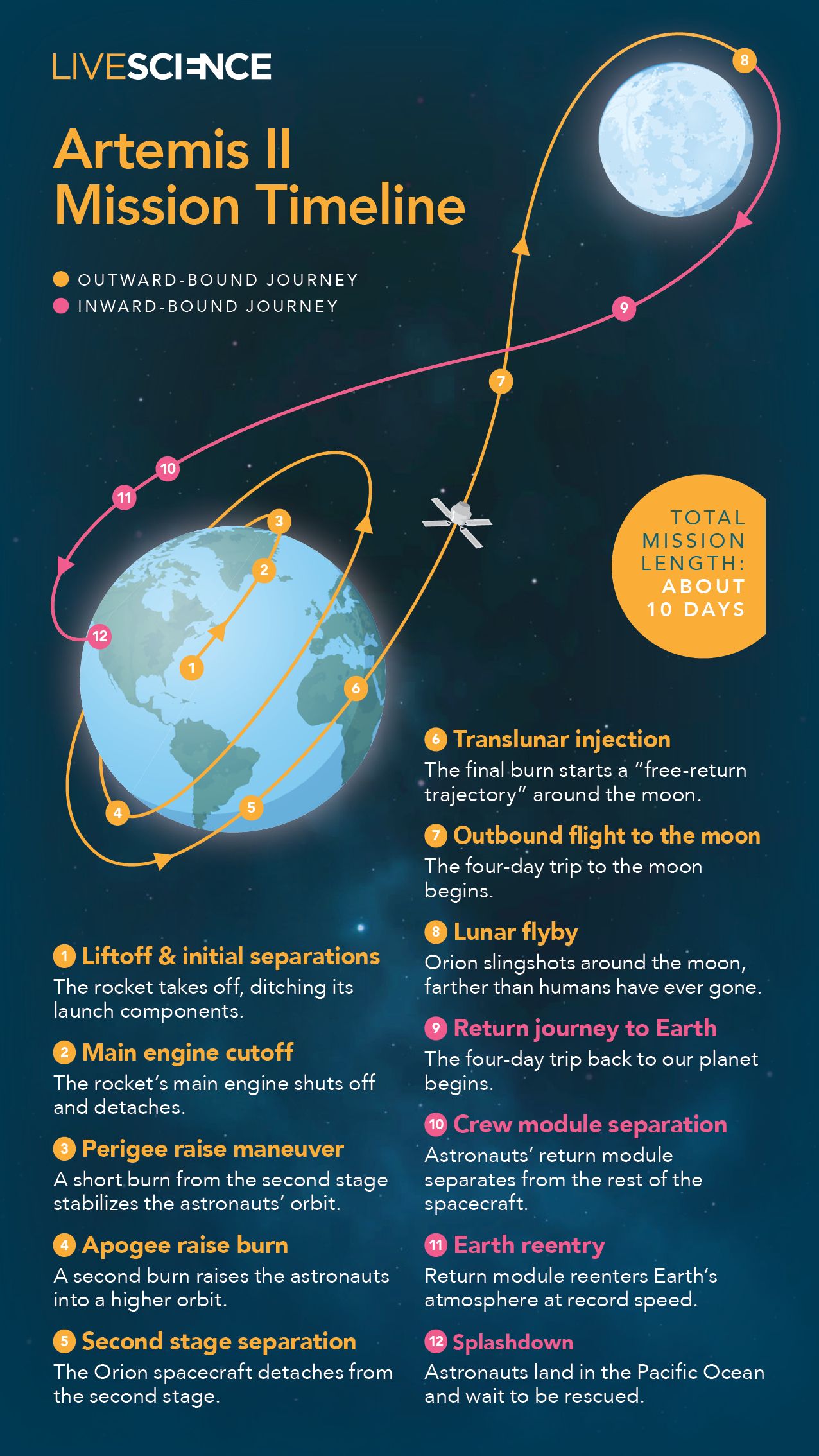
The Artemis II mission timeline is not a cinematic sprint to the Moon but a carefully choreographed 10 day loop designed to prove that crewed deep space logistics are ready for prime time. For a generation that expects instant gratification, the long coast phases, communication handoffs, and heat shield drama are the real tests. The pain point is patience: after years of delays, the most important success metric is boringly nominal. Understanding the exact pacing of Artemis II mission timeline events reveals why the mission matters beyond a flag-and-footprints rerun and how it tees up a sustainable cis-lunar economy.
- Launch to lunar swing-by takes roughly four days, hinging on precise
TLIandLOIburns. - Crew inside
Orionface tight checklists during coasts where boredom and vigilance collide. - Heat shield performance on the 11 km/s reentry is the mission-critical unknown.
- Timeline discipline now influences future lunar logistics, including refueling and assembly.
- The mission sets public expectations for deep space cadence and transparency.
Artemis II mission timeline: From pad to translunar injection
Countdown tension and SLS ignition
Artemis II begins with a long prop load and a series of terminal count holds that test ground systems as much as the rocket. The SLS core stage comes alive at T-6.6 seconds when four RS-25 engines light, followed by booster ignition and a brief roll program that aligns the stack on a high energy trajectory. Unlike shuttle-era flights that pitched downrange immediately, SLS holds a lofted profile to reserve more margin for the upper stage and the heavy Orion capsule.
Earth orbit insertion and systems checkout
Roughly eight minutes after liftoff, the interim cryogenic propulsion stage places the crew into a parking orbit. This lap around Earth is not dead time: flight controllers run an aggressive set of health checks on guidance, environmental controls, and the upgraded flight software that manages navigation when ground stations drop out. The crew’s workload is front-loaded, confirming suit integrity, verifying Orion displays, and preparing for the mission-defining burn ahead.
Translunar injection precision
The TLI burn, lasting about 18 minutes, must be nearly perfect. Even a small underperformance would force midcourse corrections that eat into prop margins and crew sleep. NASA engineers emphasize that the burn is executed with a narrow window to keep the free-return trajectory aligned, ensuring that if later maneuvers fail, gravity pulls the capsule back toward Earth without extra thrust. This elegant fail-safe is a direct lesson from Apollo, now executed with modern flight dynamics and the updated DSN communications plan.
Expert insight: A flawless
TLIis the difference between a demonstration and a detour. The precision here sets credibility for every future cargo and crew stack headed to the Moon.
Living the Artemis II mission timeline: Four days of coasting and choreography
Crew rhythm in deep space
Once outbound, the mission becomes a meditation on routine. With Earth shrinking outside the window, the four person crew cycles through procedure reviews, optical navigation experiments, and suit-off intervals. The risk is not drama but drift: maintaining vigilance as systems hum along. Orion‘s cabin is more spacious than Apollo, yet the schedule is dense enough to prevent complacency, balancing science tasks with health checks to track radiation exposure and psychological stress.
Communication handoffs and DSN coverage
Deep space communication is no longer an afterthought. The DSN allocates high power antennas, but the timeline includes planned handoffs that can briefly reduce bandwidth. Mission control needs those transitions to validate autonomy features. Crew voice loops may feel old school, yet the broader architecture is a testbed for future lunar relay satellites, proving how to keep high fidelity links during simultaneous science downlinks and command uplinks.
Midcourse corrections and contingency logic
Midcourse correction burns are short, but their placement in the schedule is critical. Teams weigh fuel reserves against trajectory fine-tuning, preserving margin for the return leg. Contingency procedures include pre-scripted decision points: if guidance errors exceed thresholds, larger burns trigger and crew sleep shifts. This discipline foreshadows a future where multiple vehicles share cis-lunar space and timing clashes could ripple across missions.
Lunar swing-by and return setup
Why no lunar orbit this time
Unlike later missions, Artemis II will not brake into LOI. The free-return arc swings the crew around the lunar farside, using gravity to pivot back toward Earth. The choice saves propellant, reduces risk, and compresses the mission length to about 10 days. It also allows flight dynamics teams to gather high fidelity data on Orion performance at translunar speeds, feeding models for the more aggressive Artemis III lunar orbit insertion.
Optical navigation and terrain views
As the capsule arcs past the Moon, optical navigation experiments compare camera-based solutions against the primary inertial and star tracker data. Getting this right matters: future cargo tugs and landers will need similar autonomy to rendezvous in shadowed regions where GPS-like signals are nonexistent. The crew’s limited viewing window is secondary to the data returned on how Orion handles lighting extremes and signal delay.
Setting up reentry corridor
After the swing-by, trajectory correction burns refine the reentry angle to avoid both shallow skips and steep heating spikes. The timeline compresses decision making, with mission control assessing weather at potential Pacific recovery zones. Every adjustment is logged to build confidence for later missions that will juggle docking schedules with Gateway or lunar landers.
Reentry, heat shield proof, and splashdown
Atmospheric skip reentry
The return leg culminates in a skip reentry profile, where Orion dips into the atmosphere, lifts back out, then commits to a final descent. This maneuver spreads heating over time and reduces g-loads, but it demands precise timing. The heat shield uses the same material family as Apollo but scaled and manufactured with modern processes. Post flight inspections will be scrutinized for ablation uniformity to validate models for longer lunar stays.
Communications blackout and recovery
A brief blackout during peak heating remains unavoidable. The crew is trained to handle off-nominal attitudes without ground support during this window. Once communications resume, drogue and main chute deployments follow, with recovery teams ready to secure the capsule quickly to prevent saltwater intrusion. The timeline includes instrument safing procedures immediately after splash to preserve data for failure analysis and certification reports.
Why this timeline matters for lunar economics
Certification as currency
Every line item in the Artemis II schedule feeds certification packages for future hardware. Heat shield data influences insurance rates for commercial partners. Verified comms handoffs de-risk private lunar relays. A smooth TLI sets expectations for launch provider performance when missions begin to stack.
Operational cadence and workforce planning
A 10 day loop is short enough to keep public attention yet long enough to validate life support stability. That cadence informs how NASA and industry plan shifts, consumables, and logistics for follow-on missions that will involve docking with Gateway, refueling landers, and staging cargo. The way Artemis II handles crew sleep during coasts will echo in contractor schedules for years.
Setting the bar for transparency
NASA has promised real-time updates, but the timeline contains built-in quiet zones for focused operations. How the agency communicates during those windows will shape public trust heading into more ambitious missions. A transparent mission log that explains each phase of the Artemis II mission timeline can turn routine into reassurance, a crucial asset when budgets and political will fluctuate.
Pro tips for watching the mission
If you are tracking Artemis II in real time, note the high value moments: the TLI ignition, the lunar swing-by timestamp, and the skip reentry start. Those events define mission success. Also, keep an eye on how often NASA references propellant margins and comm handoffs – these are subtle indicators of how much slack the team has preserved.
What comes after Artemis II
From demo to deployment
Assuming nominal performance, Artemis III will extend the timeline with LOI and lunar surface operations, while later flights target Gateway assembly and refueling demos. Each future mission will inherit the pacing lessons from this 10 day loop, refining sleep schedules, burn windows, and recovery logistics.
Commercial and international stakes
International partners will use Artemis II data to calibrate their contributions, from European service module enhancements to Canadian robotic interfaces. Commercial lander teams will leverage trajectory and comms findings to pitch reliable delivery slots. The mission is a keystone that turns lunar exploration from aspiration into a timetable-driven program.
The bottom line: the Artemis II mission timeline is as much about project management as it is about propulsion. Its success will prove that deep space can be run on schedule, a prerequisite for any lasting presence beyond low Earth orbit.
The information provided in this article is for general informational purposes only. While we strive for accuracy, we make no guarantees about the completeness or reliability of the content. Always verify important information through official or multiple sources before making decisions.