Artemis II moon mission finale stakes
Artemis II moon mission finale stakes
The Artemis II moon mission is barreling toward a finale that will define NASA’s credibility on crewed deep space flight: one looping shot around the moon, no landing, and a safe splashdown that proves the hardware stack is ready for the harder steps ahead. Investors, policymakers, and rivals are watching because this flight isn’t just a victory lap after Artemis I; it’s the stress test that could lock in budgets, timelines, and public patience before the agency commits to building a permanent lunar economy. For a program born in a post-shuttle era of tight scrutiny, success or failure here will ripple across launch contracts, international partnerships, and the viability of using cislunar space as the next industrial zone.
- Artemis II is the first crewed loop of the moon since Apollo, validating
Orionlife-support and SLS performance. - The mission’s finale will prove whether NASA can pivot from demo flights to a sustainable lunar cadence.
- Schedule slips, valve fixes, and heat shield concerns shadow the timeline and budget discipline.
- Commercial partners and allies hinge their own moonshot plans on Artemis II data.
- Success unlocks leverage for lunar infrastructure and Mars-prep funding.
Why the Artemis II moon mission matters now
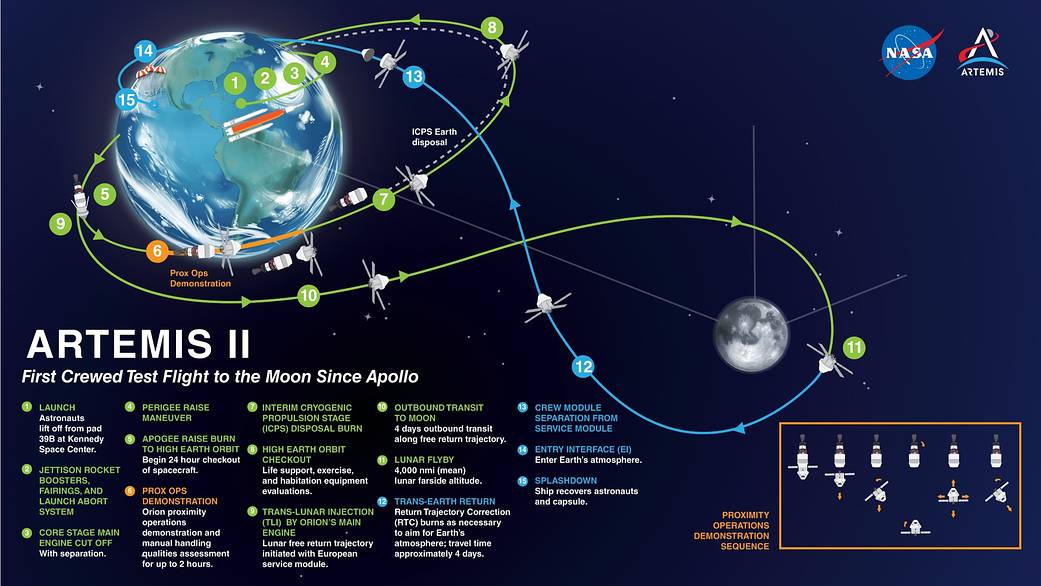
NASA’s playbook is simple but unforgiving: fly four astronauts inside Orion atop the Space Launch System, push into a free-return trajectory around the moon, and then nail atmospheric re-entry. This finale is the bridge between Apollo nostalgia and a durable supply chain that can repeat cislunar logistics on schedule. The stakes are amplified because Artemis II is the first test of ECLSS life-support in deep space, a domain where ground abort options disappear. Every subsystem – from RCS thrusters to the heat shield ablative material – must perform without the crutch of nearby rescue.
Politically, the mission lands in a window where congressional funding is brittle. A clean, on-time flight arms NASA with proof that its moon program is more than a jobs plan; it is a geopolitical signal to competitors in China and a reassurance to partners in Europe and Canada that their contributions will see the lunar surface soon.
What success unlocks
Success would greenlight assembly milestones for Gateway, the planned lunar space station, and accelerate lander readiness for Artemis III. It would also validate heat shield redesigns and set data baselines for radiation exposure, informing how quickly NASA can iterate on crewed Mars transit studies. The finale’s telemetry will feed contract clauses for commercial cargo runs and potentially expand the vendor list beyond incumbent primes.
What failure risks
A scrub or in-flight anomaly would ripple into budget revisions and invite calls to pivot toward cheaper commercial heavy-lift options. Any issue with the Orion heat shield – which already showed uneven ablation after Artemis I – could force a redesign pause that cascades through multiple fiscal years. A bad outcome also risks ceding narrative ground to China’s Chang'e program, which aims for its own crewed lunar attempts later this decade.
Inside the finale: timeline and test points
The flight plan centers on a hybrid free-return loop, minimizing propellant while maximizing test windows. After launch, Orion will perform translunar injection, then the crew will validate life-support cycling, comms latency, and cabin autonomy. Near the moon, cameras will capture Earthrise moments that double as optical nav tests. On the return leg, the vehicle will orient for a high-energy re-entry, where the heat shield must shed megajoules without shedding too much material.
Launch and ascent constraints
SLS Block 1 must demonstrate repeatable performance after its debut. Engineers will watch for any oscillations in the solid rocket boosters and verify that Core Stage engines throttle smoothly through max-Q. The upper stage’s ICPS burn sets the course; any underperformance could force contingency maneuvers that eat into margins.
Deep-space life-support validation
The ECLSS is the marquee system on Artemis II. NASA will cycle CO2 scrubbers, humidity control, and thermal regulation in true deep space conditions for the first time. Data here drives crew day-length planning for later missions. If any anomalies appear, they must be resolved while hundreds of thousands of miles from Earth – a core rehearsal for Mars mission autonomy.
Re-entry and splashdown
The finale’s climax is a skip re-entry, where Orion dips into the atmosphere, skips back to reduce G-load, then plunges to a Pacific splashdown. Heat shield char layer behavior will be scrutinized against the patchy performance observed on Artemis I. Recovery teams must also prove fast capsule retrieval to keep timelines tight for refurb and data extraction.
Technical pressure points on the Artemis II moon mission
Multiple hardware fixes frame the lead-up. Valve issues identified in ground tests have been corrected with redundant seals and updated torque specs. Software loads were revalidated to reduce false sensor trips during ascent. NASA also replaced batteries in the Orion crew module adapter and refined Launch Abort System checks after intermittent data noise. Each tweak compresses schedule slack, raising scrutiny on integration timelines.
Heat shield watchlist
Engineers are adding extra instrumentation near the aft shell to map how the Avcoat ablative material erodes. If patchy burn-through reappears, future missions could face heavier tiles or even architecture changes. That makes this finale not just a safety gate but a design fork.
Communications and autonomy
Artemis II will lean on Deep Space Network assets already strained by Mars traffic. NASA is testing adaptive routing to prevent dropouts. The crew will also run autonomy drills where the capsule simulates comms loss, pushing the onboard flight software to handle attitude and power without ground input – a prerequisite for long-duration Mars-class missions.
Why this finale shapes the lunar economy
Beyond national pride, Artemis II’s outcome influences how quickly private industry invests in lunar telecom, surface power, and in-situ resource demos. A reliable cadence from NASA signals stable demand for payload slots and services, de-risking venture bets on lunar broadband relays or regolith processing skids. If the finale slips again, capital could drift toward nearer-term low Earth orbit plays.
Allied confidence and standards
European and Canadian hardware aboard the mission sets precedent for interoperability standards. Clean data from Artemis II could solidify joint avionics specs and docking norms, making it easier for future international vehicles to plug into Gateway. Conversely, delays might trigger partners to hedge with their own systems, fragmenting the ecosystem.
Commercial leverage
NASA plans to use Artemis II telemetry to refine service-level agreements with commercial lander providers. Parameters like thermal limits and comms windows will flow into payload interface documents, giving companies clearer guardrails. That transparency accelerates design cycles and reduces integration risk for upcoming missions.
Pro tips: how to evaluate the Artemis II moon mission finale
- Track scrub reasons: weather is routine; hardware-induced scrubs signal deeper risk.
- Watch
ECLSSdata: clean cycles mean lower rework for Artemis III. - Heat shield imagery matters: look for uniform charring, not patchy craters.
- Recovery speed: under three hours from splash to ship deck shows readiness for rapid cadence.
- Telemetry transparency: fast data release indicates confidence and supports partner planning.
These signals provide a quick read on whether Artemis II is a one-off stunt or the start of a reliable logistics chain.
Future implications if Artemis II nails the finale
A flawless flight compresses the gap to Artemis III and strengthens NASA’s case to fund Artemis IV with a beefier SLS Block 1B. It also arms the agency with leverage to demand higher reliability from commercial landers and cargo providers. With validated deep-space life-support, NASA can push human factors research for Mars, tailoring habitat cycles based on Artemis II data.
In geopolitics, success sets a tempo that may outpace China’s crewed lunar ambitions, potentially locking in norms on resource rights and orbital slots. It also gives the U.S. a stronger hand to negotiate spectrum and tracking allocations critical to a crowded cislunar environment.
What to watch if schedules slip
If Artemis II drifts into late windows, expect pressure to shift payloads or alter mission scope to preserve budgets. Software workarounds might appear to offset hardware delays, but each patch must clear rigorous verification. The biggest risk is erosion of political capital; every month of delay invites fiscal hawks to question cost per launch versus emerging commercial heavy-lift competitors.
Could commercial lift replace SLS?
If schedule or cost overruns persist, the conversation will tilt toward flying Orion or future crew vehicles on commercial super heavy rockets. That scenario is complex – human-rating new stacks is non-trivial – but Artemis II’s performance data will inform whether such a pivot is feasible before mid-decade.
Bottom line
The Artemis II moon mission finale is not just a trip around our satellite; it is a referendum on NASA’s ability to execute a sustainable deep space campaign. Every subsystem, from ICPS ignition to the final splashdown, feeds the legitimacy of a lunar economy and the political will to fund it. If the agency sticks the landing – figuratively and literally – it secures a runway for the next decade of cislunar industry. If not, expect a scramble of plans, partners, and platforms that could push a return to the moon further into the future than any of its champions want to admit.
The information provided in this article is for general informational purposes only. While we strive for accuracy, we make no guarantees about the completeness or reliability of the content. Always verify important information through official or multiple sources before making decisions.