Europe’s AI Rules Get Real
Europe’s AI Rules Get Real
Europe’s AI Act is no longer a policy talking point. It is becoming a product requirement, a legal risk, and a competitive filter all at once. For startups, enterprise software vendors, and platform giants alike, the shift is brutal: build for Europe now, or pay for it later. The uncomfortable truth is that AI teams can no longer treat compliance as an afterthought buried in a legal review. The rules are shaping what gets launched, how models are trained, which data can be used, and how much transparency customers will demand. That is a direct hit to the way modern AI companies ship products. And if the early scramble around privacy laws taught the industry anything, it is that regulators move slower than markets – until they suddenly do not.
- Europe’s
AI Actis pushing compliance from the legal team into the product roadmap. - High-risk AI systems will face heavier documentation, transparency, and governance demands.
- Companies that ignore the rules risk delays, fines, and limited market access.
- Strategic teams should audit models, data sources, and deployment workflows now.
- The winners will be the firms that treat compliance as a trust advantage, not a tax.
Why the AI Act changes the game
For years, AI policy lived in the same category as future tense – important, heavily debated, and easy to postpone. That era is ending. The AI Act forces a more concrete question: can your system prove it is safe, explainable, and governed well enough to operate in one of the world’s most valuable markets? That matters because Europe is not a side market. It is a revenue engine for cloud platforms, consumer apps, enterprise tools, and foundation model providers. If a product cannot meet EU requirements, the cost is not just legal exposure. It can mean re-engineering core workflows, slowing launches, or limiting features for an entire region.
That pressure lands hardest on companies building generative AI systems, automated decision tools, and anything that influences hiring, credit, education, health, or public services. In other words: the products that matter most.
Compliance is no longer a back-office function. In AI, it is becoming a product capability.
What companies actually need to do
The smartest response is not panic. It is architecture. Teams should map where AI appears in the stack, what data it touches, and who is accountable when it makes a mistake. That starts with a practical inventory of models, vendors, and use cases. If a system is low-risk, the burden may be manageable. If it is high-risk, the obligations climb quickly.
For many teams, the first step is a blunt audit of current deployment practices. Who can change the model? What logs are kept? Are outputs reviewed by humans? Can the company trace the training data? These are no longer abstract governance questions. They are operational requirements.
Build a compliance inventory
A solid inventory should include:
- Model purpose: What does the system do, and where is it used?
- Data lineage: Where did training and fine-tuning data come from?
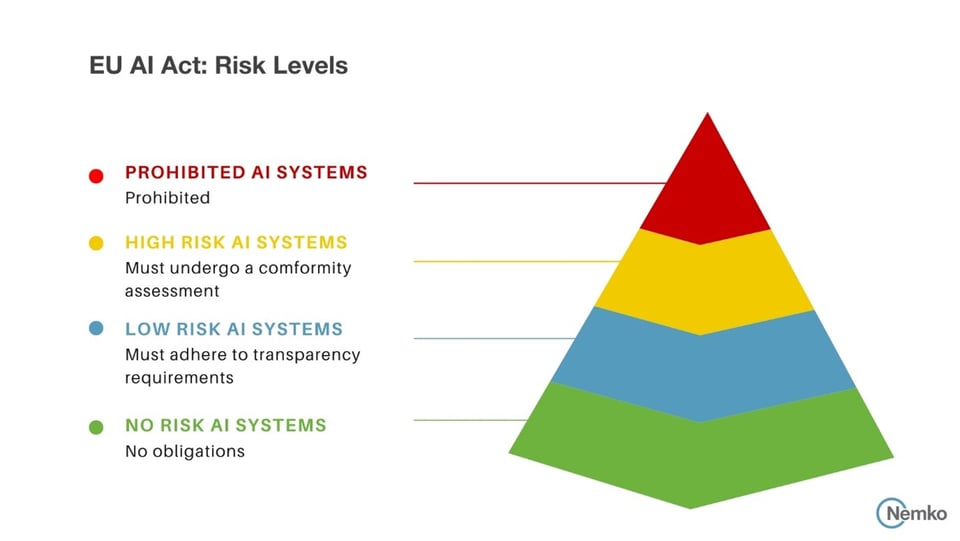
- Risk classification: Is the use case low-risk, limited-risk, or high-risk?
- Human oversight: Who reviews outputs and can override the system?
- Vendor exposure: Which third-party models or APIs are embedded in the product?
This sounds tedious because it is. But compliance failures usually come from the boring stuff: missing documentation, inconsistent logging, vague accountability. The companies that win will treat those details as product infrastructure, not legal cleanup.
Document the model lifecycle
The lifecycle matters from training to deployment to updates. If a model changes after launch, the record should show what changed, why it changed, and who approved it. That is especially important for systems that continuously learn or receive periodic fine-tuning. Without traceability, any claim of responsible AI looks cosmetic.
Pro tip: if your team cannot explain a model’s decision path to a non-technical reviewer, your documentation is probably not ready for a regulator, a procurement team, or a nervous enterprise customer.
Why this matters beyond Europe
The European approach often becomes the de facto global standard by accident, then by market pressure. That has happened with privacy, app store policy, and product security. AI is likely to follow a similar path. A company that builds to satisfy Europe may find it easier to win enterprise contracts elsewhere, especially with buyers who are nervous about hallucinations, bias, and IP risk.
There is also a strategic angle. Regulation can create a moat. Big incumbents have the legal staff, compliance processes, and engineering bandwidth to adapt quickly. Smaller companies often do not. That could slow some startups down. But it could also reward the ones that design responsibly from the start. If you are building a serious AI business, trust is not a marketing word. It is a sales advantage.
For enterprise buyers, regulated AI is increasingly easier to buy than wild-west AI.
The hidden product costs of compliance
Many founders still assume regulation only adds paperwork. That is too simplistic. Compliance influences product architecture, cloud costs, release speed, and even model choice. Systems that require stronger audit trails may need additional storage, monitoring, and human review layers. Teams may have to use smaller models in some contexts because they are easier to control or explain. Others may need to strip out features entirely in certain markets.
That has real business consequences. A feature that looks elegant in a demo can become expensive once every output needs logging, risk review, and escalation paths. A model that performs beautifully in benchmarks may be unsuitable if it cannot produce the documentation a customer or regulator wants. This is where AI strategy becomes a discipline of tradeoffs, not just performance.
Expect product teams to move slower
That does not mean innovation stops. It means release cycles become more deliberate. Teams will need governance gates, approval workflows, and red-flag testing before launch. The best organizations will build these checks into CI/CD pipelines instead of bolting them on afterward.
Here is a simple way to think about it:
- Design the feature.
- Assess its risk level.
- Map the data and model dependencies.
- Define human oversight.
- Document the controls.
- Launch with monitoring in place.
If that sounds like a burden, it is. But it is also how AI matures from experimentation to infrastructure.
How teams should prepare now
The most effective companies will act before enforcement becomes painful. They will train product managers, engineers, and legal teams to speak the same language. They will standardize documentation. They will test how systems behave under edge cases, not just happy paths. And they will assume customers increasingly care about whether a model is lawful, not just whether it is clever.
Start with three practical moves:
- Run a model audit: identify every AI feature, vendor, and data source in production.
- Create a governance owner: assign one accountable person or team per system.
- Build evidence by default: logs, decision records, and approval trails should be automatic, not manual.
These are not glamorous steps. They are survival steps. The companies that delay will spend more later, either in remediation or in lost market opportunity.
Use compliance as a design constraint
Good constraints make better products. That is true in engineering and it is true in regulation. A team that knows its system must be explainable will often build cleaner interfaces and more robust controls. A team that expects scrutiny will usually document better assumptions. The end result can be a more reliable product, which is exactly what customers say they want from AI anyway.
One practical code-level habit: keep governance metadata attached to every release artifact, such as model_version, data_snapshot, approval_owner, and risk_level. If that metadata lives in scattered docs, it will not survive pressure.
The bigger strategic bet
Europe’s AI rules are not just about avoiding punishment. They are about deciding what kind of AI economy gets built next. One path leads to faster shipping at all costs, with consumers and enterprises absorbing the risk. The other path demands slower release cycles, clearer accountability, and stronger user protections. For now, Europe is betting on the second model.
That bet will frustrate some innovators. It will also create an advantage for teams that can turn compliance into credibility. In a market flooded with noisy AI claims, credibility is becoming scarce. And scarcity, in tech as in everything else, is where durable value tends to form.
The takeaway is simple: if your AI roadmap still treats regulation as a future problem, you are already behind. The companies that adapt now will not just survive the AI Act. They will use it to outlast competitors who confuse speed with strategy.
The information provided in this article is for general informational purposes only. While we strive for accuracy, we make no guarantees about the completeness or reliability of the content. Always verify important information through official or multiple sources before making decisions.