Florida Redistricting Reshapes House Power
Florida Redistricting Reshapes House Power
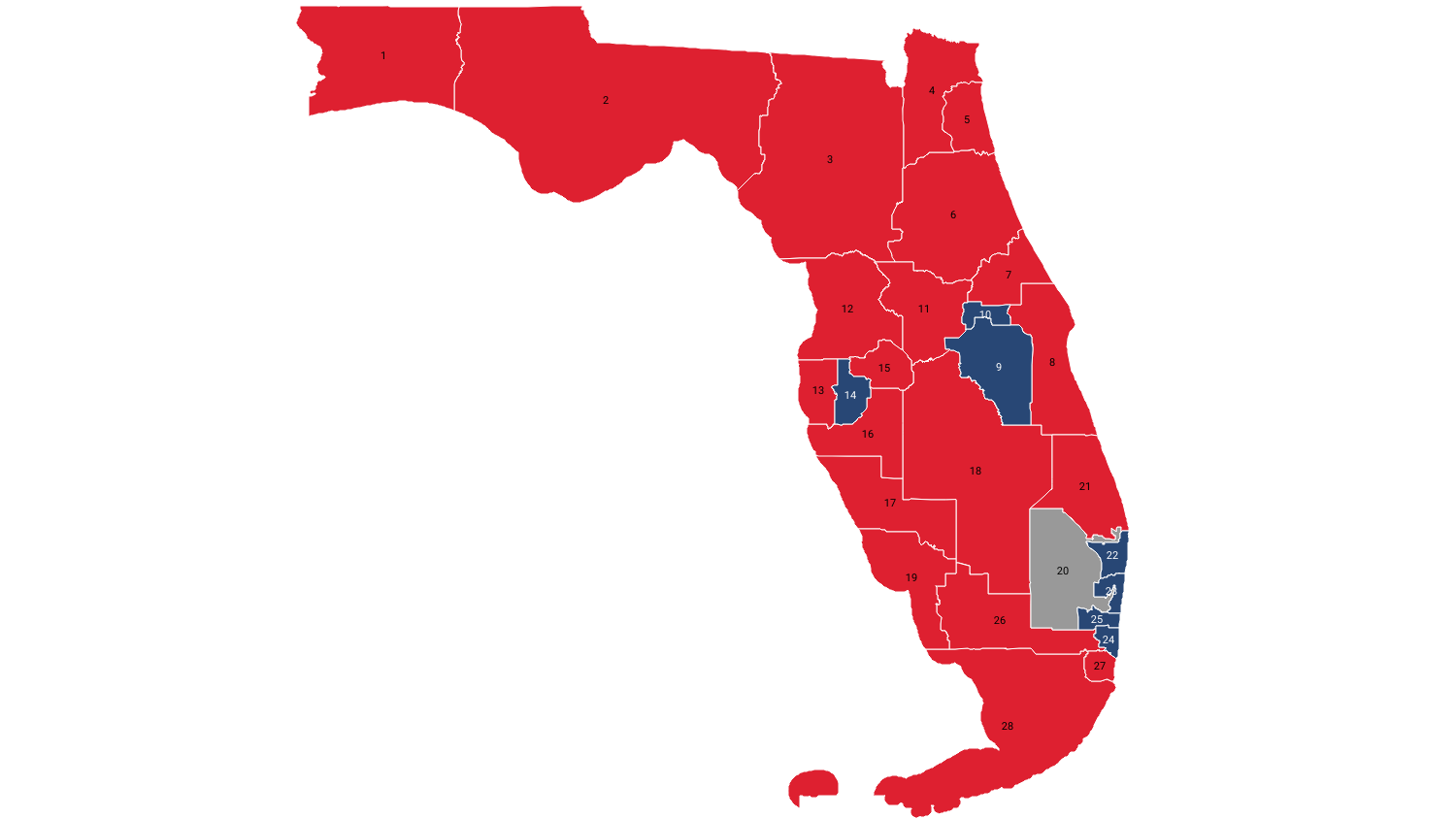
Florida redistricting is no longer a procedural fight buried in legislative process. It is a live-power struggle with national consequences, and the stakes are brutally simple: who gets represented, which communities lose leverage, and how many U.S. House seats Republicans can lock down before the next major election cycle. Florida already sits at the center of the country’s demographic and ideological realignment. Now its district lines are becoming a weapon in a broader contest over control of Congress. For voters, watchdogs, and party strategists, this is the kind of map fight that does not stay local for long. When a state as large and fast-growing as Florida redraws the battlefield, it can shift campaign spending, candidate recruitment, turnout strategy, and even which issues dominate Washington.
- Florida redistricting could materially strengthen the GOP’s House position in a closely divided national map.
- Map changes are about more than geometry: they can dilute communities, reorder turnout, and reshape candidate strategy.
- Legal and political scrutiny will likely focus on voting rights, representation, and partisan intent.
- What happens in Florida could influence redistricting tactics in other high-stakes states.
Why Florida redistricting matters beyond Florida
Redistricting always sounds technical until the consequences become impossible to ignore. Congressional maps determine which voters are grouped together, which neighborhoods are split apart, and how easy or hard it becomes for one party to convert votes into seats. In a narrowly divided House, even a small adjustment in a state with Florida’s size can ripple across the entire national political system.
That is why Florida redistricting draws so much attention from both election lawyers and campaign operatives. Florida is not just another state on the map. It is a population giant, a media-cost monster, and a trendsetter for Sun Belt politics. If Republicans can engineer additional durable advantages there, the impact can outlast a single election cycle.
The core question is not whether maps are political. They always are. The real question is how aggressively a state can convert political power into structural advantage before courts, voters, or demographic reality push back.
That tension sits at the center of the current fight. On one side is the blunt logic of partisan hardball: if a party controls the levers of state government, it uses them. On the other side is the democratic concern that maps can hollow out representation by fragmenting communities and weakening minority voting power.
The mechanics behind the map fight
At a technical level, redistricting follows familiar rules. Districts must satisfy population requirements and comply with constitutional and statutory standards. But within those boundaries lies an enormous amount of discretion. That discretion is where politics thrives.
How line-drawing changes outcomes
A district map can be redrawn to create safer seats, more competitive seats, or seats that appear balanced on paper while favoring one party in practice. The tools are familiar even if the language sounds clinical:
- Packing: concentrating opposition voters into fewer districts.
- Cracking: splitting cohesive communities across multiple districts to weaken their influence.
- Incumbent protection: designing boundaries that shield current officeholders.
- Partisan optimization: using voting history and demographic modeling to maximize seat yield.
Modern campaigns do not look at maps with a paper-atlas mindset. They use voter files, turnout models, and precinct-level performance data. In practical terms, a map is not just a shape. It is a forecast engine. With enough data, line-drawers can estimate how a district is likely to behave under different turnout scenarios, candidate qualities, and national environments.
That is what makes current redistricting battles so potent. They are not merely ideological. They are computational.
What Florida’s political geography makes possible
Florida is especially susceptible to aggressive map engineering because its political geography is complex. It combines dense urban Democratic clusters, sprawling Republican-friendly exurbs, fast-changing suburbs, and heavily polarized regional patterns. That mix creates opportunities to redraw districts in ways that look superficially tidy while still producing meaningful partisan gains.
For Republicans, the strategic appeal is obvious. If the map can turn marginal territory into more reliable seats, it reduces risk in future midterms. If it can force Democrats to spend heavily defending less favorable terrain, it also drains resources from other states. Redistricting is not just about seat count. It is about making the opposition fight on worse terms.
Who gains and who loses
The political headline is straightforward: Republicans stand to benefit if the revised map creates additional favorable House districts. But the deeper story is about who loses representation in the process.
Communities of color are often at the center of these fights because changes to district lines can alter whether voters have a realistic chance to elect candidates who reflect their interests. Even when a map complies with narrow legal requirements, it can still trigger fierce criticism if it weakens existing coalitions or fragments historically connected communities.
Maps can preserve power without ever saying so out loud. That is why critics focus not only on the text of a plan, but on the communities it disassembles.
That is also why legal battles around redistricting can become so intense. The arguments rarely stop at partisan fairness. They move into questions of racial representation, equal protection, and whether the state has undermined the practical ability of certain groups to influence elections.
Why this matters for the House majority
The House is often decided at the margins. A handful of seats can determine committee control, the legislative agenda, and whether a president gets confrontation or cooperation from Congress. Florida’s map matters because it can provide a structural cushion in that contest.
If Republicans add or secure seats through redistricting, they do not need to win every swing district elsewhere. That matters enormously in volatile national climates where inflation, immigration, reproductive rights, disaster response, and economic confidence can all reshape turnout.
Think of it as political margin engineering. A favorable map gives a party more room for candidate mistakes, scandal, fundraising gaps, or adverse national news cycles. That is the value proposition. You are not simply trying to win once. You are trying to build a sturdier path to repeated wins.
The downstream effects campaigns will feel
- Candidate recruitment becomes easier in districts designed to favor one party.
- Donors can redirect money from safe seats to a smaller number of true battlegrounds.
- Issue messaging changes when campaigns know they are speaking to different voter coalitions.
- Turnout operations become more targeted because district composition shapes persuasion strategy.
That means Florida redistricting is not just a story about lawmakers and judges. It is also a story about ad buyers, pollsters, field organizers, and national party committees recalibrating around a new map.
The legal pressure points to watch
Every major redistricting clash eventually runs into the law. The practical question is whether challengers can show that a map violates protections tied to representation or constitutional standards. The political question is whether litigation arrives quickly enough to matter before an election is already underway.
Several issues usually dominate this phase:
Minority representation
Challenges may argue that a map weakens the voting strength of Black or Hispanic communities by dismantling districts where those voters could effectively influence outcomes.
Partisan intent
Even when partisan gerrymandering claims face steep hurdles, evidence of intentional power-maximizing behavior can still shape public debate and judicial scrutiny.
Process and transparency
If a map appears rushed, opaque, or heavily controlled by partisan leadership, critics can use that process narrative to strengthen broader objections.
Pro Tip: In redistricting disputes, process matters nearly as much as boundaries. Courts and the public often read the legitimacy of a map through how it was produced, not just what it looks like after the fact.
A strategic guide to reading what happens next
Map fights generate a flood of spin, and much of it is designed to overwhelm casual observers. The easiest way to cut through the noise is to track a few concrete signals.
Watch the district math, not just the rhetoric
Ignore slogans about fairness for a moment and ask simpler questions: How many districts become safer for Republicans? How many become less competitive for Democrats? Which communities are split apart? If the seat math moves meaningfully in one direction, the strategic objective is clear.
Look at the suburbs
Suburban districts often decide whether a map merely protects current power or expands it. In Florida, suburban growth and migration patterns can make these areas especially valuable in line-drawing.
Track litigation timelines like campaign timelines
A weak legal challenge filed too late may have less practical effect than a strong challenge filed early. Elections run on deadlines, and maps often survive long enough to shape at least one cycle even under serious dispute.
Read the map as a national signal
If Florida succeeds in extracting more House advantage through redistricting, expect other states to study the playbook. Parties copy wins. They especially copy wins that convert governance power into congressional insulation.
For policy teams and political analysts, this is the shorthand:
Map control -> seat durability -> fundraising confidence -> national agenda leverage
That chain explains why the conflict feels bigger than one state legislature.
What voters should understand right now
Redistricting debates often get framed as insider baseball, but voters are not bystanders. The map influences whose calls get returned, which local priorities get elevated, and whether elected officials feel real electoral pressure. A safer district can make a representative more ideologically rigid. A more competitive district can force broader coalition-building. Boundaries shape behavior.
There is also a trust issue. When voters believe outcomes are heavily engineered before ballots are cast, faith in the system erodes. That cynicism can become self-reinforcing, depressing participation and making political systems feel less responsive. In that sense, redistricting is not just a legal or strategic fight. It is a legitimacy fight.
Democracy does not only depend on voting. It depends on voters believing their districts were not designed to make their votes matter less.
The bigger picture for American politics
Florida’s redistricting battle is a concentrated version of a national reality: parties increasingly pursue structural advantage wherever they can find it. Courts, state constitutions, and public backlash can limit that impulse, but they rarely eliminate it. The result is a system where electoral competition is shaped not only by persuasion, turnout, and policy, but by the architecture of the map itself.
That makes this fight worth watching even for readers outside Florida. The state’s sheer size means map changes can alter the congressional landscape. Its political profile means both parties will treat it as a proving ground. And its legal battles can become templates for future challenges elsewhere.
The immediate outcome may be measured in House seats. The longer-term consequence is measured in precedent. If Florida demonstrates how to harden partisan advantage through redistricting with limited political cost, that lesson will travel fast.
And that is the real story here. Not just a map. A method.
The information provided in this article is for general informational purposes only. While we strive for accuracy, we make no guarantees about the completeness or reliability of the content. Always verify important information through official or multiple sources before making decisions.