G7 Pushes AI Sovereignty Into the Spotlight

The fight over AI is no longer just about model performance, startup valuations, or who can ship the slickest chatbot. It is now about power. At the G7 level, the conversation has shifted toward AI sovereignty, a phrase that sounds abstract until you realize what is at stake: who controls the compute, the data, the models, and the policy levers that increasingly shape modern economies. For governments, the pain point is obvious. Depend too heavily on a handful of foreign tech giants and you risk losing leverage over critical infrastructure. For businesses, the shift could mean new compliance burdens, procurement rules, and a more fragmented global AI market. The result is a very different race than the one Silicon Valley imagined. This is not just about smarter software. It is about whether nations can build AI systems on their own terms.
- G7 leaders are elevating
AI sovereigntyfrom buzzword to policy agenda. - The core issue is control over compute, data, infrastructure, and governance.
- Companies may face tighter rules as governments push for domestic AI capability.
- The debate could reshape global supply chains and the future of tech competition.
Why AI sovereignty suddenly matters
AI sovereignty is not a slogan for conference panels. It is the practical response to a hard reality: the most powerful AI systems are increasingly concentrated in the hands of a small set of companies, mostly based in the U.S. and China. That concentration creates dependency. It also creates vulnerability. If governments, hospitals, defense agencies, and major industries rely on external providers for foundational AI, they are effectively outsourcing part of their future digital infrastructure.
The G7’s attention to this issue signals that leaders are no longer comfortable treating AI as a purely commercial technology. They see it as strategic infrastructure, similar to energy, semiconductors, and cloud computing. That matters because strategic infrastructure always attracts policy. Once lawmakers decide a technology is too important to leave entirely to the market, the rules change fast.
Expert insight: The real shift is not that governments want to kill innovation. They want leverage.
AI sovereigntyis about avoiding a future where the most consequential digital systems are effectively rented from abroad.
What G7 leaders are really trying to solve
On the surface, the conversation is about sovereignty. Underneath, it is about dependency, resilience, and industrial strategy. The G7 has three overlapping concerns.
1. Control over critical infrastructure
AI systems are rapidly entering sectors where downtime or policy misalignment can have real consequences. Think public services, financial systems, healthcare workflows, and national security operations. If those systems depend on APIs and models controlled elsewhere, sovereign governments lose a degree of operational autonomy.
2. Data governance and local laws
Data is the fuel of AI, but it is also where regulatory conflict starts. Countries want assurance that sensitive public and private data are handled according to local standards. That includes privacy, retention, access, and cross-border transfer rules. Without those guarantees, AI adoption can slow dramatically in regulated industries.
3. Economic competitiveness
The G7 nations are also trying to avoid a future where domestic firms become mere downstream consumers of AI built elsewhere. If the most valuable layers of the stack – chips, cloud, models, and deployment tools – are controlled externally, local ecosystems risk getting squeezed into low-margin integration work. That is not a healthy long-term position for advanced economies.
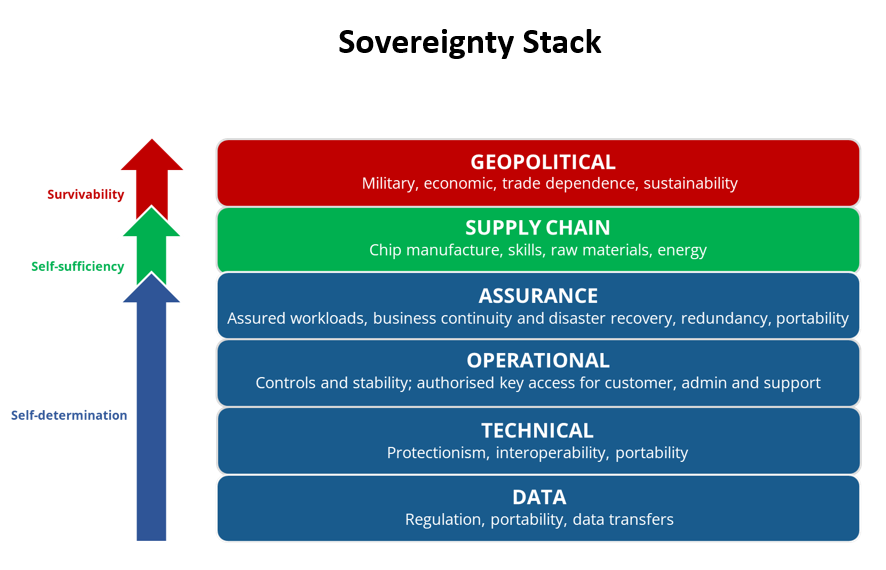
The AI sovereignty stack is bigger than models
A common mistake in this debate is to think sovereignty means building a homegrown chatbot and calling it a day. That is too narrow. Real AI sovereignty spans the entire stack.
- Compute: Access to high-end GPUs, data centers, and energy capacity.
- Cloud: Reliable hosting and orchestration for training and inference.
- Models: Foundation models that can be adapted to local needs.
- Data: Trusted pipelines, governance, and consent frameworks.
- Talent: Researchers, engineers, and public sector AI specialists.
- Policy: Procurement standards, safety rules, and cross-border coordination.
This is why sovereignty is expensive. You cannot simply decree independence from the podium and expect the infrastructure to appear. You need capital, talent, procurement discipline, and long-term political commitment. That is hard in democracies, especially when election cycles are shorter than the buildout timeline for serious AI capacity.
Why this matters for tech companies
For tech executives, the G7’s posture should be read as a warning and an opportunity. The warning is obvious: governments are getting more serious about oversight, localization, and procurement preferences. The opportunity is equally real: companies that can offer secure, compliant, and locally adaptable AI stacks may find new demand from public sector buyers and regulated industries.
This could reshape enterprise sales strategy. Vendors will need to answer questions that were once secondary: Where is the model hosted? Which data is used for training? Can outputs be audited? Can the system be deployed in a sovereign cloud or on-prem environment? If the answer to those questions is fuzzy, procurement teams may walk away.
Pro tip: If you are building AI products for government or enterprise customers, treat sovereignty as a product requirement, not a policy afterthought. Architecture decisions made today will determine whether you can sell tomorrow.
The geopolitical angle is impossible to ignore
The push for AI sovereignty is also a response to the broader geopolitical climate. Nations are increasingly treating technological dependency as a national security issue. That is especially true in a world of export controls, supply chain shocks, and rising tensions around digital infrastructure.
AI sits at the intersection of several strategic domains. It depends on advanced chips, massive energy consumption, cloud infrastructure, and large-scale data access. Each of those layers can be constrained, politicized, or weaponized. As a result, even allies are starting to think more carefully about tech independence. The G7 is not rejecting global collaboration, but it is acknowledging that collaboration without resilience is a risky bargain.
The likely outcome is not full decoupling. That would be impractical and economically damaging. Instead, expect a more selective model: shared standards where possible, national capacity where necessary, and tighter scrutiny over the most sensitive uses of AI.
What to watch next in AI sovereignty
The most important question now is whether the G7 can turn rhetoric into infrastructure. Policy language is easy. Building durable capability is not. Here are the pressure points to watch.
Public procurement rules
Governments can move markets quickly by choosing which vendors they buy from. If public agencies start requiring local hosting, auditability, or sovereignty-friendly deployments, the private sector will follow the money.
Domestic compute investments
Building national AI capacity requires access to compute at scale. That means data centers, power, and chip supply. Countries that invest here will have more leverage when setting AI policy.
Standards and interoperability
If every country creates completely different AI rules, the market fragments fast. The smarter approach is to align on core safety and governance principles while still allowing local control over sensitive data and critical systems.
Partnerships with industry
Governments cannot do this alone. They need cloud providers, chipmakers, universities, and startups to participate. The winners will be the ecosystems that can balance openness with control.
The real trade-off is speed versus control
Every sovereignty push comes with a trade-off. More control can mean more resilience, but it can also slow adoption. That is the tension at the center of the G7 debate. Companies want fast product iteration. Governments want guardrails. Citizens want both innovation and protection.
The challenge is finding a model that does not suffocate experimentation. Overly rigid rules could push innovators to friendlier jurisdictions. Too little regulation, on the other hand, leaves countries exposed to external dependencies and poor oversight. The sweet spot is likely a layered governance approach: strict controls for sensitive use cases, lighter-touch frameworks for lower-risk deployments, and aggressive investment in local capability.
That is a tall order, but it is the only plausible path. AI is becoming too embedded in everyday systems to leave unmanaged, yet too dynamic to lock down completely.
What this means for the next phase of AI policy
The G7’s embrace of AI sovereignty suggests the next phase of AI policy will be less about abstract ethical principles and more about power mapping. Who owns the stack? Who can inspect it? Who can shut it off? Who can modify it? Those are the questions that matter when AI stops being a novelty and starts becoming infrastructure.
Expect more countries to follow this lead. Some will do it to protect industry. Others will do it to reduce dependence on foreign vendors. Many will do it because they have no choice. The AI economy is consolidating quickly, and consolidation tends to provoke political backlash. Once that happens, sovereignty becomes the language governments use to claw back agency.
The bottom line is simple: the AI race is no longer only about who builds the best model. It is about who controls the conditions under which models are built, deployed, and governed. That is a much bigger contest – and it is just getting started.
The information provided in this article is for general informational purposes only. While we strive for accuracy, we make no guarantees about the completeness or reliability of the content. Always verify important information through official or multiple sources before making decisions.