Huawei Tests China Tech Resilience
Huawei Tests China Tech Resilience
The Huawei comeback story is no longer just about one company clawing its way back into relevance. It has become a referendum on whether China can build a self-sustaining tech stack under pressure: chips, software, supply chains, and consumer hardware that can survive export controls and still compete. That is why every new Huawei launch now lands like more than a gadget announcement. It signals how far domestic semiconductor and device ecosystems have progressed, and where the cracks still are.
For consumers, investors, and rivals, the stakes are obvious. If Huawei can keep shipping compelling products despite sanctions, the balance of power in technology shifts. If it cannot, then the limits of industrial policy and national ambition become much clearer. Either way, the Huawei comeback is now one of the most important tests in modern tech.
- Huawei is no longer just a smartphone brand story: it is a barometer for China’s broader technology independence.
- Its latest progress matters because it touches
chips,operating systems, supply chains, and consumer trust at the same time. - US restrictions were designed to slow Huawei, but they may have accelerated domestic substitution inside China.
- The big question is not whether Huawei can launch products – it is whether it can scale innovation sustainably.
Why the Huawei comeback matters far beyond Huawei
The central issue is not simply market share. It is strategic capacity. Huawei sits at the intersection of telecommunications, smartphones, enterprise infrastructure, cloud systems, and advanced hardware. When a company with that footprint regains momentum, it sends a message to the rest of the industry: sanctions can constrain access, but they do not automatically kill demand, engineering talent, or national support.
That is why the Huawei story has become shorthand for a much larger geopolitical technology contest. Can a major hardware company keep moving forward when access to leading-edge semiconductors, advanced manufacturing tools, and parts of the Android ecosystem is restricted? Huawei’s answer appears to be: not without pain, but not without options either.
Key insight: Huawei is now functioning like a live-fire stress test for China’s domestic tech ambitions. Success would validate years of investment. Failure would expose how hard it is to replace globally integrated supply chains.
How sanctions changed Huawei’s playbook
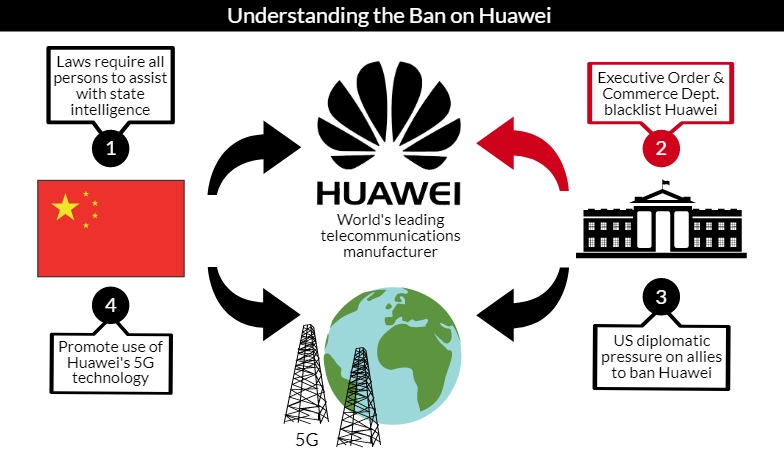
Before restrictions tightened, Huawei was one of the world’s most formidable smartphone makers. It had premium hardware, strong camera branding, global distribution, and the kind of scale that made suppliers listen. Then the rules changed. Access to key US technologies became constrained, and Huawei’s consumer business took a direct hit.
That shock forced a reset. Huawei had to rethink everything from sourcing and software to product timing and long-term research priorities. Instead of relying on the old global stack, it began pushing harder into domestic alternatives and vertically integrated systems.
Software became a strategic shield
One of the clearest examples was the push around Huawei’s own software ecosystem. Once access to familiar app and service layers became uncertain, software stopped being a convenience issue and became a survival issue. Building out alternatives to entrenched mobile ecosystems is brutally difficult, but Huawei had little choice.
This is where the story becomes more than hardware. Devices can attract attention, but software determines stickiness. If consumers believe the experience is good enough, a restricted company can retain loyalty. If they do not, even a technically impressive phone can struggle outside a protected market.
Supply chain localization moved from theory to necessity
The second major shift was supply chain localization. For years, policymakers and executives talked about reducing dependency. Sanctions made that objective immediate. Huawei’s experience likely accelerated collaboration across domestic suppliers in areas tied to chip packaging, memory, components, and manufacturing workflows.
That does not mean China can instantly replicate every layer of the most advanced global semiconductor chain. It means pressure has concentrated resources and urgency. In technology, necessity can be a very effective industrial planner.
What Huawei proves about consumer tech under pressure
Consumer technology companies usually win on three things: performance, ecosystem, and trust. Huawei’s challenge has been that it must fight on all three fronts while carrying geopolitical baggage that most rivals do not.
Yet there is a surprising lesson here. Consumers are often more pragmatic than policymakers assume. If a device is fast, stylish, reliable, and available, many buyers will tolerate ecosystem compromises – especially in a large domestic market where national pride and local platform support can reinforce demand.
This matters because it reshapes how we think about resilience in consumer electronics. A company does not always need perfect access to every global technology layer to remain influential. It needs enough engineering depth and enough market support to create an acceptable substitute.
Performance is symbolic now
Every Huawei product launch is judged not only on specs but on symbolism. Benchmarks, battery life, imaging, connectivity, and industrial design all become proxies for a larger question: how much innovation can still happen inside constraints?
That symbolic pressure cuts both ways. A strong release becomes evidence of resilience. A weak one becomes proof that sanctions are working. Few consumer brands operate under that kind of microscope.
Why this is a business story as much as a technology story
The Huawei comeback is also a business model case study. When a company loses access to pieces of the dominant global platform, it has to rebuild value elsewhere. That can mean leaning harder into premium positioning, ecosystem lock-in, enterprise relationships, or national alignment.
For China, Huawei’s trajectory also influences investor confidence in domestic innovation. If Huawei can show that local suppliers and software layers are commercially viable, more capital flows into adjacent sectors. If progress appears dependent on state support without broad competitiveness, investors become more cautious.
- For suppliers: Huawei creates demand signals for domestic component makers.
- For competitors: It raises the pressure to differentiate beyond price.
- For policymakers: It offers a visible case study in industrial resilience.
- For consumers: It tests whether brand loyalty can outlast ecosystem disruption.
Where the limits still show
It would be a mistake to frame Huawei’s progress as proof that restrictions no longer matter. They still do. The hardest part of advanced technology is not launching one headline-grabbing device. It is sustaining a repeatable, scalable innovation pipeline over years.
That means consistent access to high-performance chips, manufacturing yield improvements, software ecosystem depth, developer support, and international channels. Any one of those can become a bottleneck. The smartphone industry is unforgiving: if your cadence slips, consumer attention moves on quickly.
The skeptical view: A comeback product can prove capability. It does not automatically prove long-term competitiveness at the top of the market.
Global expansion remains complicated
Even if Huawei strengthens at home, international recovery is a separate challenge. Outside China, app ecosystems, political scrutiny, carrier relationships, and consumer perceptions all create friction. A strong domestic position can fund R&D and preserve brand prestige, but it does not guarantee a return to former global reach.
That is why Huawei’s next phase may look less like a clean restoration of the old business and more like the creation of a different one: more localized, more vertically controlled, and more tightly linked to Chinese strategic priorities.
What rivals should be learning right now
The Huawei comeback offers lessons well beyond China. Technology firms everywhere are being reminded that overdependence on a single ecosystem, market, or supplier base can turn into strategic weakness. Resilience is no longer a boring procurement topic. It is becoming a product and boardroom issue.
Pro tip for hardware brands
Companies that sell connected devices should be mapping critical dependencies at the chip, firmware, cloud, and app service layers. If one export rule, one geopolitical dispute, or one supplier failure can pause a flagship launch, that is not efficiency – it is fragility.
Practical checklist:
- Audit reliance on single-source
semiconductorsuppliers. - Build fallback plans for
OSservices and app distribution. - Invest in modular product design where components can be swapped with less disruption.
- Strengthen local partnerships in key markets before a crisis forces the issue.
Why Huawei and China tech resilience will stay in focus
The reason Huawei and China tech resilience remain such potent themes is simple: this story sits at the center of the next decade’s industrial competition. Artificial intelligence, smart devices, autonomous systems, telecom infrastructure, and cloud platforms all depend on deep hardware and software coordination. The companies and countries that control more of that stack will have more leverage.
Huawei’s role in that race is unusually visible. It is both commercial actor and geopolitical symbol. Every launch, production milestone, or ecosystem expansion gets read as evidence in a wider argument about whether technological containment can work.
And that wider argument does not end with phones. It extends into network equipment, enterprise infrastructure, edge computing, and national digital sovereignty. In that sense, Huawei’s consumer business may be the most public-facing part of a much bigger strategic machine.
The bottom line on Huawei and China tech resilience
Huawei’s resurgence, however partial or uneven, matters because it challenges a simplistic assumption: that cutting off access to top-tier global technology automatically removes a company from serious competition. What Huawei shows instead is that pressure can also reorganize incentives, redirect investment, and accelerate domestic alternatives.
That does not mean the company has solved every structural weakness. It has not. The path ahead still depends on sustained innovation, software maturity, supplier progress, and the ability to keep consumers engaged without the old global advantages. But it does mean the contest has entered a new phase.
Why this matters: Huawei and China tech resilience are no longer abstract policy themes. They are showing up in real products, real supply chains, and real market behavior. For anyone tracking the future of technology power, that makes Huawei one of the most important companies to watch – not because its victory is guaranteed, but because its struggle is revealing where the future will be won.
The information provided in this article is for general informational purposes only. While we strive for accuracy, we make no guarantees about the completeness or reliability of the content. Always verify important information through official or multiple sources before making decisions.