Iran War Shockwaves Hit the Global Economy
Iran War Shockwaves Hit the Global Economy
The Iran war economic effects are no longer a regional story. They are showing up in fuel prices, shipping insurance, investor nerves, and central bank calculations across the planet. When conflict touches a major energy corridor, the fallout rarely stays contained. It spreads through supply chains, commodity markets, freight networks, and household budgets with brutal efficiency.
That is the real risk now: not just the immediate human and political cost of war, but the way uncertainty itself becomes an economic force. Businesses delay investment. Traders price in disruption before it fully happens. Consumers absorb higher costs long before governments can respond. For countries already wrestling with sticky inflation and fragile growth, this kind of shock lands at exactly the wrong moment.
- Oil and shipping are the fastest transmission channels for the Iran war economic effects.
- Inflation risks rise quickly when energy, freight, and insurance costs move together.
- Emerging markets are especially exposed because they often import fuel and face weaker currencies.
- Central banks may be forced into tougher choices between supporting growth and containing prices.
- The biggest variable is duration: a short conflict shocks markets, but a prolonged one can reshape trade patterns.
Why the Iran war economic effects spread so quickly
Global markets are built for efficiency, not resilience. That works beautifully during calm periods and terribly during geopolitical shocks. Iran matters because it sits in a region central to global energy flows. Even when physical supply losses are limited, the fear of disruption can push prices up fast.
Energy markets are uniquely sensitive to uncertainty. Traders do not wait for a port closure, a pipeline hit, or a tanker bottleneck to react. They move on probability. That means the Iran war economic effects can hit long before a worst-case scenario materializes.
The mechanism is straightforward:
- Crude prices climb on supply risk.
- Refined fuel costs follow.
- Shipping and insurance premiums rise.
- Manufacturers and retailers pay more to move goods.
- Consumers face higher prices at the pump and in stores.
It is a classic ripple effect, but in a hyperconnected economy, the ripples behave more like shockwaves.
Oil is still the pressure point
For all the talk of energy transition, oil remains one of the world economy’s most sensitive inputs. Transportation, aviation, petrochemicals, agriculture, and logistics all depend on it directly or indirectly. That makes any conflict involving a major producer or strategic transit route economically explosive.
Price spikes do not need a full supply collapse
This is the part many policymakers underestimate. Markets price risk, not just actual shortages. If traders believe exports could be disrupted or shipping lanes could become dangerous, futures move quickly. That raises the benchmark for everything downstream.
Why this matters: even a temporary jump in crude can feed into diesel, jet fuel, plastics, fertilizer, and food transportation. Households may notice gasoline first, but businesses feel the squeeze across multiple cost centers at once.
Key insight: The economic damage from war often starts with uncertainty premiums, not physical destruction alone.
Import-dependent countries get cornered first
Countries that rely heavily on imported energy are typically the first to feel pain. Their trade deficits widen, local currencies can weaken, and governments may be pressured to subsidize fuel or electricity. That creates a dangerous feedback loop: higher import bills worsen public finances just as citizens demand relief.
For developing economies, this can be especially destabilizing. A stronger USD combined with higher oil prices is a punishing mix. It raises the cost of imports while making debt servicing more expensive.
Shipping and insurance become hidden inflation engines
Oil gets the headlines, but shipping costs are often the stealth amplifier. If conflict increases risks around key maritime routes, carriers and insurers adjust immediately. War-risk premiums, rerouting expenses, longer delivery times, and container imbalances all feed into final pricing.
Trade routes do not break evenly
Not every company gets hit the same way. Firms with diversified suppliers, stronger inventory buffers, and long-term freight contracts can absorb more pressure. Smaller businesses, by contrast, have less negotiating leverage and less room for delay.
A shipment that takes longer or costs more to insure can affect everything from electronics and machinery to apparel and food ingredients. The cumulative impact looks less dramatic than a market crash, but it can be just as economically corrosive over time.
Pro Tip for businesses
If your operations depend on imported components, this is the moment to audit exposure in plain operational terms:
- Map vendors by geography.
- Identify single points of failure.
- Review freight contract flexibility.
- Stress-test inventory assumptions.
- Model cost changes in
5%,10%, and20%scenarios.
That may sound basic, but during geopolitical disruptions, the companies that survive best are usually the ones that know their dependencies before markets force a reckoning.
Inflation could return as a political problem
Many economies entered this period hoping inflation was finally cooling into something manageable. Conflict-driven energy shocks threaten that progress. And this is where the policy picture gets ugly.
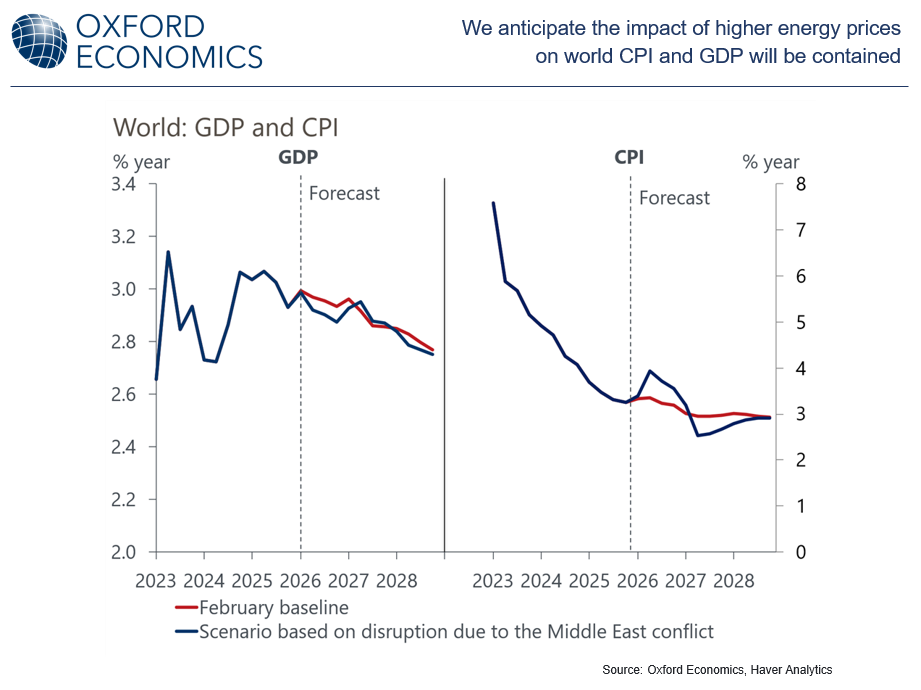
Central banks are not built to solve wars. They can tighten financial conditions, guide expectations, and defend credibility, but they cannot reopen a shipping lane or lower an insurance premium. If fuel and transport costs rise sharply, rate setters may face a familiar nightmare: inflation reaccelerates while growth slows.
The policy trap: cut rates too early and inflation strengthens; stay too tight and already weak economies lose momentum.
That tension matters politically as much as economically. Voters do not experience inflation as a chart. They experience it as pricier groceries, expensive commutes, and shrinking discretionary spending. If the Iran war economic effects persist, governments will feel pressure to intervene through subsidies, tax changes, or strategic reserves.
Markets hate ambiguity more than bad news
Financial markets can absorb bad news if it is bounded. They struggle much more with uncertainty that has no clear timeline. That is why geopolitical crises often trigger broad volatility even when analysts cannot yet quantify direct damage.
Safe havens, risk-off moves, and capital flight
When uncertainty spikes, investors tend to rotate toward assets perceived as safer. That can mean stronger demand for reserve currencies, government debt, or defensive sectors. Meanwhile, riskier assets and more vulnerable markets can sell off.
For emerging markets, this combination is especially dangerous. Capital outflows, weaker exchange rates, higher import costs, and rising debt pressure can all hit at once. The result is not just slower growth but a more fragile policy environment.
Corporate planning gets harder overnight
Public companies can hedge some commodity exposure, but few can hedge uncertainty itself. Budget forecasts become less reliable. Guidance gets softer. Investment committees turn cautious. Expansion plans pause. Hiring decisions slow.
This is one of the most underappreciated consequences of war-related market stress: it changes executive behavior before official data fully captures the shift.
Who gets hurt first and who might benefit
Economic shocks rarely distribute pain evenly. Some sectors absorb immediate losses, while others see a short-term boost.
Most exposed sectors
- Airlines facing higher jet fuel costs.
- Logistics operators dealing with rerouting and insurance pressure.
- Manufacturers reliant on imported energy or components.
- Consumer-facing businesses vulnerable to weaker discretionary spending.
- Emerging-market importers with limited fiscal room.
Potential beneficiaries
- Energy producers benefiting from higher prices.
- Defense-related firms tied to elevated security spending.
- Shipping alternatives outside the highest-risk routes.
- Commodity exporters with improved terms of trade.
But even apparent winners face a caveat: if the conflict causes a broader growth slowdown, gains can be temporary. A booming energy price environment is less attractive if it helps tip major economies toward recession.
What to watch next in the Iran war economic effects
The next phase depends less on headlines and more on a handful of operational indicators. Policymakers, executives, and investors should focus on measurable stress signals rather than rhetorical escalation alone.
Watch these signals closely
- Crude benchmarks: sustained moves matter more than one-day spikes.
- Shipping premiums: rising war-risk insurance is an early warning sign.
- Port and route disruptions: delays often reveal more than official statements.
- Inflation expectations: these shape central bank reactions.
- Currency weakness in import-heavy economies: often a sign of broader financial strain.
Think of these as the conflict’s economic telemetry. If multiple indicators worsen together, the probability of longer-lasting damage rises significantly.
Strategic fallout could outlast the immediate crisis
Even if active conflict cools sooner than feared, the strategic consequences may stick. Companies that already learned hard lessons from pandemic bottlenecks and great-power tensions are likely to accelerate supply-chain diversification again. Governments may revisit reserve policies, domestic production incentives, and trade-security planning.
This is how temporary shocks become structural shifts. A single crisis can reinforce broader trends toward redundancy, localization, and selective decoupling. Those shifts can make supply chains more resilient over time, but they often raise costs in the short term.
Why this matters: resilience is rarely free. If businesses and governments choose security over pure efficiency, consumers may ultimately bear part of that bill.
The bigger lesson for a fragile global economy
The global economy entered this period with too many unresolved vulnerabilities: uneven growth, sensitive debt markets, exposed supply chains, and inflation that has not fully disappeared. The Iran war economic effects do not create all those weaknesses, but they can expose and intensify them with surprising speed.
That is what makes this more than another geopolitical flare-up. It is a stress test for whether the post-crisis global system has actually become sturdier or simply more accustomed to operating under pressure.
Bottom line: The danger is not only higher oil. It is the combination of energy stress, logistics disruption, inflation risk, and delayed business confidence arriving at the same time.
If the conflict remains contained, the economic shock may prove sharp but manageable. If it expands or drags on, the consequences could become far more structural, touching trade strategy, monetary policy, and consumer behavior for months or even years. Either way, the message is clear: the costs of modern conflict now travel at market speed.
The information provided in this article is for general informational purposes only. While we strive for accuracy, we make no guarantees about the completeness or reliability of the content. Always verify important information through official or multiple sources before making decisions.