Redwoods Face Climate Heat Reckoning
California’s coast redwoods have survived fire, fog shifts, logging pressure, drought, and centuries of weather whiplash. But redwood climate change risk is entering a sharper phase: heat is no longer just background noise. New research into how redwoods regulate leaf temperature suggests these giants have powerful cooling tricks, yet those tricks may be tested as hotter days become more frequent and more intense. For anyone who thinks old-growth forests are too massive to be vulnerable, this is the uncomfortable update. The tallest trees on Earth are not passive monuments. They are living climate machines, constantly balancing water, sunlight, and heat. The question now is whether that machinery can keep pace with the climate humans are building around it.
- Coast redwoods can cool their leaves through water movement, canopy structure, and access to fog-influenced moisture.
- Extreme heat still matters because leaf temperature controls photosynthesis, water stress, and long-term growth.
- Redwood climate change risk is uneven across forests, with inland and drier-edge populations facing greater pressure.
- The future of redwoods depends on microclimates, conservation strategy, and whether warming outpaces their biological flexibility.
What Redwood Climate Change Research Reveals
The key insight is deceptively simple: air temperature is not the same as leaf temperature. A weather station can report brutal heat, but a leaf lives in its own microclimate. Its temperature is shaped by sunlight, wind, water flow, humidity, height in the canopy, and the tree’s ability to release water vapor through tiny pores called stomata.
That distinction matters because leaves are where a tree negotiates with the atmosphere. Through photosynthesis, redwoods turn light and carbon dioxide into energy. Through transpiration, they release water vapor and cool themselves. The tradeoff is ruthless: open the stomata and the leaf cools while gaining carbon, but the tree loses water. Close them and the tree conserves water, but leaf temperature can rise and carbon uptake slows.
The redwood survival story is not simply about being tall or ancient. It is about whether a tree can keep its living tissues within a workable temperature range while the atmosphere becomes more demanding.
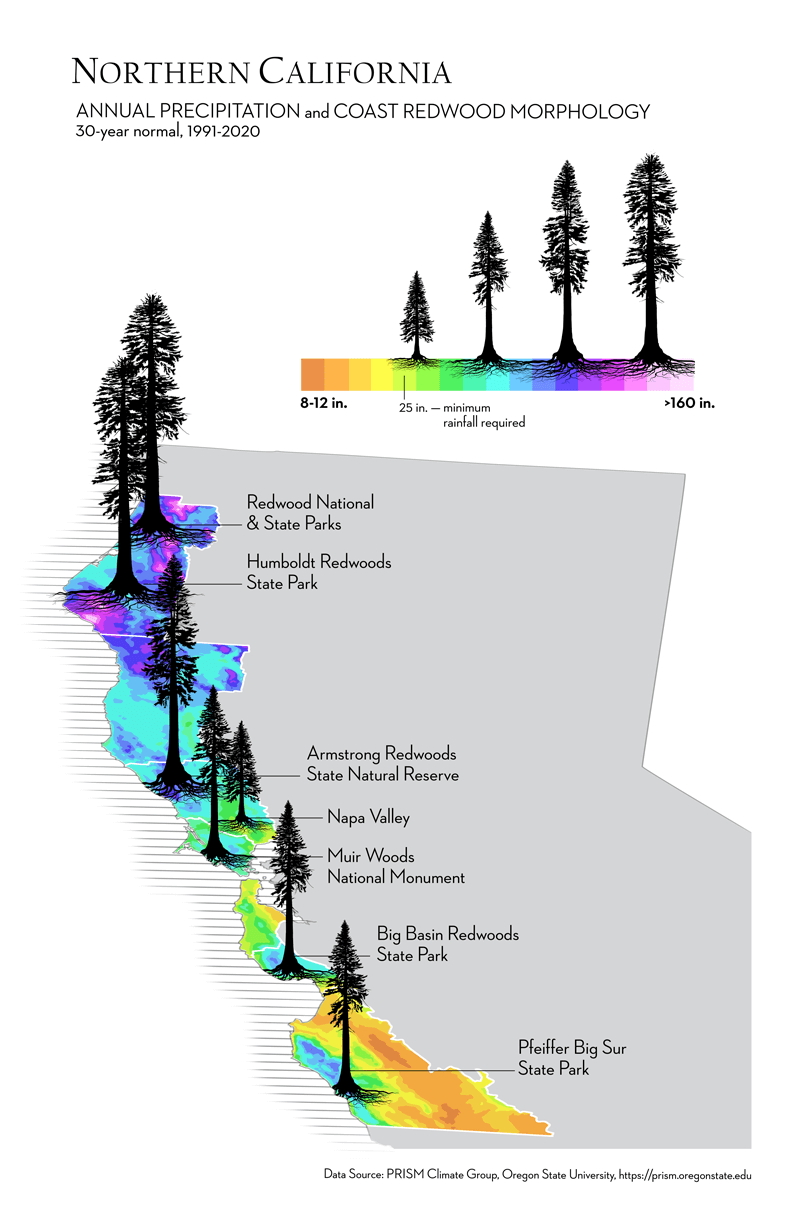
For coast redwoods, this is especially compelling because their habitat is famous for moderation. The coastal fog belt has historically buffered these forests from temperature extremes. Fog can reduce sunlight intensity, raise humidity, and supply moisture directly or indirectly. But climate change is rewriting the stability of that buffer. Hotter air can pull more water from plants and soil, and shifts in marine fog patterns may change the very conditions that helped redwoods dominate parts of the California and Oregon coast.
The leaf is the frontline sensor
Redwoods may look like one enormous organism from the ground, but the canopy is a vertical city. Conditions near the top of a giant redwood can differ dramatically from conditions near the shaded understory. Upper leaves receive more light and wind exposure. Lower leaves operate in cooler, dimmer conditions. That means heat stress is not evenly distributed.
Researchers studying canopy temperature are essentially asking how the tree’s highest, most exposed tissues cope when the environment turns hostile. If upper leaves overheat, the tree can lose productivity even if the trunk and roots remain intact. If overheating becomes common, growth slows, drought sensitivity rises, and recovery after extreme weather becomes harder.
Why Redwood Climate Change Risk Is About More Than Hot Days
Heat is the headline, but the deeper threat is compound stress. A hot day after a wet winter is not the same as a hot day during a multi-year drought. A redwood with deep access to water can keep transpiring longer than a tree on a dry slope or at the edge of its range. A forest wrapped in fog has a different risk profile than one pushed into hotter, more exposed conditions.
This is why redwood climate change cannot be reduced to a single temperature number. The danger comes from interactions among vapor pressure deficit, soil moisture, fog frequency, wildfire intensity, and disease pressure. Vapor pressure deficit is especially important because it describes how thirsty the air is. When it rises, the atmosphere pulls harder on plant water. Trees may respond by closing stomata, which limits water loss but also reduces cooling and photosynthesis.
The hidden cost of closing stomata
Closing stomata is a survival move, but it is not free. It can protect the tree from dangerous water loss in the short term while reducing carbon intake over time. For a massive redwood, even small reductions in annual carbon gain can matter across decades. Less carbon means less energy for growth, reproduction, repair, and defense.
That is the strategic tension at the center of redwood resilience. These trees are extraordinary at buffering stress, but resilience is not invincibility. A redwood can survive a bad day, a bad season, even many bad years. The concern is what happens when the bad years become the new baseline.
How Redwoods Keep Their Cool
Coast redwoods have a remarkable toolkit for thermal regulation. Their height gives them access to moving air. Their crowns can distribute leaves across varied light environments. Their roots can tap moisture where available. Their bark protects living tissue from some external extremes. And in foggy zones, their needles can intercept moisture that helps sustain the tree and surrounding ecosystem.
At the leaf level, cooling depends heavily on water transport. When water moves from roots through xylem and evaporates from leaf surfaces, it carries heat away. This is the plant equivalent of sweating. But like sweating, it only works if there is water to spend.
- Fog influence: Coastal fog can reduce heat load and improve moisture conditions around leaves.
- Canopy architecture: Different leaf positions experience different light and heat exposure.
- Water transport:
Xylemmovement supports evaporative cooling throughtranspiration. - Microclimate buffering: Old-growth forests can create cooler, more humid interior conditions.
Pro Tip for interpreting this research: do not think of a redwood forest as a uniform block of green. Think of it as layered infrastructure. The understory, mid-canopy, upper canopy, soil, fog, and surrounding landscape all affect whether heat becomes manageable or damaging.
Old-growth forests are climate infrastructure
One of the biggest implications is that old-growth redwood forests do more than store carbon. They regulate local climate. Dense, mature forests can cool the air beneath their canopies, hold moisture, slow wind, and protect soils. That makes them a form of living infrastructure in a warming world.
Cutting or fragmenting these forests does not just remove trees. It can weaken the microclimate that helps remaining trees survive. Edges become hotter and drier. Wind exposure rises. Soil moisture can decline. In other words, forest structure is part of the redwood cooling system.
Why This Matters Beyond California
Redwoods are charismatic, but the science here reaches far beyond one iconic species. Forests around the world are facing the same core problem: their leaves evolved for historical climate ranges, while today’s extremes are moving faster than many ecosystems can adapt.
Understanding leaf temperature gives scientists a sharper tool than air temperature alone. It helps identify when trees are approaching physiological limits. It also helps land managers prioritize refuges – places where terrain, fog, shade, or water availability may keep forests viable longer.
The future of forests will be decided at the scale of landscapes, but the warning signs often begin at the scale of a leaf.
For climate models, this is a big deal. If models assume trees keep photosynthesizing under heat that actually forces stomatal closure, they may overestimate future carbon uptake. If they ignore microclimates, they may miss pockets of resilience. Better leaf-temperature data can improve predictions of forest growth, carbon storage, and dieback risk.
The Conservation Playbook Needs an Upgrade
The old conservation model focused heavily on protecting acreage. That still matters, but climate pressure demands a more tactical approach. The question is not only how much redwood habitat is protected, but which habitat can remain functional under hotter conditions.
Managers may need to prioritize climate refugia, restore degraded buffers around old-growth groves, reduce fragmentation, and protect watersheds that support summer moisture. Fire strategy also matters. Redwoods are fire-adapted in important ways, but hotter droughts can intensify fires and complicate recovery, especially for younger trees and surrounding species that support forest structure.
What to watch next
The next wave of redwood research will likely focus on thresholds. How hot can leaves get before photosynthesis drops sharply? How does drought change that threshold? Which populations have the strongest cooling capacity? Are inland redwoods adapting differently from coastal ones? These questions will determine whether conservation plans are merely protective or genuinely climate-ready.
There is also a technology angle. Canopy sensors, thermal imaging, drones, and high-resolution climate models can help map stress before it becomes visible from the ground. By the time a giant tree looks sick, the physiological problem may have been building for years.
The Bottom Line on Redwood Climate Change
The most important lesson is not that redwoods are doomed. It is that their survival depends on a delicate balance that climate change is actively disturbing. Their ability to cool leaves is impressive, but it is tied to water, fog, forest structure, and the frequency of extreme heat.
That should make us both hopeful and cautious. Hopeful because redwoods have biological tools that can buffer stress. Cautious because those tools have limits, and human decisions will influence how often those limits are crossed.
Protecting redwoods in the next century means protecting more than trees. It means protecting fog belts, watersheds, old-growth structure, connected habitat, and the microclimates that make these forests possible. The tallest trees on Earth are still standing, but the thermal math around them is changing fast.
The information provided in this article is for general informational purposes only. While we strive for accuracy, we make no guarantees about the completeness or reliability of the content. Always verify important information through official or multiple sources before making decisions.