Tunisia Softens False News Law
Tunisia Softens False News Law
Tunisia false news law reform sounds like the kind of democratic course correction rights groups have demanded for years. But the real question is not whether lawmakers trimmed the sharpest edge of a controversial speech law. It is whether the state still holds a legal weapon powerful enough to chill journalists, opposition figures, lawyers, activists, and ordinary citizens who post online. Tunisia’s move to soften penalties tied to false news arrives at a politically loaded moment: public trust is strained, institutions are under pressure, and digital speech has become the front line of accountability. The headline is reform. The substance is more complicated.
- The penalty shift matters, but it does not necessarily remove the threat of prosecution under
Decree Law 54. - The core problem remains vague language around
false news, rumors, and online harm. - Journalists and critics may still self-censor if investigations, fines, or trials remain possible.
- The timing is strategic, coming as Tunisia faces scrutiny over governance, rights, and political legitimacy.
Why the Tunisia False News Law Became a Flashpoint
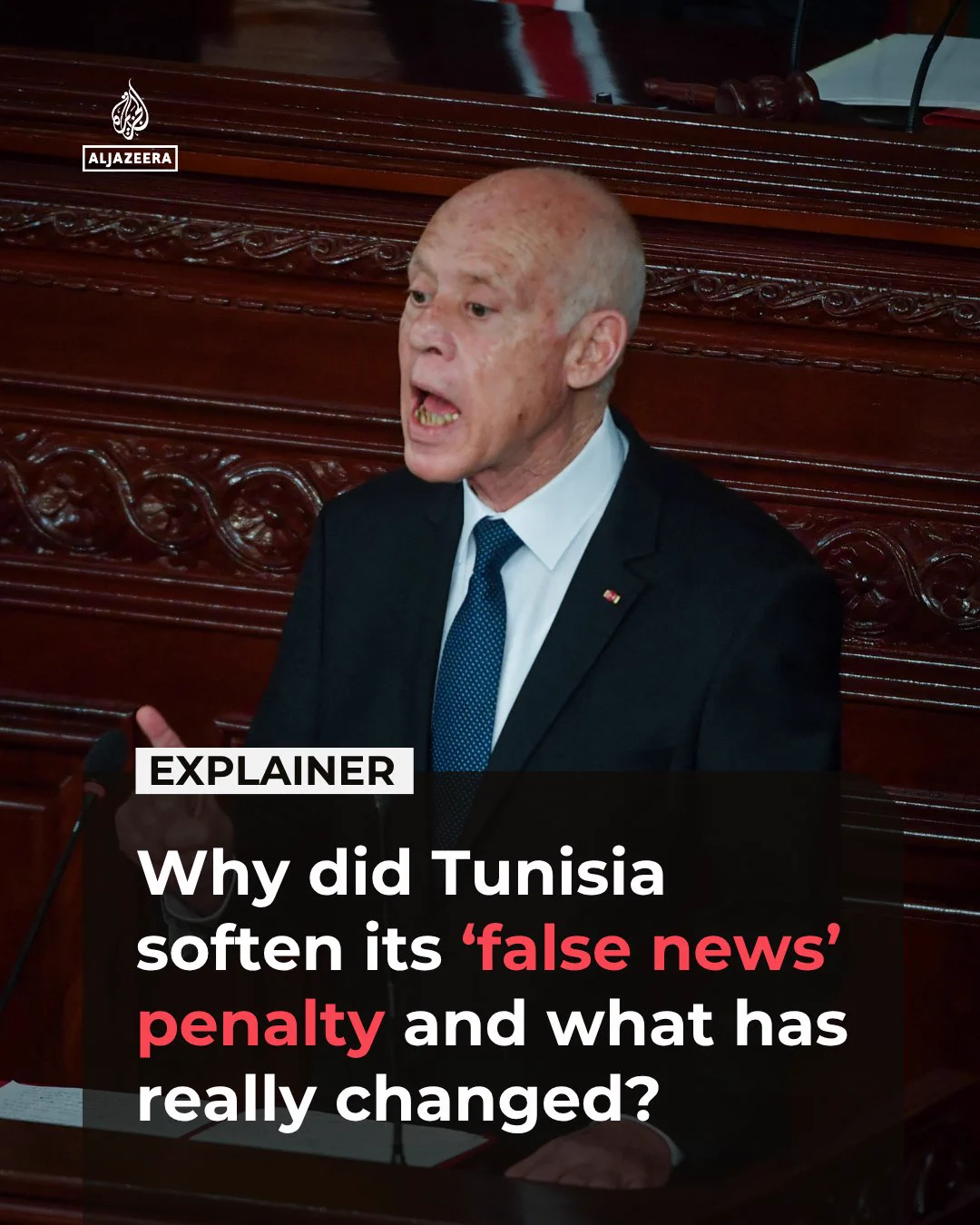
The controversy centers on Decree Law 54, a 2022 cybercrime measure introduced under President Kais Saied. Its stated purpose was to combat online disinformation, cyber abuse, and digital fraud. Those are legitimate policy goals. Every government is wrestling with coordinated manipulation, scams, harassment, and deepening distrust in information systems.
But Tunisia’s law went much further than a narrow anti-fraud framework. Rights advocates, journalists, and political opponents argued that the law’s language gave authorities broad discretion to punish speech that embarrassed officials or challenged state narratives. The most criticized provisions targeted the use of digital networks to spread false news, rumors, or information deemed harmful to public security.
The central issue was never whether disinformation exists. It was whether the state should get to define contested political speech as a crime.
That distinction matters. A narrow law against identity theft, coordinated bot fraud, or doxxing can protect citizens. A vague law against false news can become a pressure system. It may not need to jail thousands to change behavior. A handful of high-profile cases can be enough to send a message: speak carefully, post less, criticize softly.
What Changed in the Tunisia False News Law
The reported softening appears focused on penalties rather than a wholesale rewrite of the legal architecture. That means Tunisia is signaling moderation while preserving much of the state’s ability to pursue cases tied to online speech.
Under the earlier framework, critics objected to prison terms and heavy fines that could apply to online expression, especially when the subject involved public officials or state institutions. The softened version reportedly reduces the severity of punishment, shifting the law away from its harshest criminal consequences.
The Reform Is Real But Limited
A reduction in penalties is not meaningless. If prison exposure is reduced or removed for some categories of speech, that can lower the immediate personal risk for journalists, commentators, and citizens. It can also reduce the use of pretrial detention or the specter of long incarceration as a coercive tool.
Still, penalty reform does not automatically produce speech freedom. If the underlying offense remains broad, prosecutors may still open investigations. Courts may still summon journalists. Police may still question activists over posts. Media organizations may still spend time and money defending themselves instead of reporting.
Pro Tip for reading legal reform: do not stop at the punishment section. Look at the definition of the offense, who can file complaints, what evidence is required, and whether public officials receive special protection from criticism.
The Vague Language Problem
The phrase false news is deceptively simple. Some claims are demonstrably false. But political speech often involves interpretation, leaked information, criticism, satire, or allegations that are difficult to prove immediately. A journalist may report that a public institution is failing. An activist may accuse officials of misconduct. A citizen may share a rumor during a crisis. The danger comes when ambiguity becomes criminal exposure.
Modern disinformation policy works best when it distinguishes between harmful coordinated manipulation and ordinary public debate. Tunisia’s challenge is that its framework has been criticized for blurring that line.
Why Tunisia Is Moving Now
The timing is the most revealing part of the story. Tunisia has faced intensifying scrutiny over political freedoms since Saied consolidated power, rewrote institutional rules, and governed through a more centralized presidency. Supporters argue he is trying to rescue the state from dysfunction and corruption. Critics say Tunisia’s post-2011 democratic experiment has been steadily narrowed.
Softening the penalty allows the government to present a reformist signal without necessarily surrendering control. It can tell domestic audiences that it listened. It can tell international partners that it adjusted. It can tell critics that the law is no longer as severe as before.
This is the politics of calibrated concession: change enough to reduce pressure, but not enough to disarm the system.
That does not mean the reform is purely cosmetic. Legal systems often change incrementally. A softer penalty today can create space for more ambitious amendments later. But it does mean observers should judge the change by enforcement patterns, not press releases.
The Digital Speech Dilemma Tunisia Cannot Avoid
Tunisia is not alone. Governments across the world are trying to regulate an online environment where rumors travel faster than corrections, influence campaigns exploit social division, and AI-generated content makes verification harder. The policy challenge is real.
But democracies and democratic-leaning systems face a higher standard. They must fight manipulation without giving officials a blank check to punish dissent. That requires precision.
- Target conduct, not opinion: laws should focus on fraud, coordinated deception, impersonation, extortion, and threats.
- Protect public-interest reporting: journalists should not face criminal exposure for good-faith reporting on officials.
- Require proof of harm: authorities should show concrete damage, not mere embarrassment or reputational discomfort.
- Limit public official privileges: leaders should tolerate more criticism, not receive stronger shields from it.
- Use civil remedies carefully: fines can chill speech too, especially in fragile media markets.
The risk is that anti-disinformation laws become an all-purpose governance tool. Once a state can label criticism as destabilizing, the boundary between security and censorship starts to collapse.
What This Means for Journalists and Civil Society
For Tunisian journalists, the softened penalty may reduce the most severe fear, but it does not eliminate the need for caution. Newsrooms will still likely scrutinize wording, sourcing, and publication timing when reporting on politically sensitive topics. Independent outlets may remain vulnerable if fines, legal fees, or repeated summonses drain resources.
Civil society groups face a similar equation. Activists depend on fast communication, public campaigns, and social platforms to organize. If posts about corruption, migration, policing, courts, or elections can be treated as potentially criminal, advocacy becomes slower and more defensive.
Why Self-Censorship Is Hard to Measure
The most damaging effect of speech laws often never appears in court statistics. It shows up in stories not published, posts not shared, sources not contacted, and editors who decide that a topic is not worth the risk. That invisible layer of restraint is why even softened laws can remain powerful.
International observers should therefore track more than prosecutions. They should watch whether independent media can investigate state institutions, whether opposition figures can criticize leadership, and whether ordinary citizens feel safe discussing public affairs online.
The Bigger Signal for Tunisia’s Political Future
Tunisia still carries symbolic weight. After the 2011 uprising, it was widely seen as the strongest democratic opening to emerge from the Arab uprisings. Its trajectory has since become more contested, making every legal reform part of a larger argument over where the country is headed.
If the softened false news penalty becomes the first step toward narrowing Decree Law 54, strengthening judicial safeguards, and protecting public-interest speech, it could be meaningful. If it simply lowers the political cost of keeping a vague speech law alive, then the reform will look more like reputation management than democratic repair.
The next test is enforcement. Are cases dropped? Are investigations narrowed? Are journalists left alone when they report uncomfortable facts? Are officials discouraged from using the law as a reputational shield? Those answers will matter more than the amended penalty text itself.
Bottom Line on Tunisia False News Law Reform
Tunisia’s decision to soften its false news penalty is a notable shift, but not a clean break. It trims the law’s harshest image while leaving unresolved questions about vague definitions, prosecutorial discretion, and political speech. That makes the reform both welcome and insufficient.
The optimistic read is that pressure worked and legal space may slowly reopen. The skeptical read is that Tunisia has adjusted the optics while preserving a mechanism of control. Both can be true at once.
For citizens, journalists, and civil society, the stakes remain high. A country does not need to ban criticism outright to weaken public accountability. It only needs to make criticism feel legally dangerous. Tunisia has softened the penalty. Now it must prove that speech itself is no longer the target.
The information provided in this article is for general informational purposes only. While we strive for accuracy, we make no guarantees about the completeness or reliability of the content. Always verify important information through official or multiple sources before making decisions.