AI Data Centres Reshape the Cloud Race

AI Data Centres Reshape the Cloud Race
The next great technology war will not be won only with smarter models or slicker apps. It will be won with land, power contracts, cooling systems, planning approvals and chips arriving on time. AI data centres have moved from invisible plumbing to boardroom obsession because every company racing into generative tools now depends on physical infrastructure that is expensive, power-hungry and politically sensitive. For businesses, that means cloud costs may become more volatile. For governments, it means local grids and industrial policy are suddenly part of the artificial intelligence conversation. And for consumers, it means the magic of instant answers, image generation and workplace automation is tied to a supply chain that looks far less digital than the marketing suggests.
- AI data centres are becoming strategic assets, not just back-end facilities.
- The biggest constraints are power availability, cooling, chips and planning permission.
- Local communities will feel the impact through jobs, grid pressure and water demand.
- Cloud providers that control infrastructure may gain a durable advantage in the
AIeconomy.
Why AI Data Centres Became the New Power Play
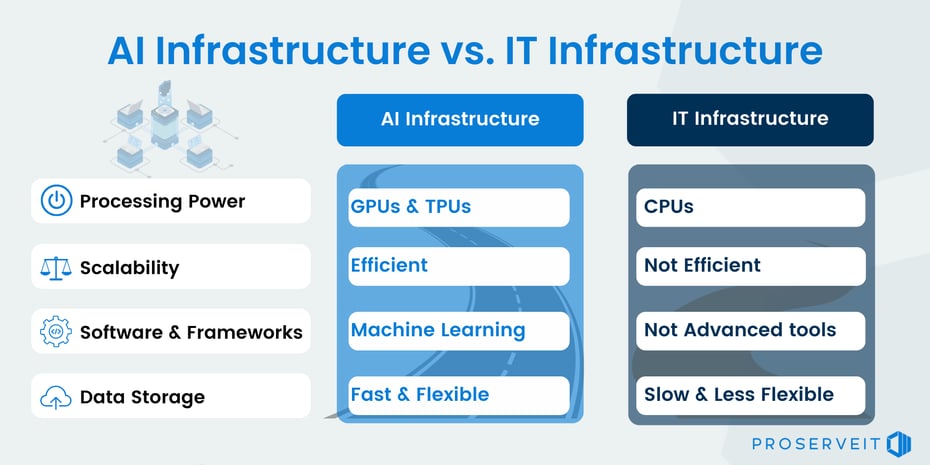
For years, the cloud industry sold a comforting illusion: compute was elastic, abstract and effectively limitless. Need more storage? Click a button. Need more processing? Spin up a bigger instance. That model worked because traditional workloads, from websites to enterprise databases, could be distributed across fleets of servers with relatively predictable demand.
Generative AI breaks that rhythm. Training large models can require thousands of specialized GPU chips running for weeks or months. Serving those models, known as inference, adds a second wave of demand every time a user asks a chatbot a question, generates an image or summarizes a document. The result is a compute appetite that is both intense and continuous.
Key insight: The cloud is no longer just software delivered at scale. It is becoming an industrial system built around electricity, silicon and real estate.
This is why the conversation has shifted from model benchmarks to infrastructure buildouts. The companies that can secure cheap power, resilient grids, advanced chips and efficient cooling will decide how quickly AI products can scale – and who can afford to use them.
AI Data Centres And The Energy Problem
The uncomfortable truth is that every impressive AI demo has a physical cost. Data centres need enormous amounts of electricity, and the newest generation of facilities designed for AI workloads can consume far more than conventional server farms. That puts pressure on national grids already balancing electrification, renewable energy targets and industrial demand.
The challenge is not simply total energy consumption. It is location and timing. A data centre needs reliable, high-capacity power in a specific place, often with limited tolerance for disruption. Renewable energy can help, but intermittent supply must be matched with storage, grid upgrades or backup generation. That makes energy procurement a competitive weapon.
The Cooling Bottleneck
Modern GPU clusters generate intense heat. Traditional air cooling is often insufficient for dense AI racks, pushing operators toward liquid cooling, immersion systems and redesigned server halls. These technologies can be more efficient, but they also demand new expertise, new maintenance models and sometimes significant water use.
That matters because local communities increasingly scrutinize what data centres take from the environment. A facility may promise investment and jobs, but residents may ask harder questions: How much water will it consume? Will it raise energy bills? Will it strain infrastructure without delivering enough local benefit?
Pro Tip For Business Leaders
If your company is adopting generative AI, do not treat compute as an unlimited utility. Ask vendors how they manage capacity, where workloads run, and what happens to pricing when demand spikes. Infrastructure strategy is now part of AI risk management.
The Chip Supply Chain Behind The Hype
The AI boom depends heavily on advanced chips, especially high-end GPU systems and networking hardware. These components are difficult to manufacture, expensive to buy and constrained by a small number of suppliers. Even the largest cloud companies can face delays when hardware demand outruns production.
This creates a hierarchy in the market. At the top are hyperscalers with enough capital to secure chips early, build custom silicon and finance massive facilities. Beneath them are smaller cloud providers and enterprise buyers competing for capacity. At the bottom are startups that may have brilliant models but limited access to the compute needed to train or serve them at scale.
That dynamic could reshape competition. The AI era may reward not only the best algorithm, but the deepest infrastructure stack. A startup with a breakthrough product still needs compute. A large platform with its own data centres, proprietary chips and distribution channels can turn infrastructure into a moat.
What This Means For Cloud Costs
Cloud pricing has always been complex, but AI makes it more unpredictable. Traditional workloads are billed through familiar units such as storage, bandwidth and virtual machines. AI workloads introduce new cost drivers: model size, token volume, GPU availability, latency targets and data movement between systems.
Developers already see this in application design. A product that sends every user request to a frontier model may be impressive, but it can become financially unsustainable. Teams are increasingly mixing large models with smaller models, caching responses, compressing prompts and using retrieval systems to reduce unnecessary compute.
- Use smaller models when a task does not require frontier-level reasoning.
- Cache repeated outputs where accuracy and freshness allow it.
- Track
tokensas a core product cost, not an engineering footnote. - Move sensitive or predictable workloads to private infrastructure when practical.
- Design fallback modes for periods of high demand or limited capacity.
For finance teams, the old question was whether to move workloads to the cloud. The new question is whether AI-heavy workflows should run on public platforms, private clusters or hybrid infrastructure. The answer will vary by scale, compliance needs and tolerance for vendor lock-in.
The Local Politics Of Global Compute
Data centres are often described in abstract global terms, but they land in specific communities. They require zoning approvals, substations, fiber routes, access roads and construction labor. They can bring tax revenue and skilled jobs, but the number of permanent roles may be smaller than the scale of investment suggests.
That mismatch can fuel tension. A community may see a huge building, heavy electricity demand and limited visible benefit. Governments will need clearer rules around transparency, energy sourcing and local economic commitments. Without that, data centre expansion risks becoming a political flashpoint.
Editorial view: If
AIis going to be treated as critical infrastructure, the public deserves more than vague promises about innovation. It deserves measurable commitments on power, water and local value.
Why AI Data Centres Matter Beyond Big Tech
It is tempting to frame this as a battle among cloud giants, chipmakers and model labs. But the consequences reach far wider. Healthcare systems exploring diagnostic assistants, banks automating compliance, manufacturers optimizing supply chains and media companies generating content all depend on the same compute base.
If capacity is scarce or expensive, smaller organizations may be priced out of advanced AI. If infrastructure is concentrated among a few providers, regulators may face new questions about competition and resilience. If energy demand grows faster than grids can adapt, climate goals and digital ambitions could collide.
Future Implications
Expect three shifts over the next few years. First, more cloud companies will promote custom chips to reduce dependence on scarce hardware. Second, data centre design will become more specialized around liquid cooling and high-density racks. Third, governments will treat compute capacity as a strategic resource, similar to energy, telecoms and semiconductors.
There may also be a renewed push for efficiency. Smaller models, on-device AI, model distillation and better software optimization could reduce pressure on centralized infrastructure. The industry has often solved scale problems with brute force. This time, brute force may be too expensive to be the only answer.
The Bottom Line
AI data centres are the hidden machinery behind the most visible technology shift of the decade. They determine which products can scale, which companies can compete and which regions become hubs of the next computing economy. The hype around AI may live in apps and chatbots, but the real leverage sits in substations, cooling loops, chip allocations and planning permits.
For executives, the takeaway is blunt: an AI strategy without an infrastructure strategy is incomplete. For policymakers, the challenge is to welcome investment without ignoring energy and community costs. And for the technology industry, the message is clear. The future of intelligence is not floating in the cloud. It is being built in warehouses full of machines, consuming real power, in real places.
The information provided in this article is for general informational purposes only. While we strive for accuracy, we make no guarantees about the completeness or reliability of the content. Always verify important information through official or multiple sources before making decisions.