California Turns Up the Heat on Hospital Costs
California Turns Up the Heat on Hospital Costs
California is betting that hospitals can be pushed toward restraint with something the healthcare system understands immediately: money. As premiums climb, employers squeeze, and families delay care because of cost, the state is taking a harder line on hospital spending limits and fines. That matters because hospital bills are not just one piece of the healthcare problem – they are often the engine that drives it. If regulators can force large systems to rein in spending, the ripple effects could hit insurance rates, patient bills, and even how aggressively hospitals negotiate with insurers. But this is not a simple crackdown. Hospitals argue they are already absorbing rising labor, drug, and supply costs, while policymakers say the status quo is no longer defensible. The question is whether California’s strategy can actually tame healthcare inflation, or whether it will merely provoke a new round of legal and political resistance.
- California is using spending limits and fines to pressure hospitals to control costs.
- The policy targets a major source of healthcare inflation: hospital pricing power.
- Supporters say the move could ease premiums and patient bills over time.
- Hospitals warn that aggressive enforcement could strain staffing and access.
- The outcome could shape how other states regulate healthcare spending.
Why California’s hospital cost crackdown matters
The core issue is simple: hospitals are expensive, and too often their prices rise faster than wages, inflation, and household budgets. California’s hospital cost crackdown is significant because it treats healthcare spending as a policy problem that can be measured, enforced, and penalized. That is a very different posture from the usual public frustration, where lawmakers complain about costs but stop short of changing the incentive structure.
For patients, the stakes are immediate. Higher hospital spending can feed into higher insurance premiums, larger deductibles, and more aggressive balance billing tactics. For employers, it means a bigger burden on benefits budgets. For the state, it becomes a broader economic issue because healthcare costs can crowd out investment in housing, education, and other public priorities.
What makes this move so notable is that California is not just asking hospitals to behave better. It is testing whether government can draw a line around how much spending growth is acceptable, then enforce that line with penalties. That is the kind of intervention that can make healthcare executives bristle and policy advocates lean forward.
California is making a direct bet that hospital pricing power is not inevitable – it can be measured, constrained, and punished when it exceeds the public’s tolerance.
How the spending limits work
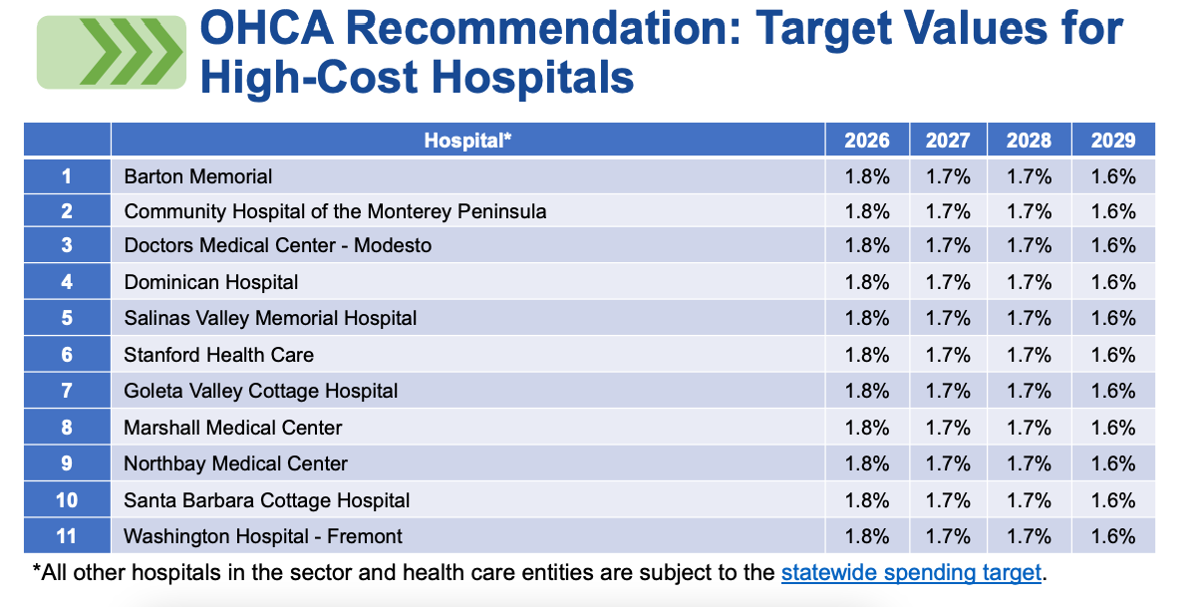
The basic idea behind California hospital spending limits is to tie hospital financial behavior to benchmarks that policymakers believe are sustainable. If a hospital or health system spends beyond the permitted threshold, the state can respond with fines or other enforcement actions. The goal is not to eliminate profit or suppress necessary investment. It is to stop the open-ended escalation that has become routine in much of the U.S. healthcare market.
This is a major departure from the usual American model, where hospitals often justify price increases by pointing to labor shortages, inflation, capital projects, and higher acuity patients. Those explanations may all be valid in some cases. The problem is that they can also be used as cover for broader market leverage. A dominant health system can often raise prices because it has little competition, not because its costs are uniquely high.
In practice, enforcement matters more than slogans. A spending cap only works if regulators can identify the relevant baseline, track compliance, and decide when an exception is justified. That is not trivial. Hospitals are complex organizations with different service lines, payer mixes, and regional pressures. A surgical center in one market is not the same as a trauma hospital in another. The policy succeeds or fails based on whether California can distinguish between legitimate cost growth and opportunistic overreach.
The enforcement challenge
Any policy built around hospital spending limits has to answer a messy question: what counts as excessive? If the state is too rigid, hospitals may argue the rules ignore local realities. If it is too lenient, the limits become symbolic theater. That tension is why these programs often live or die on the quality of their data, the clarity of their definitions, and the consistency of penalties.
Pro tip: When evaluating any healthcare cost-control policy, look for three things: the benchmark, the exemption process, and the penalty mechanism. If one of those is vague, the policy is probably weaker than it sounds.
Why hospitals are fighting back
Hospitals tend to frame spending limits as a threat to care quality, staffing stability, and future investment. That argument should not be dismissed out of hand. Many hospitals are under real pressure from labor costs, especially in markets where nursing shortages and contract staffing rates have surged. Inflation also affects medications, devices, food, utilities, and construction. A hospital is not a factory line that can simply be optimized on demand.
Still, critics of the hospital industry would say this is exactly why the state is acting. If every cost increase is treated as unavoidable, then there is no ceiling. Some systems can absorb shocks while others use them as an excuse to keep raising prices. The concern is not whether hospitals have costs – they clearly do – but whether the market gives them too much room to pass those costs onto patients and payers without discipline.
That is why California’s approach is likely to trigger a familiar fight. Hospital executives will argue that fines punish institutions already struggling to stay afloat. Policymakers will argue that unchecked spending punishes everyone else first. Both can be true in part, but the current system clearly leaves consumers with little leverage.
Pricing power, not just cost growth
One of the most important ideas here is that hospital inflation is not always about higher input costs. Often, it is about pricing power. Large hospital systems can command better rates from insurers because they are essential, geographically dominant, or politically entrenched. When that happens, higher prices do not necessarily reflect better care. They reflect market structure.
That distinction matters because it changes the policy solution. If the problem is only input inflation, the answer might be subsidies or reimbursement adjustments. If the problem is pricing power, then the answer has to be regulatory restraint. California is clearly betting on the second diagnosis.
What this means for patients and employers
For patients, the benefits may not be instant. Healthcare pricing reform tends to move slowly through the system. But if hospital spending slows, the downstream effects could include more stable premiums, lower pressure on deductibles, and less aggressive cost shifting. That is the optimistic case, and it is worth taking seriously.
Employers could feel the impact sooner. In California and beyond, healthcare costs remain one of the largest line items in compensation budgets. When hospital prices spike, employers either absorb the hit or pass it along in the form of lower wage growth, higher employee contributions, or reduced benefits. A successful enforcement regime could ease that pressure, though likely over several years rather than overnight.
The deeper question is whether hospitals will adapt by changing behavior or by changing paperwork. Healthcare organizations are famously good at compliance theater. If fines are high enough, some systems may become more cautious, while others may seek new accounting strategies to make spending appear compliant. That is why strong oversight matters more than a flashy announcement.
The real test is not whether California can announce limits. It is whether the state can keep hospitals from treating those limits as another cost of doing business.
Could other states copy California?
If California succeeds, other states will notice. It would offer a template for governors and lawmakers who are tired of watching hospital consolidation drive up prices with little accountability. A successful version of California hospital spending limits could become a model for broader state-level healthcare regulation, especially in places where federal reform feels politically impossible.
But copying the policy will not be easy. States vary widely in how concentrated their hospital markets are, how powerful their provider lobbies are, and how much data they can gather. California also has a history of ambitious regulation, which gives it room to try experiments others may not survive politically. A state with weaker administrative capacity might struggle to replicate the same oversight.
Still, the direction is clear. More states are beginning to treat healthcare affordability as a structural issue, not a consumer inconvenience. That shift could lead to stricter reporting rules, spending targets, and financial penalties across the country. If California proves the model works, it may accelerate a broader rethink of how hospital prices are set and policed.
The bigger policy signal
This is about more than one state and one set of fines. It is about whether government can reclaim leverage in a market that has grown used to operating above normal accountability. Hospitals occupy a special place in public life: they are essential, politically sensitive, and often trusted even when their pricing practices are not.
That combination makes them difficult to regulate. Yet it also makes them a revealing test case. If California can bring meaningful pressure to bear on hospital spending, it may prove that healthcare inflation is not an untouchable force of nature. It is a policy outcome. And policy outcomes can be changed.
That should be the real takeaway for readers, employers, and patients alike. If the state’s approach works, it could modestly bend the cost curve in a system that badly needs it. If it fails, it will still expose a harder truth: America keeps talking about healthcare affordability, but rarely accepts the level of discipline required to achieve it.
Why this matters: hospital spending is one of the biggest drivers of healthcare inflation. Even a small reduction in price growth can have outsized effects on premiums, budgets, and access over time.
What to watch next
The next phase will be about execution. Watch for how California defines compliance, how hospitals challenge the rules, and whether fines actually alter behavior. Also watch for spillover effects. If health systems respond by cutting services, consolidating further, or lobbying for carveouts, the policy debate will quickly shift from cost control to unintended consequences.
For now, the message from Sacramento is unmistakable. The state is done pretending hospital cost growth is an unsolvable mystery. It is drawing a line, and it is prepared to enforce it. In a healthcare system that often rewards complexity over accountability, that alone is a notable shift.
The information provided in this article is for general informational purposes only. While we strive for accuracy, we make no guarantees about the completeness or reliability of the content. Always verify important information through official or multiple sources before making decisions.