Climate Feedback Loops Demand Faster Action
Climate Feedback Loops Demand Faster Action
The climate crisis is no longer just a straight line on a temperature chart. The bigger threat is acceleration. A new study on climate feedback loops sharpens a warning scientists have been making for years: some parts of the Earth system do not merely respond to warming, they can amplify it. That matters because governments, investors, insurers, farmers, and city planners still tend to treat climate risk as gradual and manageable. If reinforcing loops kick harder than expected, today’s assumptions about safe infrastructure, food security, coastal defenses, and carbon budgets start looking dangerously optimistic. The takeaway is not fatalism. It is urgency. Feedbacks are not magic switches, but they are powerful multipliers. The more heat humanity adds now, the more work the planet may do to keep heating itself later.
- Climate feedback loops can amplify warming by releasing more heat-trapping gases or reducing the Earth’s ability to reflect sunlight.
- Key risks include
permafrostthaw, forest dieback, shrinking ice cover, ocean changes, and shifts in cloud behavior. - The study reinforces why near-term emissions cuts matter more than distant net-zero promises.
- Risk planning must move beyond average warming and account for compounding, cascading effects.
Why Climate Feedback Loops Are the Real Stress Test
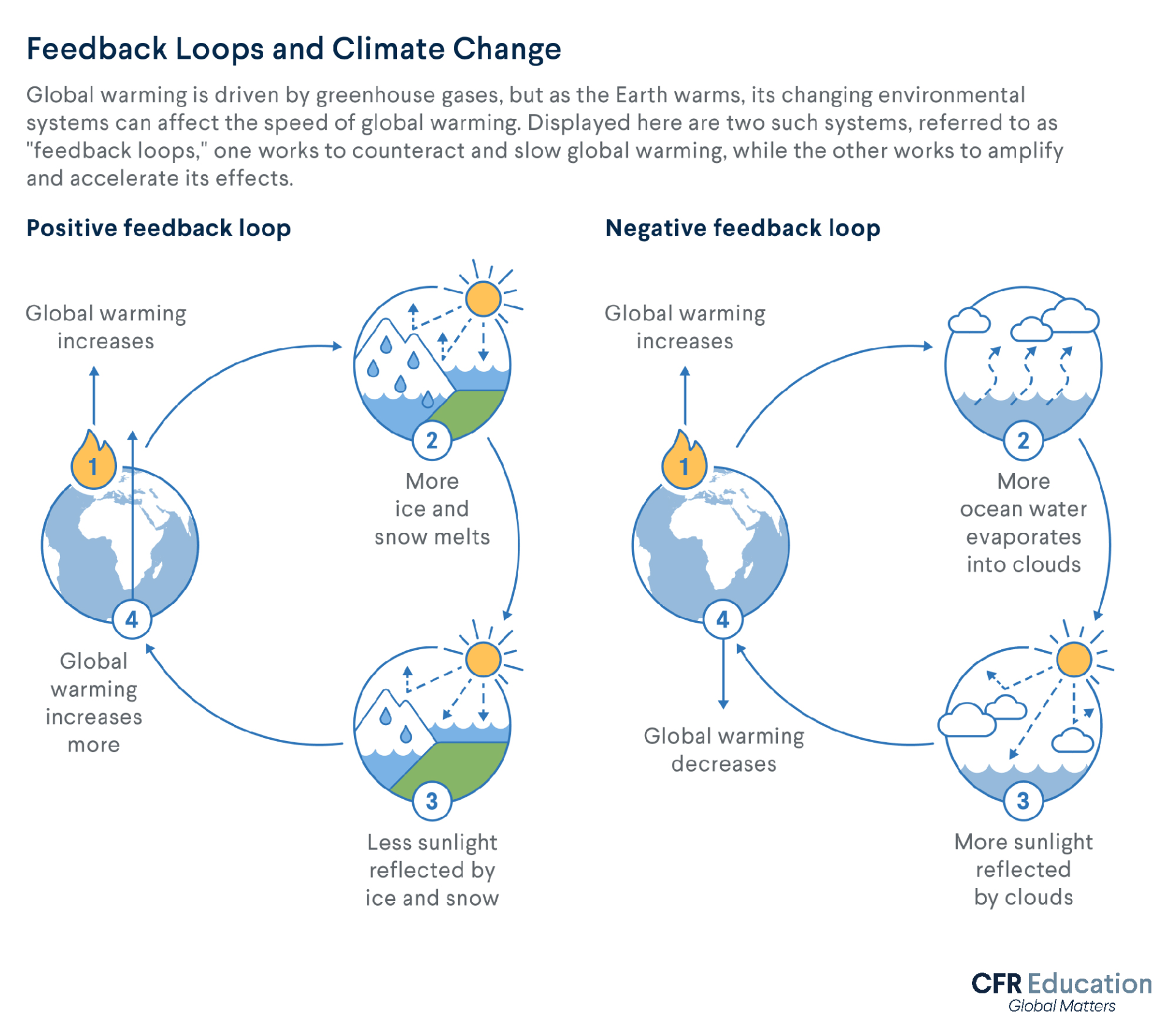
A feedback loop is a process where an initial change triggers secondary effects that either dampen or intensify the original change. In climate science, the most worrying kind is a positive feedback, which does not mean good. It means self-reinforcing.
For example, warming melts bright Arctic ice. Less ice means less sunlight reflected back into space. Darker ocean water absorbs more heat. That extra heat melts more ice. This is the classic ice albedo feedback, and it is one reason the Arctic has warmed much faster than the global average.
The new wave of attention around these loops matters because public climate debate often focuses on a single number: 1.5C, 2C, or some later-century projection. But the Earth system is not a thermostat with one clean dial. It is a network. Push one component hard enough and it can disturb another.
The most important climate question is no longer simply how much humans emit. It is how much the Earth system begins to amplify those emissions once warming is underway.
Climate Feedback Loops Scientists Are Watching Closely
Not every feedback carries the same confidence level, speed, or global impact. Some are already visible. Others remain difficult to model because they involve biology, ocean chemistry, clouds, and regional thresholds. But several deserve immediate attention.
Permafrost Thaw and the Carbon Time Bomb
Permafrost is frozen ground that stores vast amounts of ancient organic carbon. As it thaws, microbes begin breaking down that material, releasing CO2 and methane. The concern is straightforward: warming unlocks emissions that create more warming.
Methane is especially potent over the short term. Even if the release unfolds unevenly rather than explosively, it can still eat into the remaining carbon budget. That is the budget policymakers rely on when they claim the world has time to glide toward net zero. Feedback emissions make that glide path steeper.
Ice Loss and the Albedo Problem
The planet’s reflective surfaces act like a cooling shield. Snow, glaciers, and sea ice bounce sunlight away. As these surfaces shrink, the Earth absorbs more solar energy. This is one of the clearest and most intuitive climate feedback loops.
The loss is not just symbolic. It changes regional weather, ocean circulation, ecosystems, and geopolitical access to polar regions. It also demonstrates a brutal feature of feedbacks: once reflective ice disappears, restoring it is not as simple as lowering emissions slightly. Cooling a transformed system can take far longer than warming it.
Forests Under Heat Stress
Forests are often treated as climate allies because they absorb CO2. But forests under extreme heat, drought, fire, pests, and logging pressure can flip from carbon sinks to carbon sources. That shift is central to the feedback debate.
When trees die or burn, stored carbon returns to the atmosphere. When drought weakens forests, they absorb less carbon in the future. In tropical regions, continued forest loss can also disrupt rainfall patterns, increasing the risk of further dieback. The danger is not just fewer trees. It is a weakened planetary carbon pump.
Oceans, Heat, and Slower Absorption
Oceans have absorbed most of the excess heat trapped by greenhouse gases, along with a major share of human CO2 emissions. That buffering has protected land societies from even more extreme warming. But it comes at a cost.
Warmer water holds less dissolved gas. Ocean stratification can reduce mixing between surface and deep waters. Acidification stresses marine ecosystems. Changes in circulation can alter how heat and carbon move around the planet. If oceans become less efficient at absorbing heat and carbon, more of the warming burden remains in the atmosphere.
Why Models May Still Understate the Risk
Climate models are essential, but they are not crystal balls. They simplify complex systems to make global simulation possible. That means some feedbacks are represented in detail, some are approximated, and some remain uncertain. The problem is not that models are useless. The problem is that uncertainty cuts both ways, and society often behaves as if uncertainty equals safety.
Feedbacks involving clouds, vegetation, soil carbon, ice sheets, and ocean circulation can be difficult to quantify. Some unfold over decades. Others operate over centuries. Some are regional but globally consequential. The challenge for policy is that waiting for perfect precision is itself a decision, and usually a costly one.
Uncertainty is not a discount code for climate risk. It is a warning label for systems that can behave nonlinearly under pressure.
This is where the study’s broader message lands hardest. Even if a feedback is not fully locked into a model, it can still be physically plausible, observable in early stages, and material to risk planning. That should shift how decision-makers interpret projections.
Climate Feedback Loops Change the Net Zero Debate
The standard climate narrative says the world must cut emissions to reach net zero. That remains true. But feedback loops make timing far more important. A tonne of CO2 avoided today is more valuable than a tonne theoretically removed in 2045 because it reduces the chance of triggering additional Earth-system emissions in the meantime.
This is the weakness in corporate and national climate plans that lean heavily on future offsets, future carbon removal, or vague technology curves. If warming amplifiers strengthen, the atmosphere does not wait for a spreadsheet to balance.
Pro Tip for policymakers: evaluate climate targets against near-term emissions reductions, not just distant neutrality dates. The most credible plans cut fossil fuel use this decade, protect natural carbon sinks, and invest in adaptation at the same time.
Pro Tip for businesses: stress-test supply chains against compound climate shocks. A heatwave, drought, flood, crop failure, shipping disruption, and insurance repricing can interact. Feedback logic applies to markets too.
What This Means for Adaptation and Infrastructure
Adaptation planning often assumes historical data can be adjusted upward to estimate future risk. That approach is breaking. If climate feedback loops intensify warming or destabilize regional systems, infrastructure designed for yesterday’s extremes may fail faster than expected.
- Coastal cities need sea-level planning that accounts for ice-sheet uncertainty, not just median projections.
- Grid operators must prepare for higher cooling demand, wildfire risk, drought-stressed hydropower, and storm damage.
- Food systems need redundancy as heat, water stress, pests, and soil degradation interact.
- Insurers and banks should price nonlinear risk rather than relying only on backward-looking loss data.
The uncomfortable reality is that adaptation cannot substitute for mitigation. Higher warming makes adaptation more expensive, more unequal, and eventually impossible in some places. Feedbacks widen that gap.
The Politics of a Self-Amplifying Crisis
Climate feedbacks also complicate politics. Democracies operate on election cycles. Markets reward quarterly performance. Infrastructure is financed over decades. The climate system responds across all of those timescales at once.
That mismatch creates a dangerous temptation: delay action until impacts are undeniable. But feedback loops are precisely why waiting for undeniable proof can be reckless. By the time a system shift is obvious, reversing it may be far harder.
There is also a justice dimension. The countries and communities least responsible for historic emissions are often most exposed to heat, flooding, crop disruption, and debt stress. If feedbacks accelerate impacts, the moral case for climate finance, resilience funding, and faster fossil fuel phase-down becomes stronger, not weaker.
The Bottom Line on Climate Feedback Loops
The study’s warning is not that civilization is doomed. It is that the climate system has accelerators, and humanity is still pressing the pedal. Climate feedback loops turn every fraction of a degree into a bigger strategic question: how much risk are we willing to hand to systems we cannot fully control?
The sane response is a hard pivot toward rapid emissions cuts, serious adaptation, ecosystem protection, and honest risk accounting. The reckless response is to treat feedbacks as distant scientific trivia. They are not. They are the mechanics of a warmer planet, and they are already shaping the future that governments and industries claim to be planning for.
The information provided in this article is for general informational purposes only. While we strive for accuracy, we make no guarantees about the completeness or reliability of the content. Always verify important information through official or multiple sources before making decisions.