EU AI Rules Hit the Fast Lane
EU AI Rules Hit the Fast Lane
The EU AI Act is no longer a distant policy draft sitting in a Brussels folder. It is becoming a hard-edged reality for companies that build, deploy, or buy artificial intelligence across Europe. For startups, this means product choices now carry regulatory consequences. For large tech firms, it means legal, technical, and operational teams have to move in lockstep. And for everyone else, it means the era of AI experimentation without guardrails is ending faster than many expected. The pressure point is simple: if your AI system touches European users, the rules are starting to matter now, not later.
That shift is bigger than compliance theater. It changes how companies label data, document model behavior, manage risk, and decide whether a feature is worth shipping at all. The EU AI Act is shaping up to be the first real attempt to turn AI governance into product engineering. And that will reverberate far beyond Europe.
- The
EU AI Actis moving from policy to operational reality. - Companies need documentation, risk controls, and audit-ready systems.
- Product design and legal review are now tightly linked.
- Smaller firms may feel the burden first, but larger platforms face the biggest exposure.
- Europe could set the template for global AI regulation.
Why the EU AI Act matters now
The biggest mistake companies can make is treating the EU AI Act like a future problem. It is already influencing hiring, procurement, and product roadmaps. Legal teams are asking tougher questions about what data trains a model, what it can do, and whether its outputs can be explained to users and regulators. Engineering teams, meanwhile, are being asked to build systems that can be audited after the fact, not just admired in a demo.
This is not only about frontier model makers. Any company using AI to rank content, screen applicants, recommend products, detect fraud, or automate support can find itself inside the regulatory blast radius. That includes software vendors selling to European customers and global platforms whose systems inevitably spill across borders.
Compliance is no longer a paperwork exercise. Under the
EU AI Act, it becomes part of the product itself.
How the EU AI Act changes product strategy
The law’s core impact is strategic, not just legal. It forces companies to classify AI use cases by risk and then prove they know what they are doing. That sounds manageable until you start mapping a real product stack. One feature may be low-risk in isolation, but combined with customer data, automated decision-making, or sensitive user contexts, the picture changes quickly.
For product leaders, this means the launch checklist has grown up. It is no longer enough to ask whether a feature is accurate or useful. You now have to ask whether it is documented, explainable, monitored, and defensible. That creates friction, but it also imposes discipline on an industry that has often shipped first and rationalized later.
Where teams will feel the pain
The first friction points are predictable:
- Model documentation: Teams need records of training data, intended use, limitations, and known failure modes.
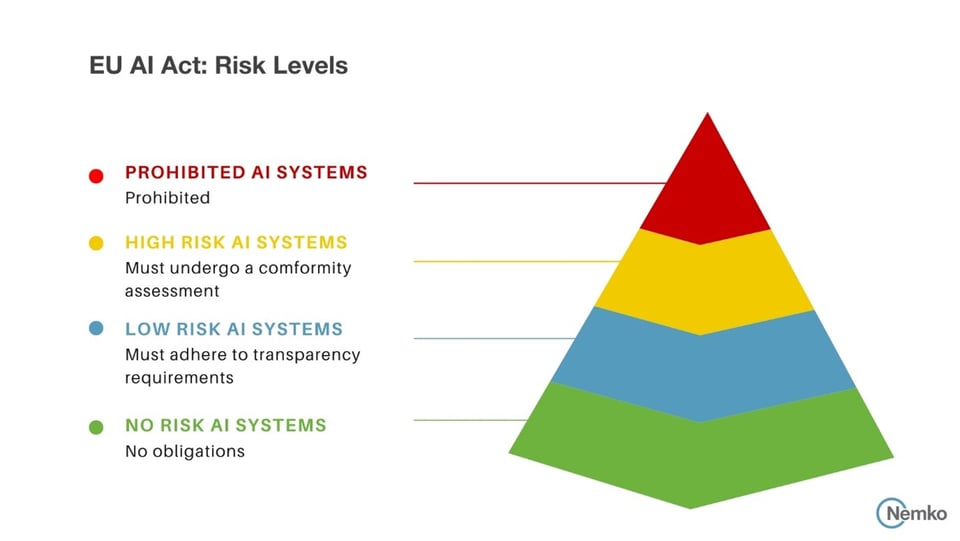
- Risk classification: Businesses must determine whether a system falls into a prohibited, high-risk, or lower-risk category.
- Human oversight: Many use cases will need a person in the loop, not just an automated endpoint.
- Post-launch monitoring: Compliance does not end at deployment. Drift, bias, and misuse have to be watched continuously.
For startups, this can look like red tape. But for mature companies, it is increasingly a moat. If you can prove governance at scale, you can sell into regulated industries with more confidence. Banks, hospitals, insurers, and public-sector buyers are going to want that assurance.
What companies should do first
There is a temptation to wait for the final contours of enforcement before making changes. That is a costly bet. The smarter move is to treat AI governance like security hardening: start with the basics, then build toward maturity. A company does not need a perfect compliance program on day one. It does need a map.
Here is the practical starting point:
- Inventory every
AIsystem in use, including third-party tools. - Document what each system does, who uses it, and what data it touches.
- Assign a risk owner for every high-impact use case.
- Create a review process before new models or features go live.
- Set up logging so outputs and changes can be traced later.
That may sound basic, but basic discipline is what separates teams that can adapt from those that scramble. The companies that survive the EU AI Act era will not necessarily be the ones with the biggest models. They will be the ones with the cleanest operational habits.
Why this is bigger than Europe
Regulation in Europe has a habit of traveling. Data privacy did it. Platform liability has done it. AI governance is likely next. Once a company redesigns a global product to comply with European law, that version often becomes the default everywhere else. The result is regulatory gravity: one region sets the baseline, and the rest of the market starts conforming.
That matters because AI is increasingly embedded in ordinary software, not isolated in research labs. If Europe forces more transparency around model training, content moderation, or automated decision-making, vendors may adopt those standards globally simply to avoid running multiple product stacks.
The
EU AI Actcould become the default export model for AI governance, the way privacy rules became a global operating assumption.
There is also a competitive angle. U.S. companies often complain that regulation slows innovation. But the counterargument is hard to ignore: regulated markets force better engineering. If AI systems have to be tested, documented, and monitored, then some of the hype gets stripped away. What remains is more durable, and often more trustworthy.
The strategic trade-off for businesses
This is the central tension: compliance adds cost, but chaos is even more expensive. A sloppy AI rollout can trigger legal exposure, reputational damage, customer distrust, and product rollback. In that context, the EU AI Act is not just a constraint. It is a forcing function that nudges companies toward better governance.
Still, the burden will not be evenly distributed. Large firms can absorb legal review, internal audits, and technical controls more easily than smaller ones. Startups may find themselves boxed in by requirements that feel built for giants. That creates a real policy question: can Europe protect users without turning compliance into a moat only the biggest companies can cross?
That answer will shape the next few years of AI competition. If the rules are too heavy, innovation may cluster elsewhere. If they are too loose, the whole point of the law collapses. The best outcome sits in the middle: firm enough to restrain abuse, flexible enough to keep the market moving.
A practical lens for leaders
Executives should be asking three questions right now:
- Which of our AI features would we be comfortable explaining to a regulator?
- Which systems could materially affect someone’s access, rights, or opportunities?
- Where are we relying on vendor promises instead of internal evidence?
If those questions are hard to answer, the company is already behind. And that is the real lesson of the EU AI Act: governance can no longer be outsourced to a policy slide deck. It has to be embedded in the way products are built.
What happens next
The next phase will be defined by enforcement, interpretation, and adaptation. Regulators will test the law’s boundaries. Companies will discover how expensive compliance actually is. Lawyers will spend months arguing over whether a use case is truly high-risk or merely awkward. And engineers will be asked to translate abstract obligations into concrete system design.
Expect a wave of tooling around this shift. AI governance platforms, model registries, audit logs, and compliance dashboards are likely to grow quickly because companies need ways to operationalize the law. That creates a new market, but also a new layer of vendor dependence. Businesses will need to be careful not to buy compliance theater disguised as infrastructure.
The winners will be the teams that treat this as a design challenge, not a legal nuisance. The losers will be the ones that wait until a regulator, customer, or journalist forces the issue. The EU AI Act is not killing AI innovation. It is forcing the industry to grow up. And that may be the most important development in AI governance so far.
The information provided in this article is for general informational purposes only. While we strive for accuracy, we make no guarantees about the completeness or reliability of the content. Always verify important information through official or multiple sources before making decisions.