OpenAI Tightens Its Corporate Grip
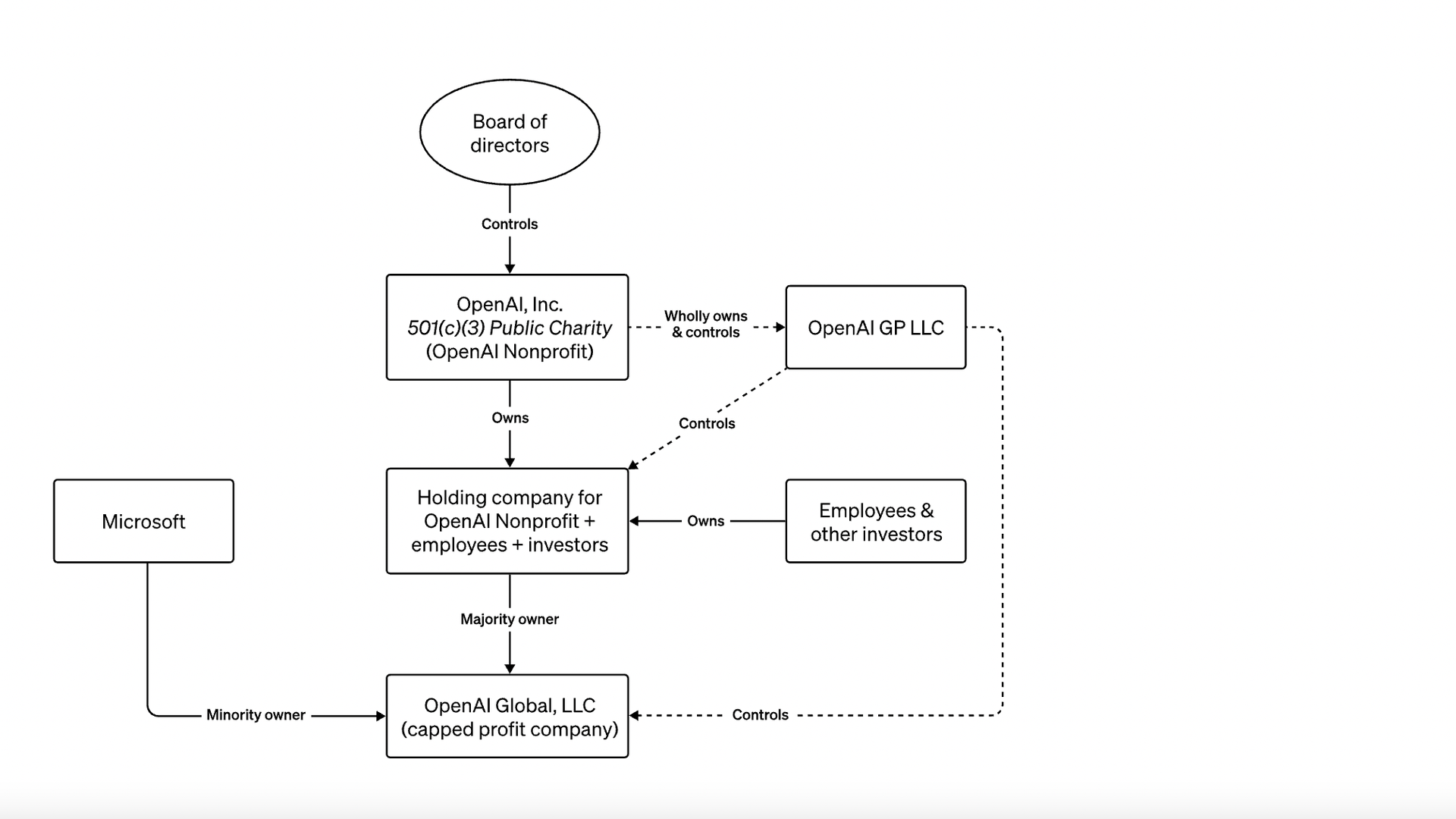
OpenAI corporate structure is no longer a niche governance story for lawyers and investors. It is a frontline issue for anyone betting on the future of artificial intelligence. The company behind the generative AI boom is trying to balance two forces that rarely coexist comfortably: idealistic claims about building AI for humanity, and the hard realities of capital, competition, and control. That tension matters because OpenAI is not just another startup. It sits at the center of an AI arms race involving cloud giants, national regulators, enterprise buyers, and millions of users who now depend on its tools.
When OpenAI changes how power is distributed inside the company, it sends a signal far beyond its boardroom. It shapes who gets to steer one of the most influential technology platforms of the decade, how quickly it can raise money, and whether its original mission can survive contact with the market.
- OpenAI corporate structure is becoming a defining issue for AI governance and investor confidence.
- The company is trying to preserve mission-driven oversight while operating at hyperscale.
- Structural changes could affect fundraising, product velocity, and regulatory scrutiny.
- This is not just about internal politics: it is about who controls foundational AI systems.
Why the OpenAI corporate structure story matters now
OpenAI has always been structurally unusual. It emerged with a public-interest mission, then layered in a capped-profit model to attract the level of funding required to train frontier AI systems. That compromise looked clever when generative AI was still a specialist topic. It looks far more fragile now that AI infrastructure demands billions in compute, partnerships, and distribution.
For a while, OpenAI could sell the market on a hybrid idea: keep mission oversight at the top, but let commercial execution run aggressively underneath. The problem is that scale changes everything. Once a company becomes central to cloud strategy, enterprise software roadmaps, and national competitiveness, governance is no longer a quirky footnote. It becomes the product.
At this stage of the AI race, the structure of the company is part of the technology stack. Governance determines speed, risk tolerance, and who gets final say when money and mission collide.
That is why every shift in the OpenAI corporate structure triggers outsized attention. Investors want clarity. Partners want predictability. Employees want stability. Regulators want accountability. And rivals would love any sign that internal complexity might slow OpenAI down.
What changed and what it signals
The latest move appears to reinforce a familiar truth: OpenAI is still searching for a structure that can support massive commercial ambition without abandoning its founding narrative. That is a difficult line to walk. The company needs enough governance flexibility to move fast, enough investor confidence to keep financing its compute-heavy roadmap, and enough mission language to reassure critics that it has not fully become just another Big Tech machine.
From a strategic perspective, structural tightening usually signals one of three things:
- A need to reduce ambiguity around decision-making.
- A push to make future fundraising or partnerships easier.
- An attempt to prevent governance shocks from destabilizing the business again.
OpenAI has reasons to care about all three. The company has already experienced very public governance turmoil. That kind of disruption might be survivable for a smaller startup. For a company building foundational AI products used by developers, enterprises, and platform partners, it becomes existential.
Control is the real currency
Money matters in AI, but control matters more. Frontier model development requires extraordinary capital, yet the party that controls the roadmap controls much more than revenue. It controls deployment policy, safety trade-offs, product access, and strategic alliances. In practical terms, whoever holds the steering wheel at OpenAI influences how quickly advanced AI capabilities enter the market and under what guardrails.
That is why the OpenAI corporate structure debate is not academic. It is a fight over institutional power in an industry where the winners could shape everything from software development to education, healthcare, media, and defense-adjacent infrastructure.
Mission language still does real work
It is easy to dismiss public-interest language as branding, but in OpenAI’s case it still performs a critical function. The mission acts as a legitimacy layer. It helps the company distinguish itself from purely profit-maximizing competitors. It also gives executives a narrative framework for making controversial decisions, whether that means delaying releases, defending safety investments, or resisting pressure for short-term returns.
The challenge is that mission language only holds if stakeholders believe it has real institutional backing. If the structure looks too commercial, critics will argue the nonprofit or mission-oriented elements are decorative. If it looks too restrictive, investors may worry the company cannot operate efficiently at scale.
Why investors and partners care so much
To outsiders, governance reshuffles can look abstract. To investors and strategic partners, they are immediate operational questions. A company with unclear authority lines can struggle to close deals, maintain leadership continuity, or reassure large customers that the roadmap is stable.
For OpenAI, this matters because its ecosystem is unusually interdependent. It is not simply selling an app. It is tied to cloud capacity, enterprise integrations, API commitments, research timelines, and a public narrative about AI safety. Any uncertainty at the top can ripple through the entire stack.
Capital intensity changes the rules
Training and deploying cutting-edge AI systems is brutally expensive. You need chips, data pipelines, world-class researchers, and sustained infrastructure commitments. This is not the kind of market where governance experimentation can continue forever without consequences.
At some point, capital providers want a cleaner answer to a basic question: Who decides?
If OpenAI can provide that answer while preserving a mission-centric identity, it gains leverage. If it cannot, it risks appearing structurally conflicted at exactly the moment competitors are trying to look more stable, more enterprise-ready, and easier to underwrite.
Enterprise customers buy predictability
Large businesses do not just buy model performance. They buy continuity. They want confidence that the company supplying a critical AI layer will not be derailed by board drama, legal confusion, or strategic whiplash.
This is where governance becomes a sales issue. If OpenAI wants to deepen its role inside major enterprises, public institutions, and international markets, it needs to project not just innovation but institutional durability.
For enterprise AI, trust is not only about model outputs. It is about whether the vendor behind the model can govern itself under pressure.
The bigger industry lesson
OpenAI is the most visible example, but the underlying problem is industry-wide. AI companies are trying to build technologies with systemic consequences using startup-era structures designed for speed. That mismatch is becoming impossible to ignore.
Foundational AI firms now sit in a strange middle ground between research labs, software vendors, and quasi-infrastructure providers. Traditional corporate governance does not fit neatly. Neither does a purely nonprofit model. The result is a wave of hybrid structures, mission charters, special voting arrangements, and board experiments that all attempt to answer the same question: how do you scale transformative technology without losing control of its consequences?
OpenAI is the test case everyone is watching
Because OpenAI has become the public face of the generative AI boom, its structural decisions will likely influence how others organize. If its model proves durable, more AI companies may borrow similar mission-plus-commercial hybrids. If it falters, investors and founders may move toward simpler, more conventional governance frameworks.
That has implications beyond Silicon Valley. Policymakers are already looking for ways to understand who is accountable when powerful AI systems are built and deployed. If even the most prominent AI company struggles to define internal authority cleanly, regulators will have more reason to intervene.
What this could mean next
The immediate question is whether the revised structure reduces uncertainty or merely repackages it. That depends on execution. A cleaner organizational chart is useful, but only if it holds up during moments of conflict: safety disputes, product launch pressure, executive turnover, or financing negotiations.
Several future implications stand out.
1. More scrutiny, not less
Any attempt to refine the OpenAI corporate structure will invite close examination from investors, employees, regulators, and critics. The company is too important now to make structural changes without triggering a broader debate about accountability.
2. Governance may become a competitive advantage
If OpenAI can show that its structure supports both innovation and oversight, that becomes a strategic asset. In an AI market crowded with performance claims, credible governance could become a differentiator.
3. The nonprofit question will keep resurfacing
As commercial stakes rise, the relationship between mission entities and profit-oriented operations will remain contentious. That tension is not likely to disappear because it sits at the heart of OpenAI’s identity.
4. Rivals will position against the complexity
Competitors may use any perceived ambiguity to pitch themselves as easier partners, more straightforward investments, or safer long-term bets for enterprise adoption.
Why this matters beyond OpenAI
The easiest mistake is to frame this as one company’s internal cleanup. It is bigger than that. OpenAI’s structure is a preview of a broader power struggle over advanced AI. The core question is simple: can institutions built for public benefit still govern technologies built with private capital at massive scale?
That question is going to shape the next decade of technology policy and platform economics. AI is moving too quickly, and becoming too embedded in core systems, for governance to remain a background issue. The organizations that build these models will need mechanisms for accountability that are credible not just on paper, but under pressure.
OpenAI’s latest move suggests the company understands that the old ambiguity is no longer sustainable. The market wants clarity. The public wants assurance. The industry wants a model that can actually work.
Whether OpenAI has found that model is another matter entirely.
Bottom line: the OpenAI corporate structure story is not a distraction from the AI race. It is the AI race, viewed through the lens that may matter most in the long run: who gets to control the systems that everyone else will soon depend on.
The information provided in this article is for general informational purposes only. While we strive for accuracy, we make no guarantees about the completeness or reliability of the content. Always verify important information through official or multiple sources before making decisions.