Police Clash Exposes AfD’s Growing Political Pressure
Police Clash Exposes AfD’s Growing Political Pressure
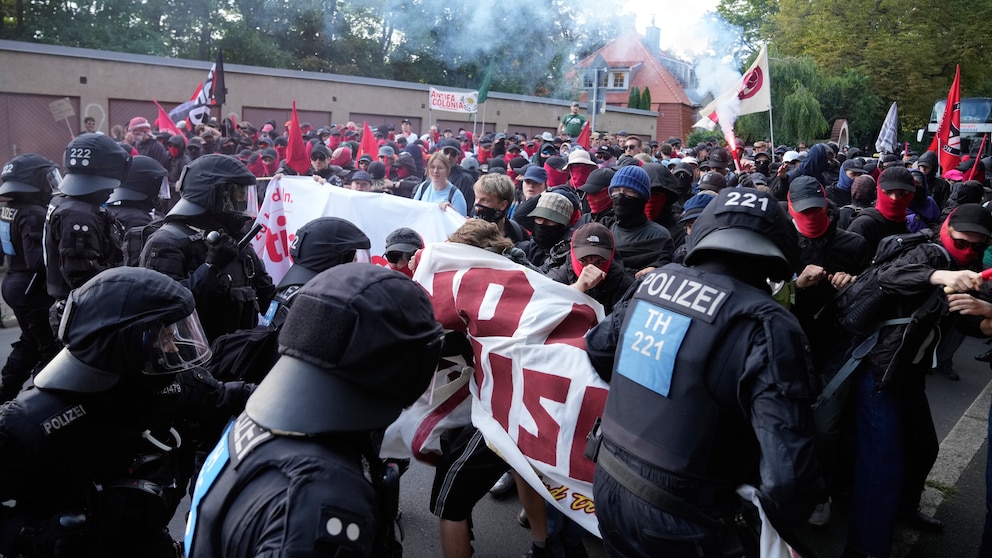
The latest police clash outside an AfD meeting is more than a street-level confrontation. It is a snapshot of Germany’s escalating political fracture, where far-right momentum, public anger, and security pressure are now colliding in plain sight. For policymakers, the scene is a warning. For voters, it is a sign that the country’s democratic tensions are no longer confined to parliament or polling data. The AfD has become a political force that draws not only supporters but also intense resistance, and that makes every public appearance a flashpoint. What happens outside these meetings now matters as much as what happens inside them, because the battle over the AfD is really a battle over Germany’s political direction.
- The police clash highlights how the AfD has become a national pressure point, not just a party.
- Street protests now mirror deeper divisions over immigration, identity, and democratic legitimacy.
- Security around political events is becoming part of Germany’s wider political story.
- The confrontation may strengthen both anti-AfD mobilization and the party’s grievance politics.
- What looks like a local incident carries broader implications for stability across Europe.
Why the police clash matters now
The AfD protest clash is important because it captures a larger shift: politics is becoming less tidy, less predictable, and more confrontational. Germany has long prided itself on institutional stability, but the rise of a hard-right party has changed the temperature. Every rally, meeting, and public appearance can now trigger counter-mobilization. That makes the AfD more than an electoral phenomenon. It has become a stress test for how a modern democracy handles polarization without letting it spill into permanent disorder.
When police are forced to intervene outside a political meeting, the optics are bad for everyone involved. Protesters risk being framed as disruptive, while the party can cast itself as a victim of political intolerance. The state is left trying to preserve order without appearing partisan. That balancing act is getting harder as distrust rises on all sides.
The AfD protest clash and the politics of visibility
The AfD understands visibility better than most parties. That is part of its advantage. The more attention it receives, the easier it becomes for it to present itself as the voice of ignored voters and embattled communities. But visibility also brings resistance. Anti-AfD protesters are not simply reacting to one meeting. They are reacting to what the party represents: hardline nationalism, anti-immigration rhetoric, and a challenge to Germany’s postwar political consensus.
This is where the cycle becomes dangerous. Protesters want to deny the AfD a normal public platform. The party uses the protests to argue that elites and opponents fear open debate. Meanwhile, police are caught in the middle, managing crowd control in a highly politicized environment. The result is a public spectacle that amplifies the message of both sides.
When a party becomes a permanent flashpoint, it is no longer just competing for votes. It is competing to define the boundaries of legitimate politics.
What this says about Germany’s political climate
The clash outside the meeting points to a broader truth: Germany’s political center is under pressure. Economic anxiety, migration debates, and frustration with mainstream parties have created fertile ground for the AfD’s rise. But the backlash against the party has also intensified. That combination creates a feedback loop in which each side sees the other as an existential threat.
Security is becoming political theater
In moments like this, policing is never just about public order. It becomes a visible part of the political narrative. A strong police presence can prevent chaos, but it can also reinforce the sense that democracy is under strain. If officers move aggressively, critics accuse the state of overreach. If they are restrained, others say authorities are letting disorder win. There is no easy outcome.
This matters because the AfD protest clash is not an isolated incident. Similar tensions have appeared across Europe as populist and nationalist parties draw both passionate support and organized resistance. Germany, with its history and its political weight, is especially sensitive to that dynamic. A street clash there resonates beyond one city or one event.
Why the backlash may strengthen the AfD
There is a familiar political irony here: attempts to suppress a movement can sometimes help it grow. The AfD has often benefited from portraying itself as excluded from fair treatment. Clashes outside its meetings allow it to frame opponents as intolerant and undemocratic, even when the protests are driven by legitimate concerns. That does not mean the backlash is unjustified. It means the party is skilled at converting conflict into narrative advantage.
For mainstream parties, this creates a strategic dilemma. Ignoring the AfD can look like denial. Confronting it too aggressively can make it more powerful. The real challenge is to address the grievances that fuel its support without legitimizing the most corrosive parts of its platform.
How political confrontation is reshaping public life
The AfD protest clash is also a reminder that political disputes are leaving institutional spaces and moving into the streets. That is not healthy. It increases the risk of escalation, makes compromise harder, and turns routine events into security operations. It also puts ordinary citizens in a more adversarial relationship with politics itself.
For democracies, that shift is costly. Public trust depends on the idea that disagreements can be managed through debate, elections, and institutions. When meetings require heavy police protection and protests routinely spiral into clashes, the message is that politics is becoming a zero-sum contest. That is how democratic fatigue sets in.
Pro tip for reading these events clearly
Do not focus only on who shouted louder or who was pushed back by police. Look at the structure underneath the confrontation: which grievances are driving turnout, which institutions are losing trust, and which parties are gaining from the outrage cycle. That is where the real story lives.
Why this matters beyond Germany
The significance of the incident extends well beyond one meeting outside one building. Across Europe, far-right parties are gaining traction by exploiting anxiety over migration, inflation, identity, and governance. At the same time, anti-far-right movements are growing more organized, more visible, and more willing to confront them directly. That creates a volatile political environment in which public spaces become battlegrounds.
If Germany struggles to contain that tension, it will send a signal to the rest of Europe. The question is not whether protest is legitimate. It is. The question is whether democratic systems can absorb intense disagreement without letting it degrade into permanent confrontation. That is the test now facing not only the AfD, but the political mainstream built to contain it.
The strategic challenge for Germany’s mainstream parties
Mainstream parties need to do two things at once: defend democratic norms and rebuild credibility with voters who feel ignored. That is a difficult line to walk, but it is essential. Simply condemning the AfD is not enough if the underlying frustrations keep growing. Yet normalizing the party is equally risky if it pulls the political center toward harder, more exclusionary positions.
The best response is disciplined, not theatrical. That means policy that addresses housing, security, migration, and economic insecurity without panic. It also means refusing to let every confrontation become free advertising for the AfD. The more politics is reduced to spectacle, the more the party benefits from the noise.
The real battle is not over one protest. It is over whether democratic institutions can still outcompete outrage as a political strategy.
What to watch next
Expect more scenes like this if the AfD continues to gain visibility. More protests. More police deployments. More efforts by the party to claim victimhood. More pressure on local authorities to keep order while avoiding the appearance of political bias. The cycle is self-reinforcing unless the underlying causes are addressed.
For now, the message from the street is clear: the AfD is no longer a fringe irritant that can be ignored. It is a central force in Germany’s political contest, and that makes every meeting, every protest, and every police intervention part of the same larger story.
The AfD protest clash is not just about confrontation. It is about the fragile state of political trust in a country where that trust once seemed unusually secure. That is why this moment matters. It shows how quickly public anger can turn a meeting into a national symbol, and how hard it is for democracy to hold the line when politics becomes a street fight.
The information provided in this article is for general informational purposes only. While we strive for accuracy, we make no guarantees about the completeness or reliability of the content. Always verify important information through official or multiple sources before making decisions.