Rewrite the AI Playbook Now
Rewrite the AI Playbook Now
AI is no longer the shiny experiment parked in a lab while executives debate the future. It is already inside customer support, software development, marketing, hiring, and operations, quietly changing how companies work and how mistakes scale. That is the real pressure point: organizations are moving fast enough to capture upside, but not fast enough to control the fallout. The result is a widening gap between what AI can do and what businesses are actually ready to manage. If your team is still treating AI like a side project, you are probably underestimating both the opportunity and the risk. The companies that win the next phase will not be the ones that adopt the most tools. They will be the ones that build a clearer AI strategy around governance, accountability, and measurable outcomes.
- AI adoption is accelerating, but governance and oversight are lagging behind.
- The biggest advantage now comes from disciplined deployment, not experimentation for its own sake.
- Teams need clearer rules for data, quality control, and human review.
- The next wave of winners will connect AI use cases directly to business value.
- Companies that delay policy and training may pay later through errors, compliance issues, and trust loss.
Why the AI strategy conversation just got more urgent
The problem with most AI strategy conversations is that they focus on capability first and consequence later. That order is backwards. When a model produces an answer in seconds, it feels like progress. But speed without guardrails can create messy downstream costs: hallucinated outputs, privacy exposure, weak audit trails, and brittle workflows that collapse when edge cases show up.
That is why the current phase of AI adoption is less about discovering what the technology can do and more about deciding where it should be allowed to operate. A smarter approach starts by asking a blunt question: which tasks deserve automation, and which ones still require human judgment? The answer is not the same across departments, and it should not be.
AI is powerful, but power without policy is just risk with a better interface.
How leading teams are reframing AI strategy
The strongest organizations are moving away from vague optimism and toward operational clarity. They are not asking employees to “use AI” in the abstract. They are defining specific use cases, identifying owners, and establishing approval pathways. That matters because AI is not a single tool. It is a layer that can touch search, summarization, coding, analytics, and customer engagement all at once.
To make that manageable, leadership teams are splitting adoption into three buckets:
- Low-risk assistance – drafting, summarizing, internal knowledge retrieval.
- Medium-risk augmentation – customer service triage, sales support, code suggestions.
- High-risk decision support – hiring, finance, medical, legal, and security-related workflows.
This framework is useful because it avoids the all-or-nothing trap. A company does not need to ban AI to stay safe. It needs to match the level of oversight to the level of impact.
Where automation should stop
There is a point where AI becomes a liability if it is allowed to operate without meaningful human review. Sensitive decisions are the obvious line, but the less obvious danger is compound error. A flawed model output copied into a report, then into a dashboard, then into an executive decision, can create a chain of confident mistakes that looks efficient until it fails publicly.
That is especially relevant for teams using generative tools in content production, internal analysis, and customer communications. A polished answer can hide weak sourcing, stale data, or subtle bias. The interface is convincing. The output is not always correct.
What a practical AI strategy looks like
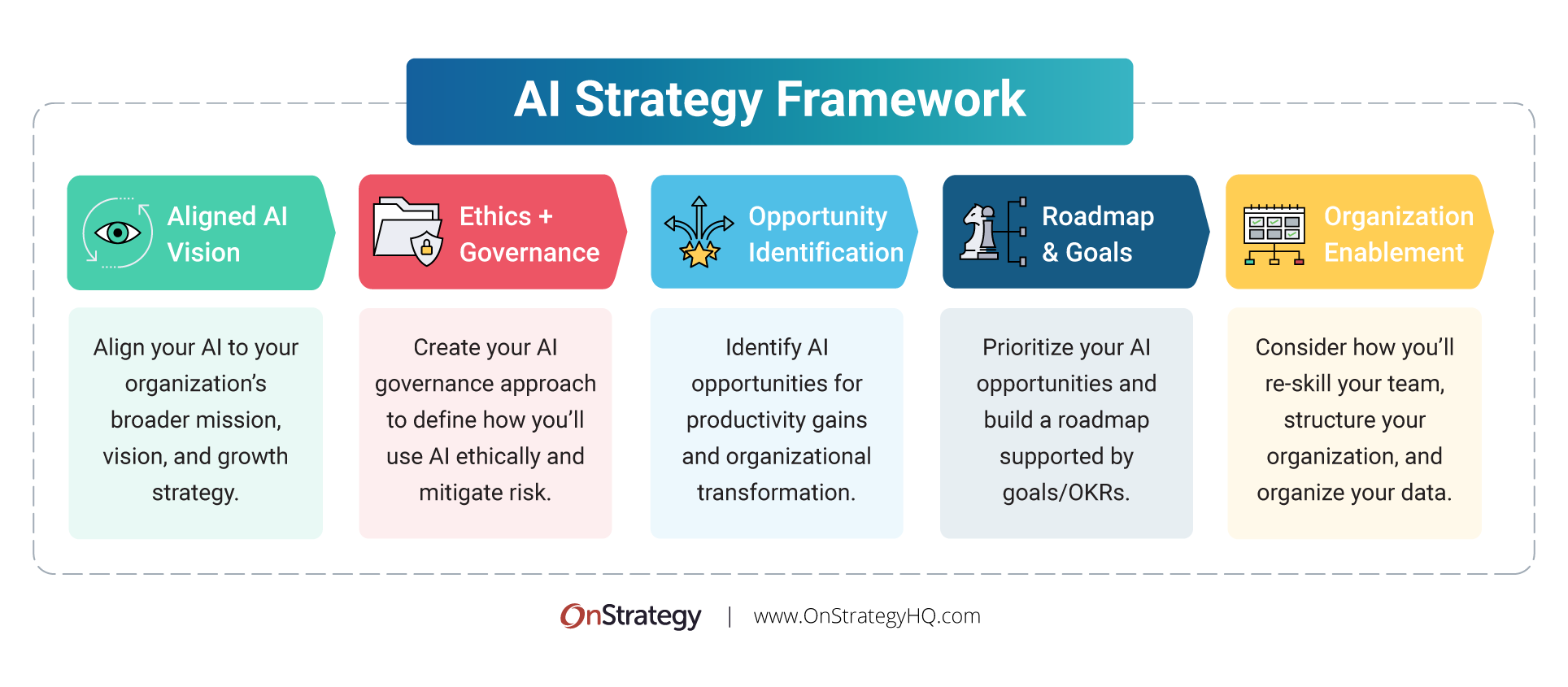
A practical AI strategy is less glamorous than a grand transformation narrative, but it is far more durable. It begins with inventory. Organizations need to know which teams are already using AI, what tools they rely on, and what data those tools can access. Shadow usage is one of the fastest ways to create avoidable risk, especially when employees adopt consumer-grade tools without checking policy or security requirements.
Once the inventory exists, leaders should define a basic operating model:
- Assign ownership for each AI use case.
- Classify the sensitivity of the data involved.
- Require review for external-facing outputs.
- Set performance metrics beyond speed, including accuracy and user trust.
- Document fallback procedures when the model is wrong or unavailable.
This is not bureaucracy for its own sake. It is what separates repeatable value from chaotic experimentation.
Pro tip for managers
If a team cannot explain why a model is being used, what data it touches, and who signs off on its output, the use case is not ready. That does not mean it should be killed. It means it needs definition before deployment.
Why the business case is changing
For a while, many organizations approached AI like a novelty tax: pay a little now, see if something useful happens later. That phase is ending. Budget holders now want proof that AI improves throughput, lowers costs, or lifts revenue in ways that survive scrutiny. This is where a disciplined AI strategy becomes a competitive advantage rather than a compliance exercise.
The best return on AI often appears in unglamorous places. Internal search gets better. Knowledge workers waste less time digging through documents. Support teams resolve routine requests faster. Engineers spend less time on boilerplate. These are not headline-grabbing transformations, but they compound quickly.
At the same time, the hype cycle is making buyers more skeptical. That is healthy. Not every workflow deserves AI. Not every vendor pitch deserves a pilot. And not every pilot deserves a rollout.
The smartest AI investments are often the least flashy ones, because they solve real workflow friction instead of chasing demos.
Governance is becoming the moat
The next phase of competition is likely to reward companies that can move fast without creating organizational chaos. That means governance is no longer a back-office concern. It is part of product quality, brand protection, and enterprise resilience.
Good governance does not mean slowing innovation to a crawl. It means building a system that can withstand scrutiny from customers, regulators, employees, and investors. That includes clear policies on data retention, output review, vendor evaluation, and incident response. It also means training people to recognize model failure modes instead of assuming the machine is objective.
For smaller teams, this can sound intimidating. It should not. Start simple:
- Keep a register of AI tools in use.
- Restrict sensitive data from unapproved systems.
- Use human review for any customer-facing or legally sensitive output.
- Track errors and near misses.
- Update the policy as tools and regulations evolve.
Those basics will not solve every problem, but they will prevent many of the worst ones.
The future of AI strategy will reward restraint
The most important shift ahead may be cultural. The companies that treat AI as a productivity shortcut alone will eventually hit trust issues. The companies that treat it as an operating discipline will build something stronger: a repeatable way to capture value without losing control.
That matters because AI systems will keep getting faster, cheaper, and more embedded in everyday software. The threshold for adoption will drop. The threshold for accountability should rise. If your organization can explain its choices, test its outputs, and limit exposure when needed, it will be far better positioned for the next wave.
There is no finish line here. An effective AI strategy is a living system, not a one-time memo. It should evolve as the tools evolve, the regulations tighten, and the business learns where automation genuinely helps. That is the uncomfortable truth and the opportunity: the real advantage will belong to teams that can pair ambition with discipline.
The age of casual AI adoption is ending. The age of intentional deployment is just beginning.
The information provided in this article is for general informational purposes only. While we strive for accuracy, we make no guarantees about the completeness or reliability of the content. Always verify important information through official or multiple sources before making decisions.