Stop AI Scams Before They Drain You
Stop AI Scams Before They Drain You
AI scams have moved past spammy emails and obvious robocalls. They now sound like your family, mimic your bank, fake customer support, and generate convincing messages at industrial scale. That changes the risk calculation for everyone with a phone, inbox, or social media account. The old advice – look for bad grammar, strange formatting, or awkward phrasing – is no longer enough. Generative tools have made fraud cheaper to produce and easier to personalize, while deepfake audio and synthetic identities make social engineering feel alarmingly real. For consumers, this means one missed signal can lead to stolen savings, hijacked accounts, or long-term identity damage. For businesses, the threat is bigger: trust itself is under attack. The smartest response is not panic. It is updating your scam defenses for an era where machines can fake familiarity at scale.
- AI scams are more persuasive because they combine automation, personalization, and believable language or voice cloning.
- The most dangerous attacks create urgency: fake bank alerts, family emergencies, account lockouts, and invoice fraud.
- Old red flags still matter, but verification habits now matter more than spotting typos.
- Consumers should use out-of-band checks, account security tools, and family safe words to reduce risk.
- Businesses need stronger identity verification because customer trust is becoming a security layer.
Why AI scams feel different now
Traditional scams relied on volume. Fraudsters blasted millions of low-quality emails and hoped a small percentage would bite. AI changes that model. It lets bad actors generate endless variations of believable messages, tailor them to specific victims, and adapt their language instantly. A scammer no longer needs strong writing skills, polished scripts, or even much time. With the right prompts, they can create fake support chats, romance messages, job offers, or urgent payment requests that sound uncannily professional.
The shift is not just about language quality. It is about friction disappearing for criminals. Tools that summarize social profiles, draft custom pitches, and imitate real speech can compress the time between targeting and theft. What used to require a call center and a script can now be done with a laptop, a cloned voice sample, and a payment app.
The real breakthrough for scammers is not creativity. It is scale with credibility.
That matters because people do not make decisions in perfect conditions. They respond when they are rushed, tired, embarrassed, or afraid. AI exploits those moments better than previous fraud waves because it can manufacture realism on demand.
How AI scams work in practice
Voice cloning turns trust into a weapon
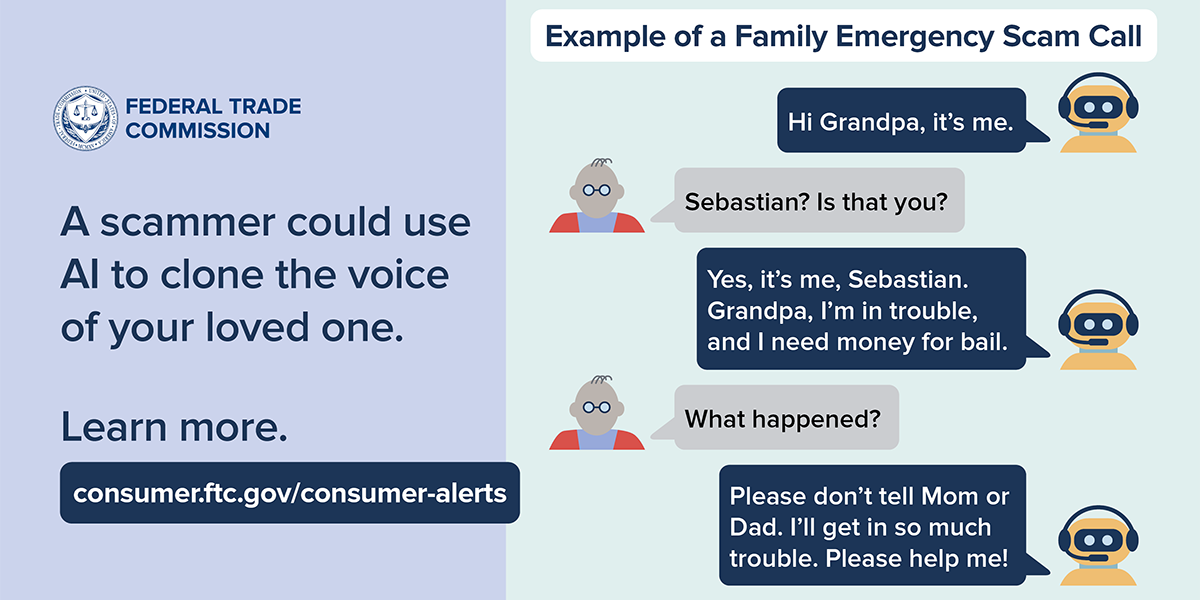
One of the most unsettling developments is cheap voice cloning. A short sample pulled from social video, voicemail, or another recording can be enough to imitate someone you know. The result may not fool a forensic examiner, but it does not have to. It only has to work for 30 panicked seconds.
A call from a “child” saying they have been in an accident. A “boss” requesting a wire transfer. A “relative” asking for emergency bail money. These are old scam formats with a new layer of persuasion. The emotional trigger is the point.
Chatbots make phishing conversational
Classic phishing often failed because it felt robotic. AI flips that weakness into a strength. Fraudsters can now run convincing, multi-turn conversations that answer objections in real time. If you challenge a fake bank representative, the system can generate a plausible explanation. If you hesitate, it can escalate urgency. If you ask for help, it can walk you through the theft step by step.
That makes phishing less like receiving a suspicious letter and more like being manipulated by a patient, responsive operator.
Synthetic identities blur the line between fake and real
Another dangerous trend is the rise of synthetic identities: profiles built from a mix of stolen and fabricated data. AI helps fill in the gaps with believable names, profile photos, resumes, and message histories. These identities can be used to open accounts, run marketplace scams, or build trust over time before requesting money.
For platforms, this creates a moderation problem. For users, it means that a profile looking polished or active is no longer a meaningful trust signal.
AI scams and the collapse of old red flags
For years, consumer safety advice focused on obvious errors. Misspellings. Strange logos. Weird spacing. Those clues still matter, but they are no longer reliable enough. AI can write clean prose, mimic brand tone, and structure messages like real support teams. A text message with perfect grammar is not proof of legitimacy. Neither is a professional-sounding caller.
This is the core challenge of modern scam defense: you cannot authenticate intent from presentation alone. The surface layer of communication has become easy to fake.
That means the best defense shifts from visual detection to process discipline. Instead of asking, “Does this look real?” ask, “Can I verify this through a separate trusted channel?” That mental switch is critical.
How to protect yourself from AI scams
The good news is that while AI improves deception, it does not eliminate the value of basic verification. In fact, the strongest protections are surprisingly low-tech because they interrupt the emotional momentum scammers depend on.
Use out-of-band verification every time
If a caller claims to be from your bank, hang up and call the number on the back of your card. If a message says a family member needs money urgently, contact them directly through a known number. If a company texts you a login link, do not tap it – open the app or type the site manually.
This one habit defeats a huge percentage of attacks because it breaks the scammer’s controlled environment.
Create a family safe word
For households worried about cloned-voice emergencies, set a simple code word or phrase that only trusted relatives know. If someone calls in distress, ask for it. The tactic sounds old-fashioned because it is – and that is exactly why it works.
Lock down account recovery paths
Your email account is often the master key to your digital life. Protect it first. Use strong, unique passwords and a password manager. Turn on multi-factor authentication, ideally through an authenticator app or hardware key rather than relying solely on SMS. Review backup email addresses, phone numbers, and recovery questions.
Fraudsters often target the weakest account recovery route, not the front door.
Slow down payments
Scammers push instant payment methods because speed reduces reflection and reversibility. Treat any request involving gift cards, wire transfers, crypto, or immediate payment apps as high risk. Build a personal rule: no large transfer without independent verification and a waiting period.
Watch for context mismatch
Even polished AI scams often slip in the surrounding context. A bank asking for information it already has. A manager using an unusual tone. A friend making an odd request. A support agent pressuring you to install remote access software. The content may look real, but the situation feels off. Trust that friction.
Why businesses should worry about AI scams too
This is not just a consumer headache. Companies are now exposed on multiple fronts: executive impersonation, invoice fraud, fake candidate profiles, fraudulent customer support interactions, and account takeover attempts that scale far faster than human teams can review.
Customer-facing brands are especially vulnerable because scammers borrow their identity to close the trust gap. When users repeatedly receive convincing fake alerts from a bank, retailer, or telecom provider, the damage goes beyond stolen money. It erodes confidence in legitimate communications. Every authentic notification starts to look suspicious.
When trust becomes cheap to imitate, verification becomes part of the product.
That has strategic implications. Businesses need clearer authentication patterns, stronger in-app messaging, and support workflows that teach users what the company will never ask for. They also need internal controls that assume voice and text can be spoofed. Finance approvals, password resets, and vendor changes should require layered verification, not just a familiar name or believable call.
What the next wave of AI scams could look like
Hyper-personalized attacks
As generative tools improve, expect scams to feel even more specific. Public data, prior breaches, and social breadcrumbs can be combined into messages that reference your employer, recent purchase, location, or family. Precision increases response rates.
Better multimodal fakes
Today, a voice clone might be enough. Tomorrow, fraudsters will more routinely combine voice, image, text, and live video filters. Even if the quality remains imperfect, the psychological effect will be powerful in moments of stress.
Automated scam testing
Criminals can use AI the same way marketers use optimization tools: testing scripts, refining subject lines, and improving conversion paths. That means scams will not just multiply. They will iterate.
The uncomfortable truth is that fraud is becoming a product discipline. The countermeasure has to be better security habits, better platform defenses, and better public awareness.
Pro tips that actually reduce risk
- Set transaction alerts on banking and credit accounts so suspicious activity is caught quickly.
- Freeze your credit if you are not actively applying for loans. It makes identity-based account opening harder.
- Separate channels: use one email for financial accounts and another for shopping or newsletters.
- Minimize public voice samples where possible, especially for children and older relatives who may be targeted in family emergency scams.
- Practice a response script: “I do not approve anything on unsolicited contact. I will call back through an official number.”
Why AI scams matter beyond individual victims
The broader story here is about digital trust. The internet has always required a balance between convenience and skepticism. AI is pushing that balance harder by making imitation cheap, fast, and personalized. The result is not just more fraud. It is a more exhausting online experience, where every urgent request demands investigation.
That carries social and economic costs. Older adults may become more isolated from digital services. Small businesses may suffer losses from impersonation schemes. Customer support systems may become less efficient as verification expands. And consumers may grow numb, missing real alerts because they look too much like fake ones.
Still, there is a practical takeaway: you do not need to outsmart every new tool scammers use. You need a repeatable verification system that works even when the deception looks polished. That means fewer reflexive clicks, more independent confirmation, and a willingness to pause when someone wants you to panic.
AI scams are not dangerous because machines became geniuses. They are dangerous because they amplify the oldest con in the book: manufactured urgency wrapped in borrowed trust. Once you see that pattern, the defense becomes clearer. Verify first. Pay later. Assume familiarity can be faked.
The information provided in this article is for general informational purposes only. While we strive for accuracy, we make no guarantees about the completeness or reliability of the content. Always verify important information through official or multiple sources before making decisions.