AI Data Centres Redraw Tech Power

The AI boom has moved from software demos to concrete, steel, substations, and water pipes. AI data centres are now the physical battleground for the next phase of computing, and the stakes are bigger than faster chatbots. Every hyperscaler, chipmaker, utility, regulator, and local council is being pulled into the same question: who gets enough power to run the future? For businesses, this is no longer an abstract infrastructure story. It affects cloud pricing, model access, sustainability promises, latency, national competitiveness, and the resilience of digital services people use every day. The industry wants bigger models, faster inference, and always-on automation. The grid was not designed for that kind of appetite.
- AI data centres are becoming strategic infrastructure, not just back-office tech facilities.
- Power availability is now as important as chip supply in the race to scale artificial intelligence.
- Local communities face real trade-offs around jobs, water use, land, noise, and grid pressure.
- Enterprises should expect cloud architecture, procurement, and sustainability reporting to change fast.
- The winners will be companies that optimize models, workloads, energy contracts, and location strategy together.
AI Data Centres Have Become The New Industrial Stack
The internet used to feel weightless. Apps launched in the cloud, photos synced invisibly, and enterprise software scaled with a few clicks. Artificial intelligence has shattered that illusion. Training and running large models requires huge clusters of GPU servers, high-speed networking, advanced cooling systems, redundant power feeds, and facilities engineered for loads that would have looked extreme only a few years ago.
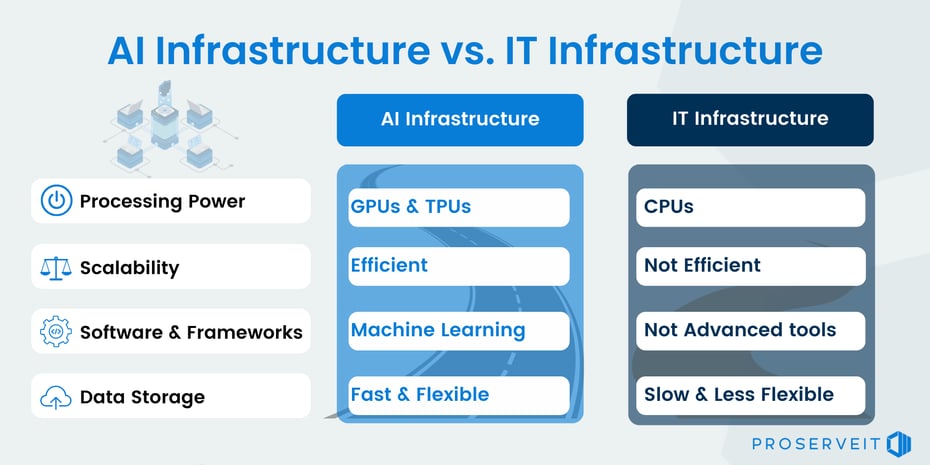
The shift is structural. Traditional data centres were designed around relatively mixed workloads: databases, web applications, storage, enterprise software, streaming, and backup services. AI facilities are different. They concentrate dense, power-hungry hardware into tightly coupled clusters where performance depends on keeping thousands of accelerators working together. That changes the economics of everything from rack design to electricity procurement.
The most important AI race may not be about who has the cleverest model. It may be about who can secure power, land, cooling, chips, and network capacity at industrial scale.
This is why AI infrastructure has become a board-level issue. It is not enough to buy access to a model API and assume the platform will always be cheap, fast, and available. Behind every prompt sits a supply chain of silicon, energy, fibre, water, logistics, and planning permission.
Why AI Data Centres Are Straining The Grid
The pressure comes from both training and inference. Training a frontier model requires massive compute bursts over weeks or months. Inference, the process of running a trained model for users, can be even more consequential over time because it happens continuously and at global scale. Every customer support bot, coding assistant, AI search result, image generator, and workplace copilot adds to demand.
Unlike some consumer internet traffic, AI workloads can require sustained high power. A rack filled with GPU servers may draw many times more electricity than a conventional enterprise rack. Multiply that by thousands of racks, then add cooling, backup systems, storage, and networking, and the resulting facility starts to look less like a server room and more like a major industrial site.
The bottleneck is not only electricity generation
It is tempting to reduce the debate to whether there is enough electricity. The harder issue is delivery. Data centres need grid connections, transformers, substations, transmission lines, and local capacity. Those projects can take years. A region may have renewable energy targets and still lack the grid infrastructure to support a new hyperscale AI campus quickly.
This creates a new geography of digital power. Markets with available energy, permissive planning, cool climates, fibre connectivity, and political support are becoming more attractive. Places with constrained grids or community resistance may lose out, even if they have strong tech talent.
Cooling is becoming a design frontier
AI hardware runs hot. More dense compute means cooling is no longer a secondary facilities problem. Operators are experimenting with advanced airflow, liquid cooling, and direct-to-chip systems. Terms like liquid cooling, heat reuse, and power usage effectiveness are moving from engineering teams into investor calls and policy discussions.
Pro Tip: businesses buying AI services should ask vendors not just about model quality, but also about infrastructure resilience, regional availability, energy sourcing, and incident response. The cheapest model endpoint is not always the safest long-term dependency.
AI Data Centres And The New Cloud Economics
The last decade of cloud strategy was built around elasticity. Developers learned to spin resources up and down, store more data, and treat infrastructure as programmable. AI complicates that model because the most valuable compute is scarce, expensive, and physically constrained.
That scarcity is already reshaping the cloud market. Hyperscalers with deep capital budgets can reserve chips, build facilities, and negotiate long-term power contracts. Smaller providers may differentiate through specialized hardware, regional compliance, open-source stacks, or lower-cost inference. Enterprises, meanwhile, are being forced to decide which AI workloads deserve premium infrastructure and which can be optimized, delayed, compressed, or run locally.
Model efficiency is now a financial strategy
The first wave of generative AI rewarded scale. Bigger models often produced more impressive results. The next wave will reward efficiency. Techniques such as quantization, distillation, retrieval augmented generation, caching, and workload routing can reduce compute demand without necessarily destroying user experience.
For many companies, the smartest AI system will not be one giant model answering everything. It will be a layered architecture: smaller models for routine tasks, specialized models for domain work, and frontier models reserved for high-value reasoning. That kind of design reduces cost and lowers pressure on infrastructure.
- Use smaller models when accuracy requirements are narrow and measurable.
- Cache repeated answers where freshness is not critical.
- Route complex prompts only to high-capability models.
- Monitor token usage as a core cloud cost metric.
- Test whether
RAGimproves results before fine-tuning large models.
The Local Politics Of AI Data Centres
Data centres bring investment, construction work, tax revenue, and technical jobs. They can also bring frustration. Residents may ask why a facility that employs relatively few people after construction should receive priority access to land, water, or grid upgrades. Communities may worry about noise from cooling equipment, diesel backup generators, visual impact, and pressure on local infrastructure.
The industry cannot treat these objections as anti-tech reflexes. They are governance questions. If AI is going to be embedded in education, health care, finance, media, defence, and public services, then the infrastructure behind it deserves public scrutiny. A data centre may be privately owned, but its energy and environmental footprint intersects with public systems.
Transparency will become a competitive advantage
Expect growing pressure for operators to disclose energy use, water consumption, emissions impact, and grid agreements. Corporate sustainability claims will become harder to defend if AI adoption drives a major increase in electricity demand. Regulators may eventually require more granular reporting for high-density compute facilities, especially where public incentives or grid upgrades are involved.
Why This Matters: the AI sector risks a trust gap if it promises productivity and climate innovation while quietly expanding energy demand faster than clean infrastructure can keep up. The companies that explain their trade-offs clearly will be better positioned than those that hide behind vague efficiency language.
What Enterprises Should Do Now
AI infrastructure may sound like a hyperscaler problem, but every serious enterprise has exposure. If your product roadmap assumes cheap, unlimited AI calls, you are making a supply-side bet. If your compliance strategy depends on keeping data in certain regions, facility availability matters. If your sustainability goals include digital operations, AI workloads must be measured rather than buried inside vendor invoices.
Build an AI capacity plan
Companies should create a practical map of current and expected AI demand. That includes user-facing features, internal copilots, software development tools, analytics workloads, and automated customer service. Track tokens, latency requirements, regional needs, model dependencies, and fallback options.
A strong capacity plan answers five questions:
- Which AI workloads are mission-critical?
- Which workloads can tolerate delay or degraded performance?
- Which vendors provide regional redundancy?
- What happens if inference prices rise?
- How will AI energy use be represented in sustainability reporting?
Design for portability
Lock-in is not new, but AI raises the stakes. Teams should avoid binding every workflow to a single proprietary model unless the business case is overwhelming. Abstraction layers, evaluation benchmarks, prompt management, and model routing can make it easier to switch providers or use multiple systems.
That does not mean every company needs to run its own models. It means buyers should preserve leverage. In a market where compute supply can tighten, portability becomes a form of resilience.
The Future Belongs To Efficient AI Infrastructure
The next phase of AI will be judged not only by benchmark scores, but by deployment reality. Can systems run affordably? Can they scale without overwhelming power networks? Can they meet privacy and latency requirements? Can they justify their environmental footprint? These questions are now central to product strategy.
The most likely future is not a slowdown in AI demand. It is a more disciplined stack. Hardware will become more specialized. Cooling will become more sophisticated. Models will become more efficient. Workloads will be routed more intelligently. Data centre locations will be chosen with the same strategic intensity once reserved for factories, ports, and chip fabs.
AI is becoming physical infrastructure. The companies that understand that shift early will make better bets than those still treating it as just another software upgrade.
The hype cycle made AI feel instant. The infrastructure cycle is slower, harder, and more expensive. That is where the real competition is moving. AI data centres are not just supporting the future of technology. They are defining who can afford to build it, where it will run, and how much the rest of society will pay for the privilege.
The information provided in this article is for general informational purposes only. While we strive for accuracy, we make no guarantees about the completeness or reliability of the content. Always verify important information through official or multiple sources before making decisions.